




Contents: Checking the level ↓ Replacing the coolant ↓
The expansion tank of the cooling system is installed in the engine compartment on the left side on the mudguard and is secured to the bracket with a rubber clamp.
Recommendation. When removing and installing cooling system hoses, it is recommended to replace the standard band clamps with worm clamps marked 25-40. These clamps are more convenient to install and seal the connections more reliably.
Checking the level
The fluid level in the expansion tank should be 3-4 mm above the "MIN" mark on the translucent body of the tank.
1. For ease of monitoring the fluid level, unfasten the rubber belt, holding the tank with your hand.
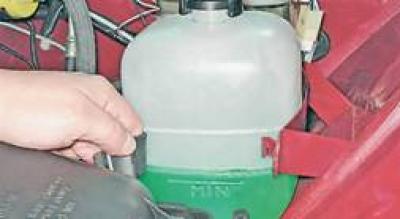
Attention! The expansion tank cap should only be unscrewed on a cold engine, since excess pressure is created inside the tank on a warm engine.
2. If necessary, open the tank cap and add coolant (see "Operating fluids") to the required level.
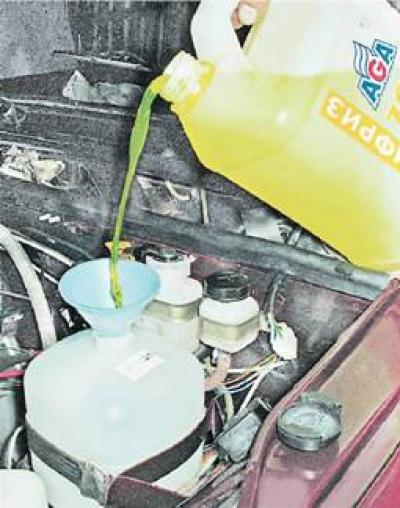
[The original can be viewed on the portal: VAZbook.ru]
Warning! Coolant is poisonous, be careful. If it gets on the paintwork, the liquid may cause its color change, so remove the liquid immediately with a rag.
Do not use water as a coolant, it does not contain corrosion inhibitors, does not lubricate the pump seals well and freezes at sub-zero temperatures.
Replacing the coolant
We replace the coolant in accordance with the maintenance schedule (see "Periodic maintenance"), as well as in case of a change in its color (this is a sign of aging of the fluid). Replace the fluid only when the engine is cold!
1. Place the vehicle on an inspection pit or overpass (see "Preparing a car for maintenance and repair").
2. Move the interior heater control lever to the extreme right position (open the heater valve completely).
3. Unscrew and remove the radiator and expansion tank caps.
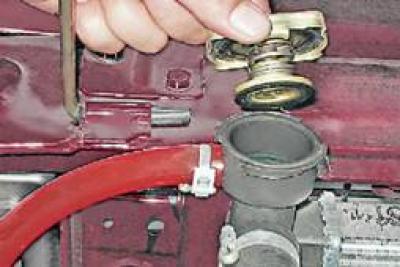
4. Remove the engine mudguard (see "Mudguard - Removal and Installation").
5. Place the container (not less than 10 l) under the drain plug in the cylinder block.
6. Using a 13 mm socket wrench with an extension, unscrew the drain plug.
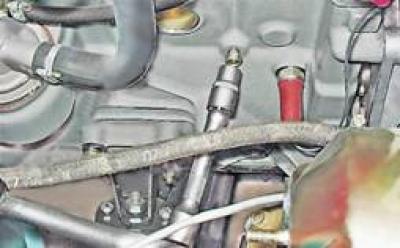
7. Drain the coolant from the cylinder block.
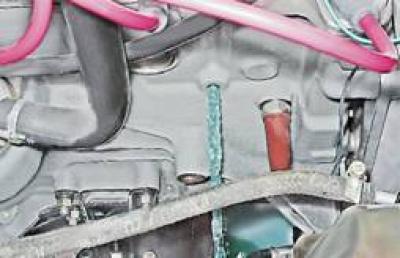
8. Place the same container under the radiator drain hole and unscrew the plug.
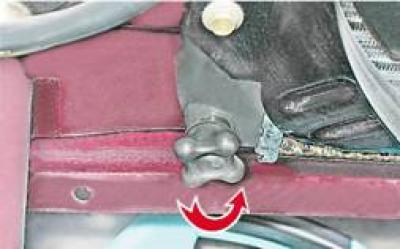
9. Drain the coolant from the radiator.
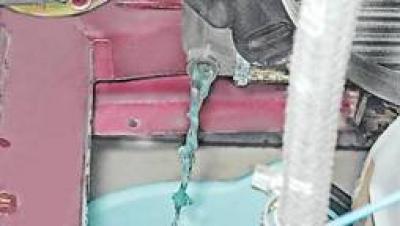
10. After unfastening the expansion tank fastening belt and lifting it, drain the liquid from the tank through the radiator.
11. Install the tank in place and secure it with a belt.
12. Tighten the drain plugs on the radiator and cylinder block.
Note: To avoid air locks, it is recommended to remove the rubber hose from the intake manifold heating unit pipe (throttle bodies on injection engines).
When filling the system, at the moment the liquid comes out of the hose, we put it on the branch pipe.
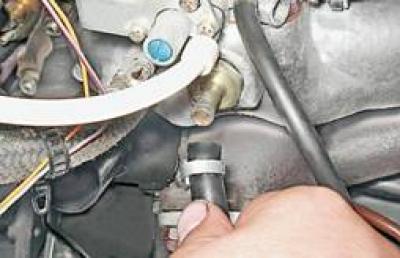
12. Fill the engine cooling system through the radiator neck until the fluid level reaches the lower edge of the neck.
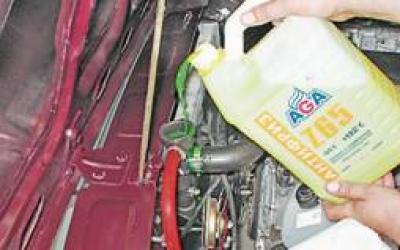
13. During the process of filling the system with liquid (to reduce the likelihood of air locks forming) we squeeze the radiator hoses with our hands. We close the radiator cap.
14. Fill the expansion tank with coolant to a level 3-4 mm above the "MIN" mark on the tank wall and close the plug.
15. Start the engine and let it idle for 3-5 minutes to remove air locks, then stop the engine and add coolant to the radiator and reservoir to the required level.