




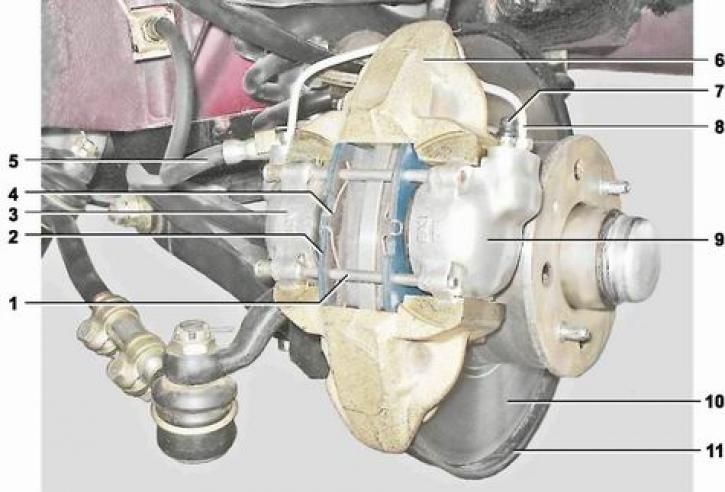
Front wheel brake mechanism: 1 - guide pin of the pads (2101-3501132); 2 - brake shoe (2101-3501089); 3 - inner working cylinder (2101-3501182/83); 4 - brake shoe pressure spring (2101-3501035); 5 - front wheel brake hose (21061-3506060); 6 - support (2101-3501016/17); 7 - front wheel brake bleed nipple (2101-1602591); 8 - connecting pipe of working cylinders (2101-3501086-01/85-01); 9 - outer working cylinder (2101-3501180/81); 10 - brake disc (2101-3501070); 11 - protective cover (2101-3501146/47)
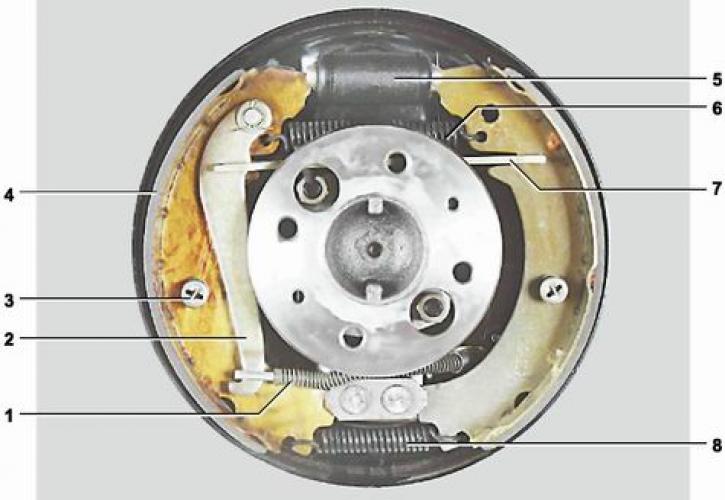
Rear wheel brake mechanism: 1 - rear parking brake cable (2101-3508180); 2 - parking brake expansion lever (2101-3507034/35); 3 - outer cup of the support post (2101-3502104); 4 - brake shoe (2101-3502090-01); 5 - working cylinder (2105-3502040); 6 - upper tension spring (2101-3502035); 7 - spacer bar (2101-3507036); 8 - lower tension spring (2101-3502038)
The car is equipped with two braking systems - service and parking. Hydraulic drive the working system consists of two independent circuits that activate the brake mechanisms of the front and rear wheels. If one circuit fails, the car is braked by the second circuit, although with an increase in the brake pedal travel and braking distance. Working system consists of a pedal assembly, a vacuum booster, a master brake cylinder, a reservoir with a brake fluid level sensor, pipelines, front and rear wheel brake mechanisms with working cylinders and a rear brake pressure regulator.
The brake pedal is fixed on the same axis as the clutch pedal and is equipped with a return spring. Above the pedal is a brake light switch, the buffer of which, when adjusted correctly, should touch the pedal stop. When the brake pedal is pressed, the switch contacts close and the brake light lamps in the rear lights come on.
Vacuum booster, installed on the bulkhead of the engine compartment, it serves to reduce the force on the brake pedal due to the vacuum in the intake manifold when the engine is running.
Master brake cylinder is mounted on two studs screwed into the vacuum booster housing and is secured to it with nuts. The fittings of the brake pipes of the front and rear circuits of the working brake system are screwed into the cylinder.
A reservoir is secured to the engine compartment bulkhead with a clamp, from which brake fluid is supplied to the main brake cylinder via hoses. The reservoir has marks for the maximum and minimum fluid levels. A fluid level sensor with a float is installed in the reservoir cap. When the fluid level in the reservoir drops below the permissible level, a red warning light comes on in the instrument cluster.
Front wheel brake mechanism - disc and consists of a cast iron, non-ventilated brake disc, a caliper with two working cylinders and two brake pads. The brake disc is replaced when its working surface wears to a thickness of less than 9.5 mm. The working cylinders of the right and left brake mechanisms are not interchangeable. The minimum permissible thickness of the brake pad lining of the front wheel is 1.5 mm.
Rear wheel brake mechanism - drum and consists of a brake drum, a working cylinder, two brake shoes with tension springs and a spacer lever of the parking brake drive. The brake drum is aluminum with a cast iron insert. The largest permissible internal diameter of the drum when worn or after boring is 251 mm.
The working cylinder is a two-piston one with an automatic clearance adjustment mechanism between the drum and the shoes. The main element of the automatic clearance adjustment mechanism are two elastic steel split rings installed on the pistons in the working cylinder with an axial clearance of 1.25-1.65 mm. The thrust rings are installed in the cylinder with an interference fit, providing a shear force along the cylinder surface of at least 35 kgf, which exceeds the force from the tension springs of the brake shoes. As the brake shoe linings wear out, the pistons move the rings in the cylinder during braking, thereby maintaining a constant clearance between the drum and the shoes.
To reduce the braking force on the rear axle, a pressure regulator is included in the hydraulic drive of the rear wheel brake mechanisms. It prevents the car from skidding when braking, limiting the pressure in the working cylinders, depending on the position of the rear part of the body relative to the rear axle beam.
Parking brake system drive - mechanical, cable, on the brake mechanisms of the rear wheels. It consists of a parking brake lever, a front cable, a guide, a rear cable and a parking brake spacer lever. When the parking brake lever is moved to the upper position, the spacer levers mounted on the shoes rotate and act on the spacer bars. The shoes of the brake mechanisms of the rear wheels move apart and fix the drums from rotating.
During operation, the parking brake system requires periodic adjustment. This is due to wear of the pads and stretching of the drive cables.