




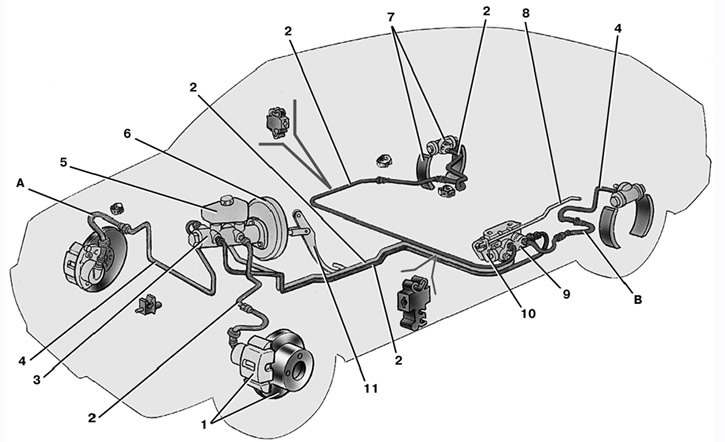
8.1. Hydraulic brake drive diagram: A - flexible front brake hose; B – flexible rear brake hose; 1 – front wheel brake mechanism; 2 – left front – right rear brake circuit pipeline; 3 – main cylinder of the brake hydraulic drive; 4 – right front – left rear brake circuit pipeline; 5 – master cylinder reservoir; 6 – vacuum booster; 7 – rear wheel brake mechanism; 8 – elastic lever of pressure regulator drive; 9 – pressure regulator; 10 – pressure regulator drive lever; 11 – brake pedal
The vehicle uses a service brake system with diagonally divided circuits (Fig. 8.1), which significantly increases the safety of driving the vehicle. One hydraulic drive circuit ensures the operation of the right front and left rear brake mechanisms, the other - the left front and right rear. If one of the circuits of the service brake system fails, the second circuit is used, ensuring the vehicle stops with sufficient efficiency.
The hydraulic drive includes vacuum booster 6 and dual-circuit regulator 9 of pressure in the rear brakes.
The parking brake system has a drive to the brake mechanisms of the rear wheels.
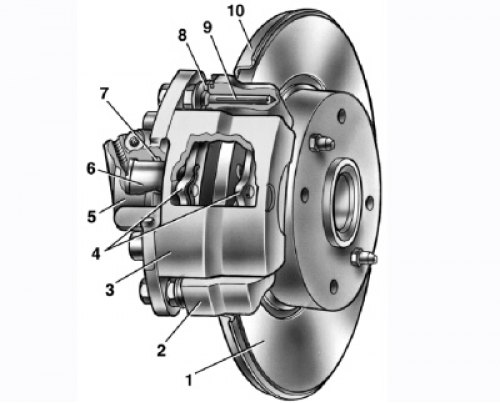
8.6. Front wheel brake mechanism: 1 – brake disc; 2 – shoe guide; 3 – support; 4 – brake pads; 5 – working cylinder; 6 – piston; 7 – sealing ring; 8 – Protective cover of the guide pin; 9 – guide pin; 10 – protective cover
Front wheel brake mechanism disc, with automatic adjustment of the gap between the pads and the disc, with a floating bracket.
The bracket is formed by the support 3 (Fig. 8.6) and the working cylinder 5, tightened with bolts. The movable bracket is attached with bolts to the pins 9, installed in the holes of the shoe guide. Grease is placed in these holes, rubber covers 8 are installed between the pins and the shoe guide. Brake shoes 4 are pressed against the grooves of the guide by springs.
In the cavity of the cylinder 5, a piston 6 with a sealing ring 7 is installed. Due to the elasticity of this ring, an optimal gap is maintained between the brake pads and the disk. In a variant version, pads with a pad wear indicator can be installed on cars.
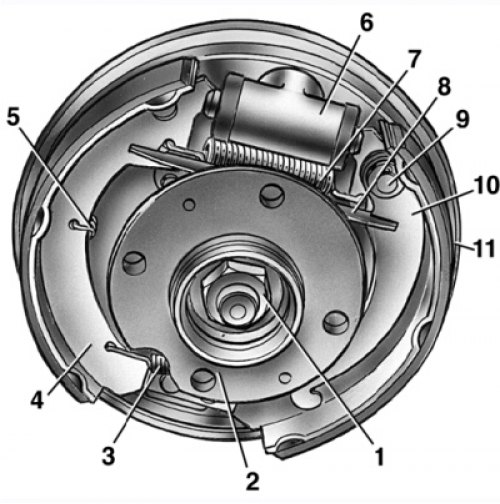
8.7. Rear wheel brake mechanism: 1 – hub mounting nut; 2 – wheel hub; 3 – lower brake shoe tension spring; 4 – brake shoe; 5 – guide spring; 6 – working cylinder; 7 – upper tension spring; 8 – expansion bar; 9 – parking brake lever finger; 10 – parking brake drive lever; 11 – brake mechanism shield
Information taken from the website: VAZBOOK.RU
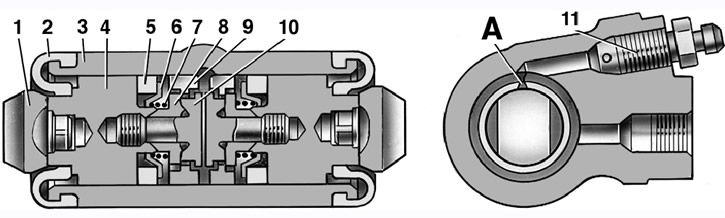
8.8. Rear wheel brake slave cylinder: A - slot on the thrust ring; 1 – brake shoe stop; 2 – protective cap; 3 – cylinder body; 4 – piston; 5 – seal; 6 – support plate; 7 – spring; 8 – crackers; 9 – thrust ring; 10 – stop screw; 11 – nipple
Rear wheel brake mechanism(Fig. 8.7) drum, with automatic adjustment of the gap between the shoes and the drum. The automatic gap adjustment device is located in the working cylinder. Its main element is a split thrust ring 9 (Fig. 8.8), installed on the piston 4 between the flange of the thrust screw 10 and two crackers 8 with a gap of 1.25–1.65 mm.
The thrust rings 9 are inserted into the cylinder with tension, providing a force of shifting the ring along the cylinder mirror of at least 343 N (35 kgf), which exceeds the force on the piston from the tension springs 3 and 7 (see fig. 8.7) brake pads.
When the gap of 1.25–1.65 mm is completely selected due to wear of the linings, the flange on the stop screw 10 (see fig. 8.8) is pressed against the flange of ring 9, as a result of which the thrust ring shifts after the piston by the amount of wear. When braking stops, the pistons are shifted by the force of the tension springs until the crackers stop against the flange of the thrust ring. In this way, the optimum clearance between the shoes and the drum is automatically maintained.
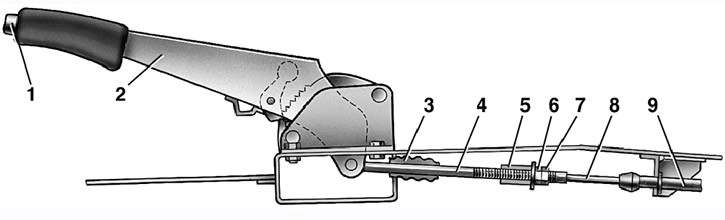
8.9. Parking brake system drive: 1 – lever lock button; 2 – parking brake drive lever; 3 – protective cover; 4 – traction; 5 – cable equalizer; 6 – adjusting nut; 7 – lock nut; 8 – cable; 9 – cable sheath
Parking brake system with a mechanical drive, acts on the brake mechanisms of the rear wheels. The parking brake drive consists of lever 2 (Fig. 8.9), adjusting rod 4, equalizer 5, cable 8, lever 10 (see fig. 8.7) manual drive of the pads and expansion bar 8.
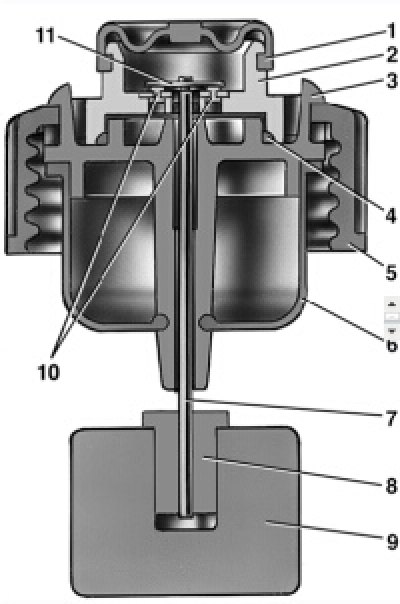
8.10. Brake fluid emergency level sensor: 1 – protective cap; 2 – sensor body; 3 – sensor base; 4 – sealing ring; 5 – clamping ring; 6 – reflector; 7 – pusher; 8 – bushing; 9 – float; 10 – fixed contacts; 11 – movable contact
Brake fluid emergency level sensor mechanical type.
The body 2 (Fig. 8.10) of the sensor with the seal 4 is pressed to the base 3 by the clamping ring 5, screwed onto the neck of the tank. At the same time, the flange of the reflector 6 is pressed to the end of the neck. In this position, the clamping ring is held by two clamps made on the base 3.
A pusher 7 passes through the opening of the base, connected to a float 9 by means of a sleeve 8. A movable contact 11 is located on the pusher, and fixed contacts 10 are located on the sensor body. The cavity of the contacts is sealed with a protective cap 1.
When the brake fluid level in the reservoir drops to the maximum permissible level, the moving contact drops onto the fixed contacts and closes the circuit of the brake system emergency status indicator lamp in the instrument cluster.
Helpful tips: Bleed the brakes without an assistant, there are two ways.
- The first is the most reliable: order an aluminum or bronze cover for the main brake cylinder from a turner, screw a valve from a chamber into it and connect it to the spare wheel with an additional hose; air pressure should not exceed 0.05–0.07 MPa (0.5–0.7 kgf/cm²).
- The second is not very reliable, but acceptable: connect a rubber bulb to the nipple of the wheel cylinder - the connection should be very tight. Squeeze the bulb, unscrew the nipple; when the bulb is half full, tighten the nipple. Repeat the procedure 3-4 times. Check the brake operation during test braking.
The free travel of the brake pedal with the engine off should be 3–5 mm. Too little free travel indicates that the wheel cylinder is seized and causes increased fuel consumption and accelerated wear of the brake pads; too much free travel is a sign of excessive clearances in the pedal mechanism or a breach in the tightness of the brake system.
If the free travel decreases with repeated pressing of the pedal, i.e. it becomes "harder", there is air in the system. If the full travel of the pedal begins to increase, the system is not airtight.
If the brake pedal starts to vibrate when braking, most often the problem is in the warping of the brake discs. Unfortunately, in such a situation, they only need to be replaced, and both at once.
If the car starts to pull to one side when braking, check the wheel cylinders: they may need to be repaired or replaced.
If a knocking noise appears in the front suspension that disappears when braking, check the tightening of the two caliper mounting bolts.
After brake pad replacement before you start moving, be sure to press the brake pedal several times - the pistons in the wheel cylinders should fall into place.