




To complete the work you will need a caliper.
Sequence of execution
1. Place the vehicle on an inspection pit or overpass (see "Preparing a car for maintenance and repair").
2. To check the condition of the brake hydraulic drive, you will need an assistant who should vigorously press the brake pedal 3-4 times and hold it pressed during the check, thereby creating pressure in the system. If leaks are detected in the connections, tighten their fasteners.
There should be no bulges on the surface of the brake hoses; if there are, replace the hose. Hoses, regardless of their condition, are recommended to be replaced after five years of vehicle operation, since the hose, due to the aging of the rubber, may burst during braking. Brake pipes should not have dents or cracks. Otherwise, they must be replaced (see "Brake pipes - replacement").
3. Check the condition of the front wheel brakes. To do this, remove the wheel (see "Wheel - replacement") and visually evaluate and, if necessary, measure the thickness of the friction linings of the brake shoes. If the lining thickness is less than 1.5 mm, replace the brake shoes of the right and left wheels (see "Front Brake Pads - Replacement"). Remove the brake caliper and assess the condition of the brake disc. If deep grooves or cracks have formed on the working surface of the disc, it must be replaced (see "Front wheel brake mechanism - disassembly").
Since the brake pads do not fit the disc over its entire surface, a ridge is formed at the outer edge of the disc. This must be taken into account when measuring the thickness of the brake disc.
Using a caliper or micrometer, we measure the thickness of the brake disc.
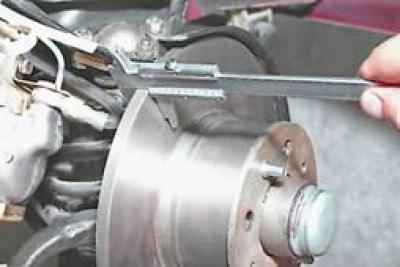
If the thickness of the working surface of the disc has become less than 9.5 mm, it must be replaced (see "Front wheel brake mechanism - disassembly").
4. Check the condition of the rear wheel brakes.
Having removed the plug on the brake shield, we visually assess the thickness of the friction lining of the brake shoe. If the thickness of the lining is less than 1.5 mm, we replace the shoes, both the right and left brake mechanisms (see "Rear wheel brake pads - replacement").
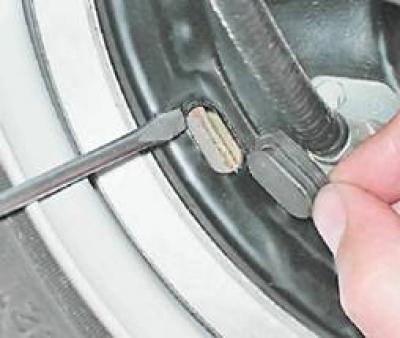
To inspect the remaining parts of the brake mechanism, remove the brake drum (see "Rear wheel brake pads - replacement").
We inspect the working surface of the brake drum. If the surface is heavily worn and its internal diameter increases to 251 mm, we replace the drum.
Caution! Do not press the brake pedal with the brake drum removed, as this will cause the pistons to be pushed out of the working cylinder.
We evaluate the condition of the working cylinder. Brake fluid leakage from under the protective cylinder boots is not allowed.