




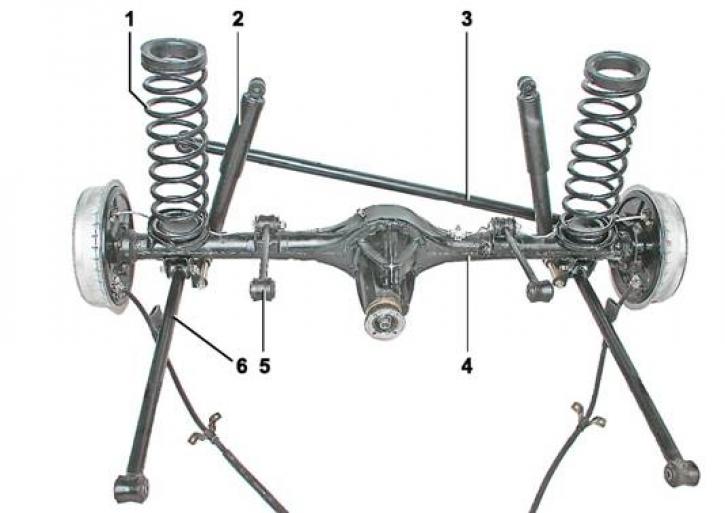
Rear suspension details: 1 - spring (2101-2912712); 2 - shock absorber (21012915402-04); 3 - crossbar (2101-2919110-01); 4 - rear axle beam (2101-2401010-01); 5 - upper longitudinal bar (2101-2919013-01); 6 - lower longitudinal rod (2101-2919012-01 (10-01))
The rear suspension is dependent. The rigid beam of the rear axle is suspended from the body on five barbells, four longitudinal and one transverse. The lower longitudinal rods are longer, the upper ones are short. Due to their attachment to the rear axle with an offset relative to the wheel axis, each pair of rods perceives reactive moments during acceleration and braking of the car, therefore the rods are called reactive. In addition, they transmit pushing and pulling forces from the rear axle to the body. The transverse rod is located behind the rear axle beam, it keeps the rear axle from lateral displacement. All rods are connected to the body and rear axle with rubber-metal hinges (silent blocks).
The elastic elements of the suspension consist of two cylindrical springs, two main and one additional buffers compression stroke. The lower ends of the springs rest on cups welded to the rear axle beam via plastic gaskets. The upper ends of the springs are installed in the support cups of the body via rubber insulating gaskets. The main rubber compression stroke buffers are located inside the springs and are attached to the body. An additional buffer is attached to the bottom of the body above the rear axle housing. The buffer takes up the load only when the car is moving on an uneven road at high speed, overloaded, or when the main buffers are destroyed.
The vibrations of the rear axle are damped by two twin-tube telescopic oil shock absorbers. In them, the vibration energy is converted into heat by pumping liquid through calibrated holes. The lower and upper ends of the shock absorbers are connected respectively to the rear axle beam and the body with bolts also through rubber-metal hinges.