




Front suspension
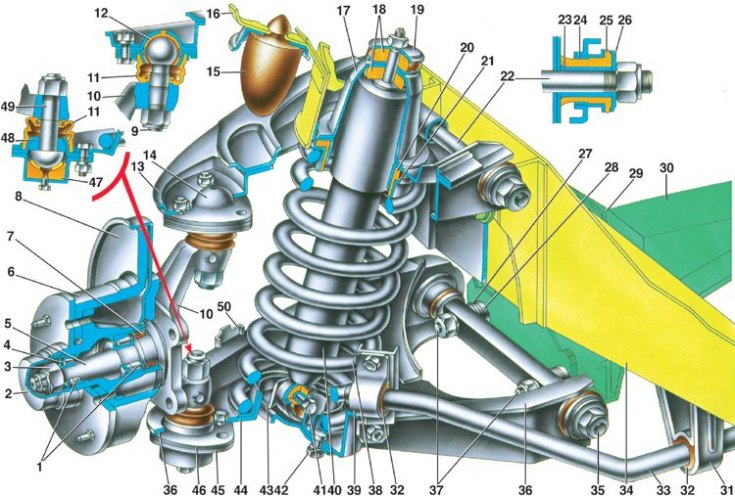
1 – front wheel hub bearings; 2 – hub cap; 3 – adjusting nut; 4 – washer; 5 – steering knuckle journal; 6 – wheel hub; 7 – oil seal; 8 – brake disc; 9 – ball pin of the upper support; 10 – steering knuckle; 11 – Ball joint protective cover; 12 – Upper support bearing; 13 – Upper suspension arm; 14 – upper support bearing housing; 15 – compression stroke buffer; 16 – compression stroke buffer bracket; 17 – shock absorber support cup; 18 – shock absorber mounting pads; 19 – pillow washer; 20 – suspension spring insulating gasket; 21 – Upper support cup of suspension spring; 22 – Upper suspension arm axle; 23 – inner sleeve of the hinge; 24 – outer sleeve of the hinge; 25 – rubber bushing of the hinge; 26 – support washer; 27 – adjusting washers; 28 – spacer washer; 29 – bracket for fastening the cross member to the body side member; 30 – front suspension cross member; 31 – stabilizer bar mounting bracket; 32 – stabilizer bar cushion; 33 – stabilizer bar; 34 – body side member; 35 – lower arm axle; 36 – lower suspension arm; 37 – lower arm axle mounting bolts; 38 – suspension spring; 39 – stabilizer bar mounting clip; 40 – shock absorber; 41 – shock absorber mounting bolt; 42 – nut securing the shock absorber bracket to the suspension arm; 43 – shock absorber mounting bracket to lower suspension arm; 44 – lower support cup of suspension spring; 45 – lower support liner collar; 46 – lower support bearing housing; 47 – ball pin cage insert; 48 – lower support bearing; 49 – ball pin; 50 – front wheel rotation limiter
The front suspension is independent, on two wishbones on each side, with coil springs, telescopic shock absorbers and an anti-roll bar.
The upper 13 and lower 36 suspension arms are connected to the pivot pin 10 by ball joints. The upper ball joint 14 is fastened to the upper suspension arm by three bolts. The bearing 12 is located in the joint housing, the base of which is resin, and the friction surface is Teflon fabric, tightly fitting the spherical surface of the pin 9. The joint parts are protected from contamination by a reinforced cover 11. The conical part of the pin enters the conical hole of the pivot pin and is fastened with a self-locking nut.
The lower ball joint 45 is connected to the pivot pin and the suspension arm similarly to the upper joint. In the housing 46 of the joint, there is a pin 49 with a hemispherical head. A metal-ceramic bearing 48 with a hemispherical surface is put on the rod of the pin. A liner 47 made of oil-resistant rubber is inserted with tension into the lower part of the housing. A plastic layer is applied to the surface of the liner that contacts the hemisphere of pin 49 (nylon molybdenum sulfide blend). There is a hole in the lower part of the hinge housing through which the hinge is lubricated. It is closed with a plug.
The upper arm 13 of the suspension is connected by an axis 22 to the front pillar of the body, and the lower arm 36, by means of an axis 35, is suspended by bolts 37 to the crossmember 30 of the suspension, which is fastened by brackets 29 to the side members. Distance 28 and adjusting 27 washers are installed between the axis of the lower arm and the crossmember. By changing the number of washers 27, the longitudinal angle of inclination of the steering axis and the camber angle of the front wheels are adjusted. Both suspension arms are connected to the axles through rubber-metal hinges, ensuring a gap-free connection of these parts. Such a hinge includes a rubber bushing 25, outer 24 and inner 23 metal bushings. A thrust washer 26 is installed between the hinge and the nut.
Spring 38 rests with its upper end through support cup 21 with rubber gasket 20 on the front pillar of the body. The lower end of the spring rests in support cup 44 of the lower arm. According to the length under a load of 435 kgf, the front suspension springs are sorted into groups A and B. Group A springs are marked with yellow paint on the outer side of the coils, and group B springs are marked with green paint. The upward travel of the front wheel is limited by the stop of the upper arm 13 in the rubber buffer 15 installed in the bracket 16.
The lateral roll of the body when turning the car is reduced by the anti-roll bar, made in the form of a rod 33 made of spring steel. The ends of the rod are attached to the brackets of the lower suspension arms with clips 39 through rubber cushions 32. The rod itself is attached to the side members 34 with two brackets 31, in the holes of which rubber bushings are located. Shock absorbers 40 are attached to the lower suspension arms. The shock absorber rod passes through the hole of the support cup 17 and is fastened with a nut. Rubber cushions 18 are installed between the shock absorber casing and the cup, as well as between the support washer 19 and the cup. The shock absorber is attached to the lower arm by means of a bracket 43 and bolts 41, 42.
The wheel hub 6 is mounted on the pivot pin of the steering knuckle on two conical bearings 1, which are pressed by the adjusting nut 3. Between the nut and the outer bearing, a thrust washer 4 is installed with a whisker entering the groove of the pivot, due to which it is held from turning when the nut is tightened. On the inside, a self-tightening oil seal 7 is installed in the hub socket. From the outside, the hub cavity is closed by a cap 2, which is pressed into the hub. The brake disc 8 and the pressure ring are fastened to the hub flange with two guide pins, and the wheel disc is fastened with bolts.