




Contents: Sequence of execution ↓ Installation ↓
The fuel level in the float chamber is checked when replacing the float, needle valve or when disassembling the carburetor. The fuel level and supply required for normal operation of the carburetor are ensured by the correct installation of the shut-off device elements: the float and the needle valve.
To check, we prepare two templates from thick material (cardboard) with a width of 6.5+0.25 mm and 14+0.5 mm.
Sequence of execution
1. Prepare the vehicle for operations (see "Preparing a car for maintenance and repair").
2. Remove the carburetor cover (see "Carburetor cover - removal and disassembly").
3. The maximum fuel level in the float chamber is determined by the moment the fuel supply hole is closed by the needle valve located in the valve seat. We install the cover in a vertical position so that the float tongue touches the spring-loaded valve ball, but at the same time its spring is not compressed. Using a template, we check the distance between the float and the gasket adjacent to the carburetor cover.
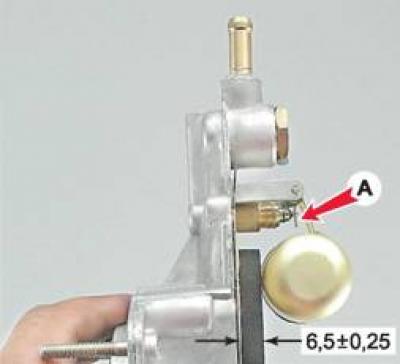
This distance should be within 6.5+0.25 mm. If the distance does not correspond to the specified one, then we adjust it by bending the tongue A of the needle valve fastening.
4. The maximum opening of the needle valve is determined by the float stroke. With the float pulled back as far as possible, we use a template to check the distance between the float and the gasket adjacent to the carburetor cover.
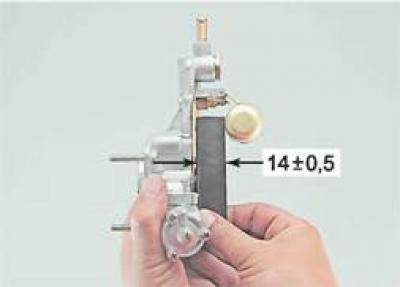
This distance should be 14+0.5 mm.
5. If necessary, bend the stop on the float bracket.
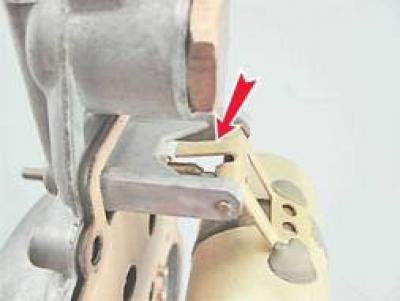
When the extreme positions of the float are set correctly, its stroke is 8+0.25 mm.
Installation
We install the carburetor cover on the body (see "Carburetor cover - removal and disassembly").