




The battery consists of six series-connected batteries, located in separate compartments of a common housing (positive and negative lead plates are separated by separators). The compartments are filled with an electrolyte – a solution of sulfuric acid in distilled water, with a density of 1.27–1.28 g/cm³.
Technical specifications
| Nominal voltage, V | 12 |
| Capacity at 20-hour discharge and electrolyte temperature of 25°C, A.h | 55 |
| Volume of electrolyte, l | 3,6 |
| Charging current, A | 5,5 |
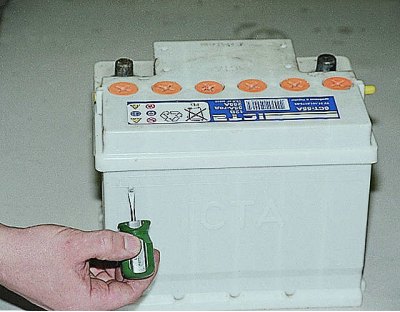
The battery case is made of translucent plastic with marks indicating the permissible electrolyte level.
Maintenance of the battery consists of checking the level and density of the electrolyte. If the electrolyte level is poorly visible, we orient ourselves by the lower edge of the filler hole.
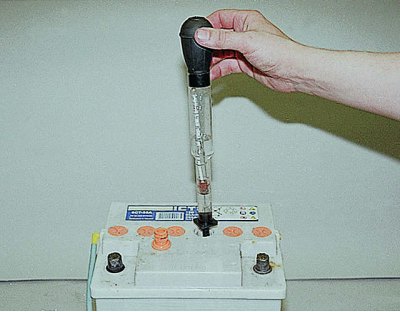
We measure the density with a hydrometer. When adding water, keep in mind that until the water is completely mixed with the electrolyte, the hydrometer readings will be underestimated.
The state of charge of the battery can be indirectly determined by the voltage at its terminals (see table).
Battery voltage, V | Degree of charge, % |
| 12,6 | 100 |
| 12,0 | 75 |
| 11,6 | 50 |
| 11,3 | 25 |
| 10,5 | 0 |
Wipe the outer surfaces of the battery with a rag soaked in a solution of baking soda.
When working with a battery, strictly follow safety precautions. Regularly check the reliability of the clamps on the battery terminals.