




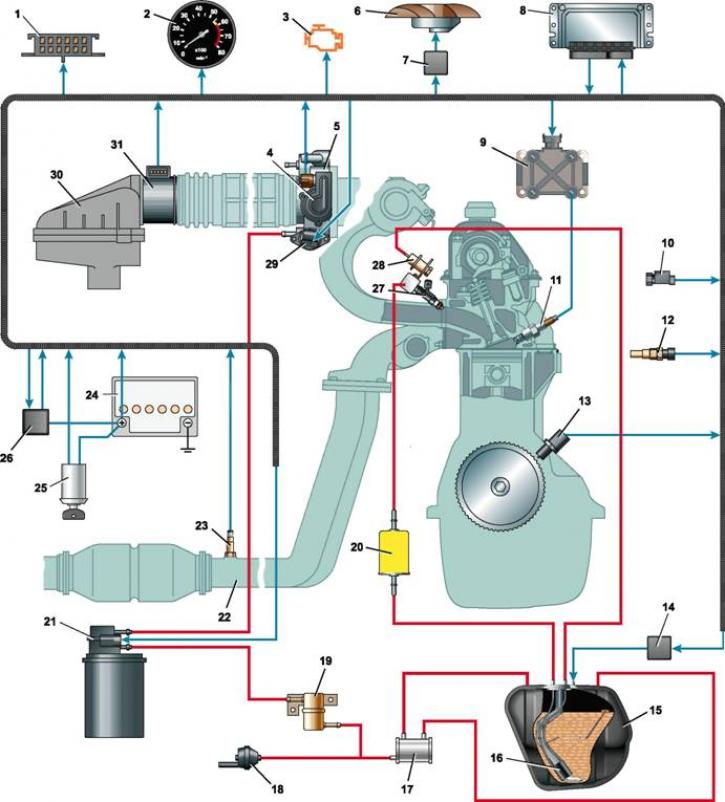
Engine Management System Elements: 1 - diagnostic connector; 2 - tachometer; 3 - Engine management system malfunction indicator lamp; 4 - throttle position sensor; 5 - throttle body; 6 - radiator electric fan; 7 - Electric fan relay; 8 - electronic control unit; 9 - ignition coil (module); 10 - vehicle speed sensor; 11 - spark plug; 12 - coolant temperature sensor; 13 - crankshaft position sensor; 14 - Electric fuel pump relay; 15 - fuel tank; 16 - Electric fuel pump; 17 - bypass valve; 18 - safety valve; 19 - gravity valve; 20 - fuel filter; 21 - purge valve of the adsorber; 22 - intake pipe; 23 - oxygen concentration sensor; 24 - battery; 25 - ignition switch (lock); 26 - main relay; 27 - nozzle; 28 - fuel pressure regulator; 29 - idle speed control; 30 - Air filter housing; 31 - mass air flow sensor
The engine management system with distributed fuel injection is electronic. It controls the amount of air and fuel entering the engine cylinders, turns the fuel pump on and off, controls spark formation on the spark plugs and adjusts the ignition timing, regulates the crankshaft speed at idle, and controls the electric fan of the engine cooling system.
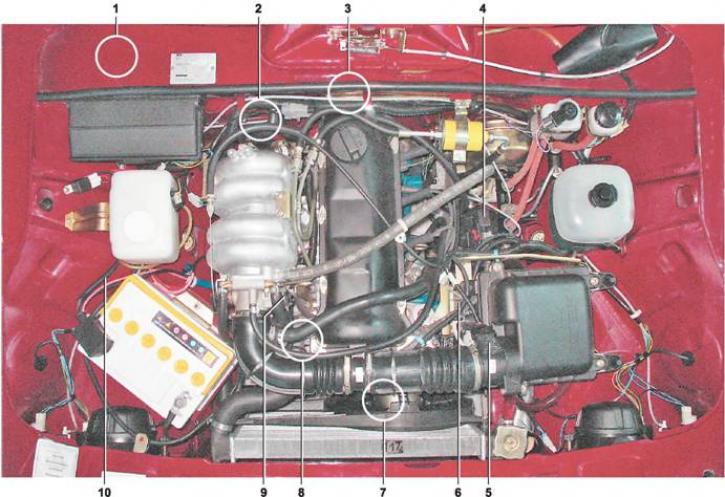
Location of engine control system components: 1 - electronic control unit, relays and fuses (located under the glove compartment in the passenger compartment); 2 - oxygen concentration sensor (located on the intake pipe); 3 - vehicle speed sensor (located on the gearbox); 4 - purge valve of the adsorber; 5 - mass air flow sensor; 6 - ignition coil; 7 - crankshaft position sensor (located on the camshaft drive cover); 8 - coolant temperature sensor (located in the cooling system pipe); 9 - throttle position sensor; 10 - control system wiring harness
The system consists of the following elements:
- electronic Control Unit (ECU);
- sensors:
- crankshaft position;
- throttle position;
- oxygen concentrations;
- coolant temperature;
- mass air flow;
- car speed;
- actuators:
- main relay;
- fuel pump relay;
- ignition coil;
- electric fan relay for cooling system;
- tachometer;
- engine Management System Malfunction Indicator Lamp;
- idle speed controller;
- purge valve of the adsorber;
- injectors;
- connecting wires;
- diagnostic connector pads.
The engine management system malfunction indicator lamp is located on the instrument panel in the indicator block (see "Controls and instruments"). When the ignition is turned on, the system is tested for serviceability, and the lamp lights up and goes out after the engine starts. When the lamp lights up while the engine is running, it signals the need to check the engine management system. On some vehicle modifications, the control lamp may be located on the upper insert of the radio panel.
The main control element of the system is electronic control unit (ECU, or as it is often called - controller), with built-in microprocessor.
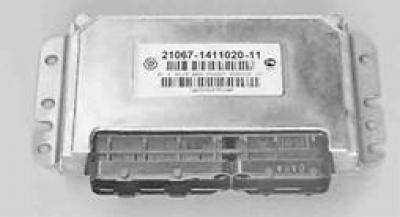
Electronic control unit (ECU)
In essence, the ECU is a specialized minicomputer in which the engine control program is installed, and the sensors and actuators are the peripheral equipment of this computer. The unit receives and analyzes the signals from the sensors. Based on the received data, the unit calculates control commands and issues them to the actuators. The unit has two types of memory: read-only memory (ROM) and random access memory (RAM).
ROM - non-volatile memory (that is, the information in the memory is retained when the power is turned off). The ROM stores the calculation program and the data required for the calculation (engine parameters, transmission ratios and other characteristics). During operation, the ECU monitors the serviceability of all elements and circuits of the engine management system. Having detected a malfunction, the ECU switches the engine management system to the backup mode and turns on the engine malfunction indicator lamp. The engine will then be able to continue operating (except in case of crankshaft position sensor failure, see below), which allows you to get to the repair site under your own power. The ECU records the codes of detected faults in the random access memory (RAM). The operational information that the ECU microprocessor uses in calculations is also stored there. When the battery is disconnected from the vehicle's on-board network, all information stored in the RAM will be lost.
The electronic control unit is installed in the passenger compartment under the glove compartment on a bracket attached to the engine compartment bulkhead.
The car is equipped with an engine management system based on the M7.9.7 ECU for EURO II toxicity standards. The car with the 21067 engine is equipped with the 21067-1411020-11/12 control unit, and with the 2104 engine - 2104-1411020-10.
Note: Some of the produced vehicles are equipped with ECUs M1.5.4N and January-5.1.3 (see "Electrical diagrams").
Crankshaft position sensor (DPKV) is designed to generate signals by which the ECU synchronizes its operation with the engine's working cycles. Therefore, this sensor is often called a synchronization sensor. The sensor is installed in the hole of the camshaft drive cover bracket.
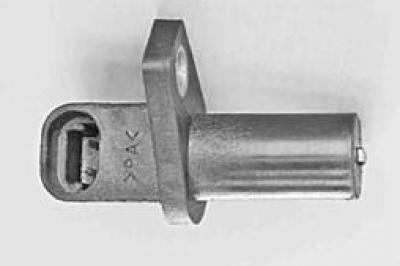
Crankshaft position sensor
The sensor operates on the principle of induction - when the crankshaft pulley teeth pass the sensor core, AC voltage pulses occur in the sensor circuit. The frequency of the pulses corresponds to the crankshaft rotation frequency. The teeth are located around the pulley circumference at the same distance. The distance between two of them is made larger. This is done to form reference signals in the sensor circuit - a kind of reference points relative to which the ECU determines the position of the crankshaft. The engine cannot operate with a faulty crankshaft position sensor.
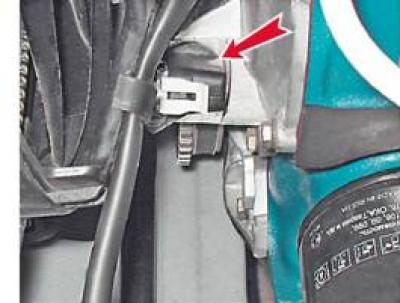
Location of the crankshaft position sensor
Mass Air Flow Sensor (MAF) film type is installed on the air filter housing.
Based on the sensor signal, the ECU calculates the amount of air entering the engine intake manifold. If the MAF is faulty, the electronic control unit switches the system to backup mode.
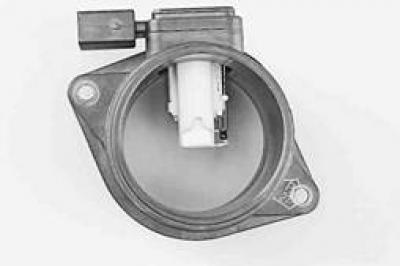
Mass Air Flow Sensor
Throttle position sensor (TPDZ) is a variable resistor whose resistance depends on the angle of rotation of the throttle valve.
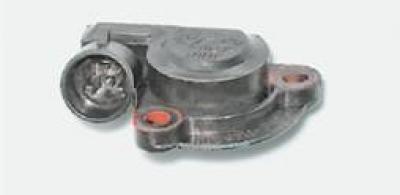
Throttle position sensor
The sensor is installed on the throttle valve body and is connected to its axis. Based on the TPS signal, the electronic control unit determines the throttle valve opening angle. If the TPS malfunctions, the electronic control unit switches the system to the backup operating mode.
(The original is on the portal www.VazBook.ru)
Oxygen concentration sensor determines the oxygen content in the exhaust gases and transmits a signal to the ECU.
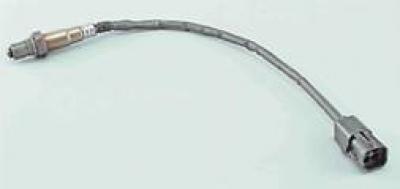
Oxygen concentration sensor
It is installed in the exhaust pipe of the exhaust system.
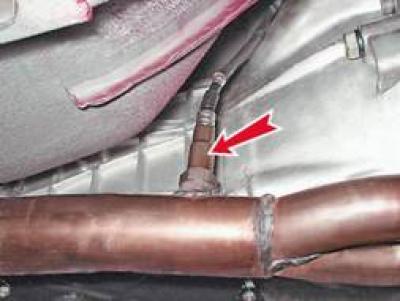
Location of oxygen concentration sensor
Based on the data received from the oxygen concentration sensor, the ECU adjusts the amount of fuel injected by the injectors into the intake manifold, thereby maintaining the optimal proportion of the air-fuel mixture necessary for the efficient operation of the catalytic converter. The sensor begins to operate when its sensitive element warms up to a temperature of at least 360°C. To reduce the warm-up time, a heating element is built into the sensor.
Warning! The presence of lead and silicon compounds in the exhaust gases can disable the oxygen concentration sensor. Therefore, the use of leaded gasoline is not allowed (it contains lead compounds). When repairing an engine, you should also not use a sealant with a high silicone content (silicon compounds), vapors of which can enter the cylinders through the crankcase ventilation system and then into the exhaust system. You should use a sealant whose packaging the manufacturer indicates that the sealant is safe for the oxygen concentration sensor.
Coolant temperature sensor (DTOZH) is a semiconductor device - a thermistor, the electrical resistance of which changes depending on the temperature of the coolant.
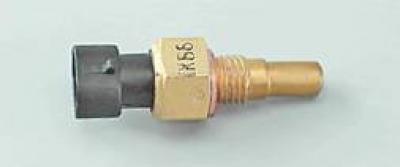
Coolant temperature sensor
The coolant temperature sensor is installed in a threaded hole in the engine cooling system pipe.
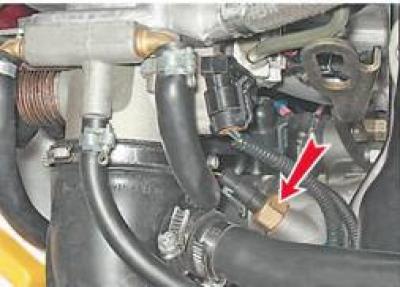
Coolant Temperature Sensor Location
The ECU evaluates the engine temperature mode based on the sensor resistance value. The obtained data are used to calculate most of the control commands of the engine management system, as well as to turn on the electric fan of the engine cooling system.
If the coolant temperature sensor fails, the electronic control unit switches the system to backup mode.
Operating principle vehicle speed sensor based on the Hall effect.
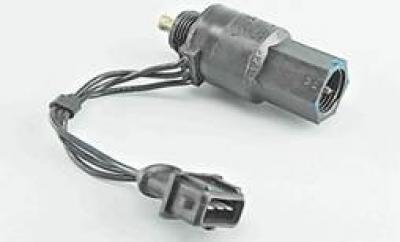
Vehicle speed sensor
The sensor is fixed to the speedometer drive housing, which is installed on the gearbox. The speedometer drive cable is attached to the sensor.
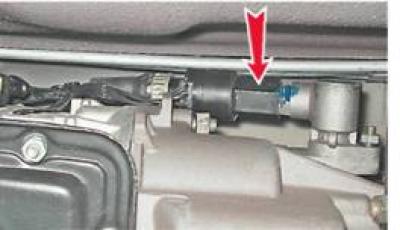
Vehicle speed sensor location
Based on the pulses generated by the sensor, the ECU calculates the vehicle speed.
Diagnostic connector block designed to connect an external diagnostic device (type DST-2M) to the engine management system. Block A is mounted on the same bracket as the fuse and relay block B on the front panel under the glove compartment.
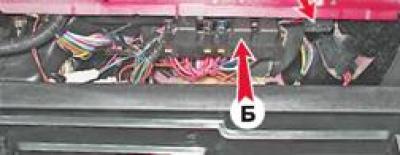
Location of diagnostic connector block relay and fuses
The engine control system circuits are protected by 7.5 A and 15 A flag-type fuses.
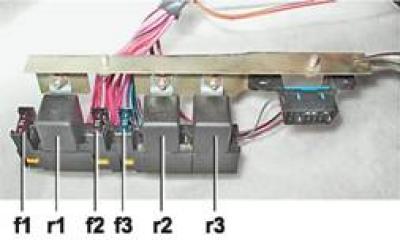
Engine Management System Fuses and Relays: f1 - main relay circuit fuse (7.5 A); f2 - ECU fuse (7.5 A); f3 - electric fuel pump circuit fuse (15 A); r1 - main relay; r2 - fuel pump relay; r3 - electric fan relay.
Note: On vehicles with ECU M1.5.4N and January-5.1.3, fuses f1 and f2 with a rating of 15A are installed.
The ignition coil is mounted on the left side of the cylinder block on a bracket. The coil is two high-voltage transformers combined into one non-separable unit. The terminals of the secondary winding of one coil are connected by high-voltage wires to the spark plugs of the 1st and 4th cylinders, the other - to the spark plugs of the 2nd and 3rd cylinders. The numbers of the cylinders, to the spark plugs of which the coil terminals are connected, are applied next to the terminals.
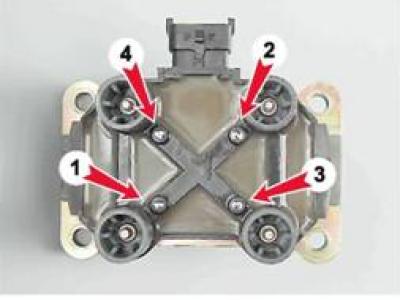
Ignition coil
High voltage electrical pulses from the coil are fed simultaneously to the spark plugs of two cylinders: to one at the end of the compression stroke, where the combustion mixture ignites, and to the other at the end of the exhaust stroke (the spark plug fires in vain).
On cars with ECU M1.5.4N and January - 5.1.3, an ignition module is installed instead of a coil. It combines two ignition coils and two electronic units that control the coils.