




The characteristics of vacuum and centrifugal ignition timing regulators can only be measured using special equipment.
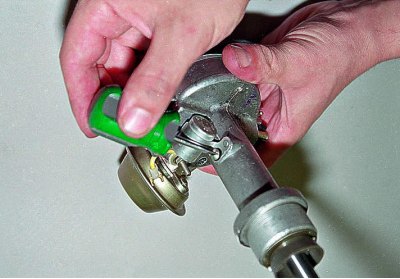
Using a screwdriver, unscrew the screw securing the capacitor.
To check the capacitor, you need a special device, but you can first evaluate its condition with an ohmmeter. First, connect the capacitor terminal to its body so that it discharges. Connect one ohmmeter probe to the body, and the second to the tip of the wire (it is better to switch the ohmmeter to the upper measurement limit). In a working capacitor, the arrow should sharply deviate towards "0", and then smoothly return to the end of the scale, to the "infinity" symbol. If you change the polarity, the arrow should deviate even more towards "zero".
We replace the faulty capacitor.
Remove the runner (see Replacing the distributor rotor).
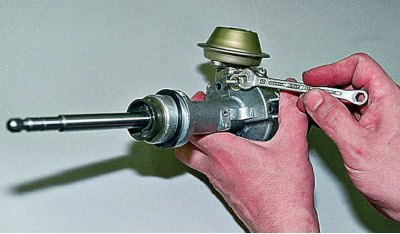
Using a 7 mm spanner, unscrew the low voltage contact nut...
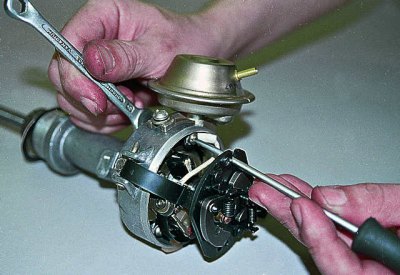
…holding the screw with a screwdriver.
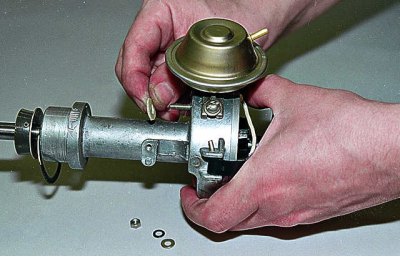
We remove the washers,...
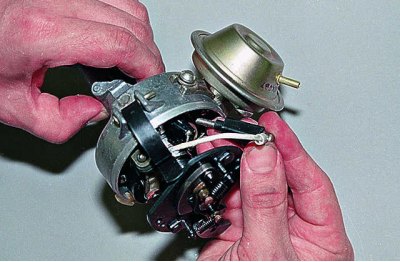
…we take out the screw, remove the insulator and the wire tip from it.
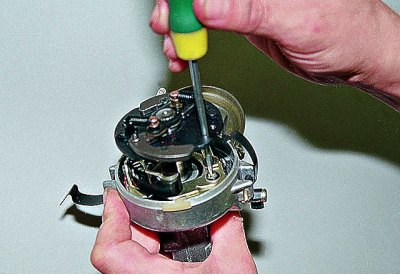
Unscrew the two screws securing the contact group (see Adjusting the angle of the closed state of the breaker contacts).
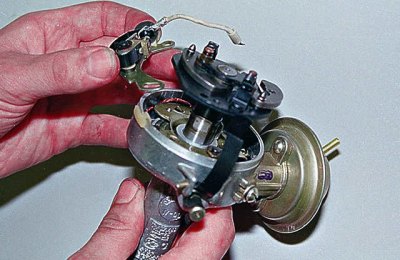
We remove the contact group.
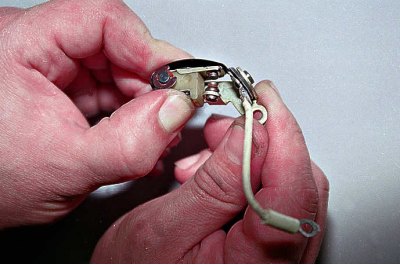
We check the condition of the contacts, if necessary, we level their surface with a file. If the contacts are very worn (melted) - we change the contact group as a whole.
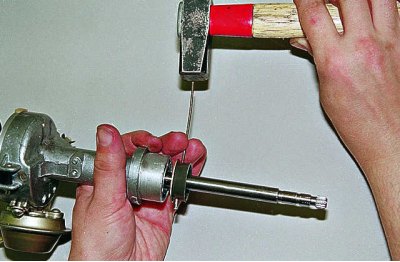
We knock out the cotter pin with a thin punch.
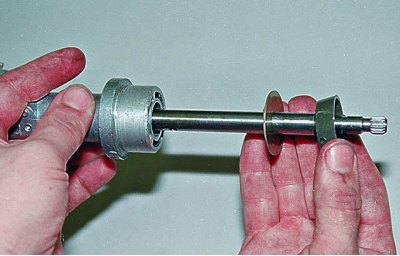
We remove the oil deflector and washer from the shaft.
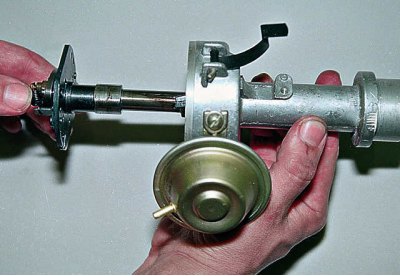
We remove the roller from the distributor housing.
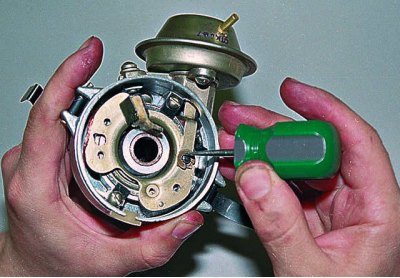
Using a thin screwdriver, remove the locking washer and rod from the pivot plate pin.
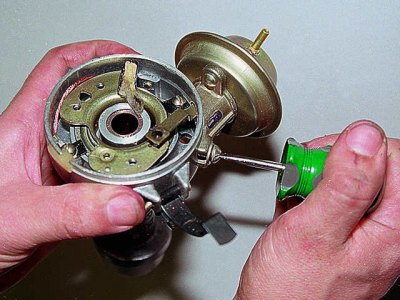
We unscrew the two screws securing the vacuum ignition timing regulator..
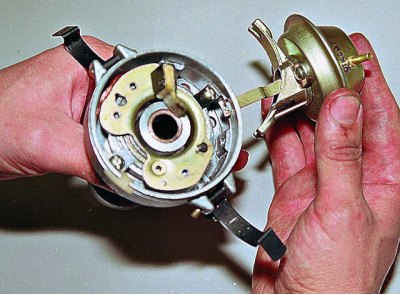
…and we take it off.
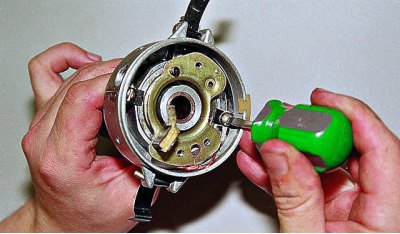
We unscrew two screws (the screw on the side of the plastic insert secures the "mass")…
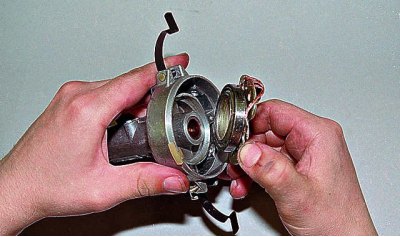
…and we take out the bearing with the swivel plate.
The bearing should not jam or have any play when rotating. Replace the faulty bearing.
We assemble the ignition distributor in the reverse order of disassembly.