




Contents: Removal ↓ Installation ↓
We replace the thermostat if the engine operating temperature regime is violated (the engine takes a long time to warm up or overheats).
The thermostat operability test can be performed on the vehicle. After starting a cold engine with a working thermostat, the lower radiator hose should begin to heat up at a coolant temperature of 80-85°C (the liquid temperature indicator arrow is almost in a vertical position). Otherwise, remove the thermostat and check the temperature at which the main valve begins to open and its stroke.
Removal
Attention! The thermostat should only be removed when the engine has cooled down.
1. Place the vehicle on an inspection pit or overpass (see "Preparing a car for maintenance and repair").
2. Drain the coolant (see "Coolant - Checking Level and Replacing").
3. Using round-nose pliers or a flat-blade screwdriver with a thin blade, loosen the band clamp securing the hose coming from the radiator.
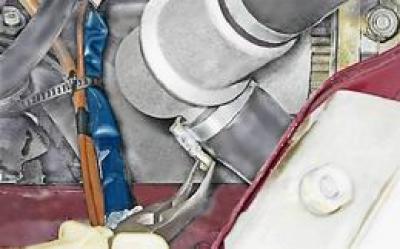
4. Disconnect the hose from the thermostat inlet pipe.
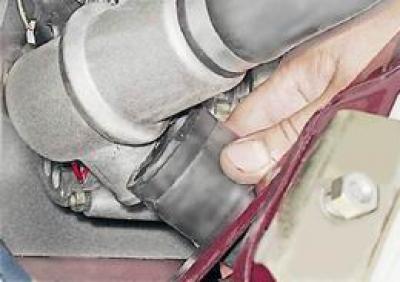
On cars of recent years of production, the hoses are fastened to the thermostat pipes with band clamps, and to the coolant pump and the cylinder head pipe - with worm clamps. In this case, it is more convenient to loosen the worm clamps and remove the thermostat together with the hoses.
5. With a socket wrench by 8 mm or use a Phillips screwdriver to loosen the clamps securing the hoses to the coolant pump and cylinder head pipes.
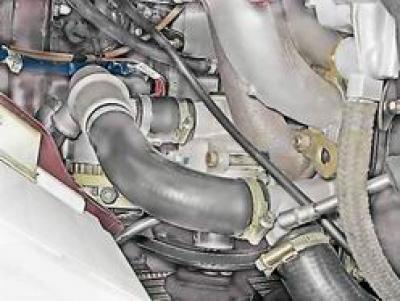
6. Remove the thermostat and disconnect the hoses from the pipes.
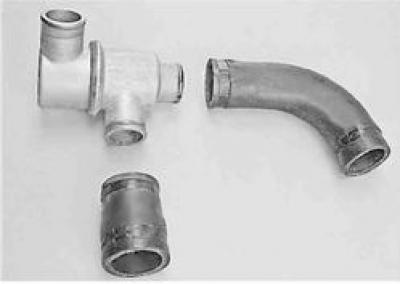
[The original source is located on the website VAZBOOK]
To check the thermostat, place it in a heat-resistant container with water. Heat the water and monitor the temperature of the beginning of the opening of the main valve using a thermometer. If this temperature is not in the range of 80.6-81.5°C, the thermostat must be replaced.
Installation
1. Place the hoses on the thermostat pipes.
2. Install worm clamps on the hoses instead of band clamps, without tightening them.
3. Connect the hose coming from the radiator to the lower inlet pipe of the thermostat and tighten the clamps.
4. Fill with coolant (see "Coolant - Checking Level and Replacing") and, after starting the engine, we check for leaks.