




Thermostat (figure 35) consists of a body and a cover, which are rolled together with the seat of the main valve 9. The thermostat has a branch pipe 1 for the inlet of cooled liquid from the radiator, a branch pipe 5 for the bypass hose of liquid from the cylinder head to the thermostat, a branch pipe 7 for supplying coolant to the pump and a branch pipe 10 for the expansion tank hose.
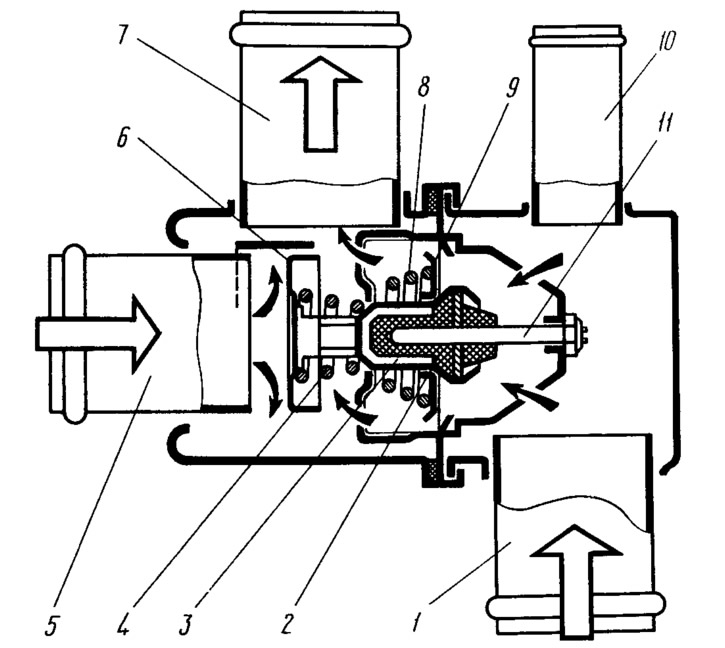
Figure 35. Thermostat:
1 - inlet pipe (from the radiator); 2 - rubber insert; 3 - solid heat-sensitive filler; 4 - additional valve spring; 5 - inlet pipe (from the engine cooling jacket); 6 - additional valve; 7 - outlet pipe (to the pump); 8 - main valve spring; 9 - main valve; 10 branch pipe (from the expansion tank); 11 - piston.
The main valve is pressed into a cup in which a rubber insert 2 is rolled. This insert contains a polished steel piston 11, secured to a fixed holder. Between the walls of the cup and the rubber insert 2 is a heat-sensitive solid filler 3. The main valve 9 is pressed by a spring 8 to the seat. Two posts are attached to it, on which a bypass valve 6 is installed, pressed by a spring 4.
The thermostat, depending on the temperature of the coolant, automatically turns on or off the cooling system radiator, passing the liquid through the radiator or bypassing it.
On a cold or insufficiently warmed up engine, when the coolant temperature is below 87°C, the main thermostat valve 9 is closed, and the bypass valve 6 is open (the temperature values are indicated on the bottom of the thermostat). The coolant, circulating from the engine cooling jacket through the thermostat bypass valve, is sucked in through the hose and supply pipe 19 (see figure 31) pump 16 and is again fed into the cooling jacket (small circle), bypassing the radiator. This ensures rapid engine warm-up.
If the fluid temperature is above 102°C, the solid thermostat filler expands, compresses the rubber insert and pushes out the piston. In this case, the main valve opens completely, and the bypass valve closes completely. The fluid will circulate from the engine cooling jacket through hoses 3 and 5 through the radiator to thermostat 25, then through the main thermostat valve through hose and tube 19 to the pump and cooling jacket (great circle of circulation). In the radiator, the liquid is cooled by the air flow. When the liquid temperature drops, the electric fan is automatically switched off by sensor 8, installed in the radiator tank.
Within the temperature range of 87...102°C, the liquid circulates both in the large circle and in the small circle, since the thermostat valves are in intermediate positions. Increasing the opening of the main thermostat valve leads to a gradual increase in the supply of liquid cooled in the radiator and maintaining the optimal thermal mode of engine operation.
[The material is posted on the online resource: VazBook.ru]