




1. Before each trip, carefully inspect the car wheels and their fastening elements. Each wheel is attached to the hub with four bolts. Press vigorously on the side of the wheel with your foot, swinging it in the transverse direction. If the wheel fastening bolts are not tightened, it will start to dangle on the hub. At the slightest suspicion of a loose wheel fastening, check the tightening of the bolts (the tightening torque is specified in the "Reference data" section). Wheel disks must be free of cracks and signs of deformation. The tires must not have cuts, peeling, tears, swellings ("hernias"), or protruding cords.
2. In the absence of mechanical damage to the tire, its suitability for use is determined by the height of the tread pattern.
We visually determine the tread height using the indicator protrusions in the grooves of the pattern.
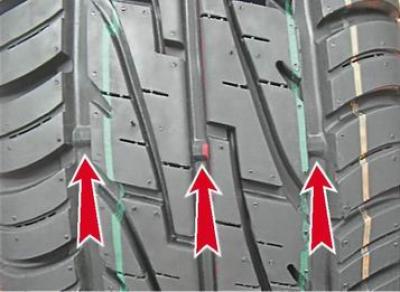
The lugs are 1.6 mm high. Once the tread height is equal to the lug height, the tire should be replaced.
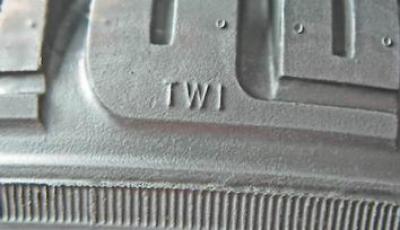
The indicators are located around the entire circumference of the tire at some distance from each other. We find them by the conventional designations in the form of the letters "TWI" or the arrows "▲" on the sidewall of the tire.
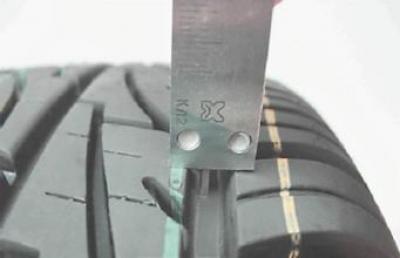
3. We determine the exact tread height using a depth gauge and compare the degree of wear of the tire at the edges and in the middle. Accelerated wear of the middle part of the tread indicates that the tire is being used with increased pressure, at the edges of the tire - with decreased pressure, and rapid wear of the inner or outer part of the tread indicates the need to adjust the wheel alignment angles. Intensive wear of one of the wheels may be caused by deformation of the suspension elements or power elements of the car body.
Warning! According to the "Appendix to the Basic Provisions for the Admission of Vehicles to Operation and the Duties of Officials to Ensure Road Safety", it is prohibited to operate a passenger car:
- if the tire tread depth is less than 1.6 mm;
- with tires that have external damage (punctures, cuts, tears) exposing the cord, as well as delamination of the carcass, separation of the tread and sidewall;
- if there is no mounting bolt or there are cracks in the wheel disk and rims, there are visible violations of the shape and size of the mounting holes;
- if the tires do not match the vehicle model in size or load capacity;
- if tires of different sizes and designs are installed on one axle of a vehicle (radial, diagonal, tubed, tubeless), models with different tread patterns, studded and non-studded, frost-resistant and non-frost-resistant, new and restored.
4. The appearance of vibration felt on the body or steering wheel when the car is moving at a constant speed of over 80 km/h may be a consequence of an imbalance of one of the wheels. To identify the cause, we check the wheel balancing at a tire shop. If the vibration is caused by a deformation of the disk, damage to the tire or its uneven wear, we replace the tire or disk.
(The original can be seen on the website: VAZBOOK.ru)
5. We hang up each wheel of the car one by one (see "Preparing the car for maintenance and repair") and swing it in a vertical plane.
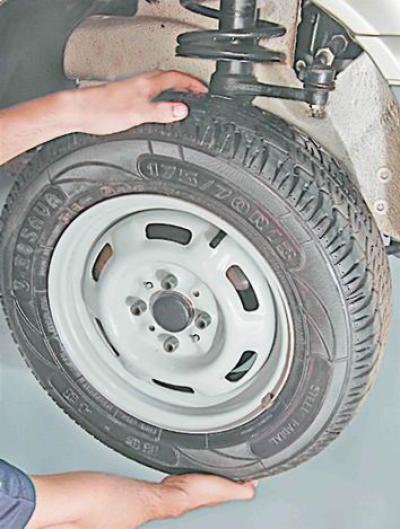
In hubs with worn bearings, play will be felt. To make sure that the play is not caused by faulty suspension components, repeat the check with the brake pedal pressed. If the knocking disappears, then the hub bearing is faulty.
We replace faulty bearings (see "Front Wheel Hub Bearing - Replacement" and "Rear Wheel Hub Bearing - Replacement"). If a knock is heard, then we check the condition of the suspension (see "Front suspension - technical condition check" and "Rear suspension - technical condition check").