




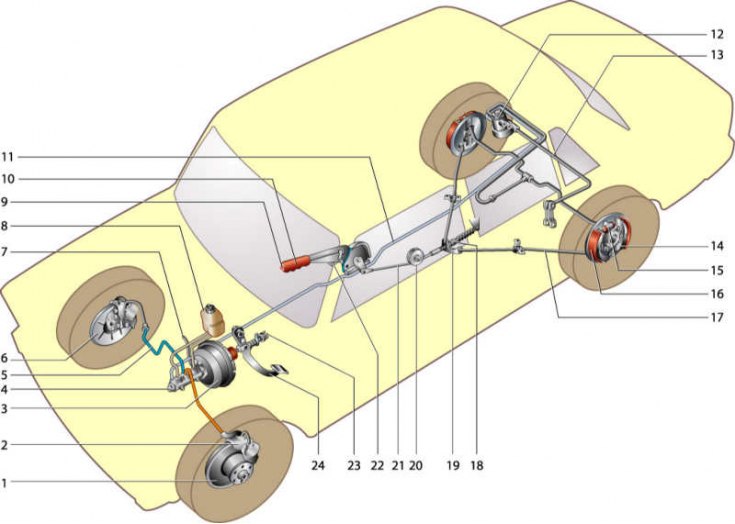
1 – brake disc; 2 – front brake caliper; 3 – vacuum booster; 4 – main cylinder of the brake hydraulic drive; 5 – Front brake drive circuit pipeline; 6 - Front brake protective cover; 7 – vacuum pipeline; 8 – master cylinder reservoir; 9 – Parking brake lever button; 10 – parking brake drive lever; 11 – rear brake drive circuit pipeline; 12 – rear brake pressure regulator; 13 – pressure regulator drive lever; 14 – manual brake pad drive lever; 15 – rear brake wheel cylinder; 16 – rear brake pads; 17 – rear cable; 18 – adjusting nut with lock nut; 19 – rear cable equalizer; 20 – guide roller; 21 – front cable; 22 – parking brake indicator lamp switch stop; 23 – brake light switch; 24 – brake pedal.
Description of the design
The car is equipped with two braking systems - service and parking. The service has a hydraulic drive and ensures braking of the car during movement, the second, as a rule, is used during parking and has a mechanical drive.
The service brake system consists of two separate circuits for the drive of the front and rear brake mechanisms. If one of the circuits fails, the second one allows, although with less efficiency, to brake the car. Both circuits operate independently of each other.
The working system includes a pedal assembly, a master brake cylinder with a reservoir and a vacuum booster, a rear brake pressure regulator, front and rear wheel brake mechanisms with working cylinders and pipelines.
The front wheel brake mechanisms are disc brakes. The main elements of each mechanism are a brake disc, a caliper with two working cylinders and two brake pads.
The rear wheel brakes are drum brakes with two-piston wheel cylinders and automatic adjustment of the gap between the shoes and the drum. The main element of the automatic adjustment mechanism is steel spring split rings. They are inserted with tension, providing a shift force along the cylinder mirror of at least 35 kgf, which exceeds the force of the tension springs of the brake shoes. When the brake linings wear out, the thrust rings shift by the amount of wear. In case of damage to the cylinder mirror, the rings can "stick" and the pistons will lose mobility. In this case, the cylinders are replaced.
The main brake cylinder is double-cavity, has two pistons, is attached to the vacuum booster body on two studs. The cavities of the main cylinder are connected by hoses to the supply tank. A sensor for insufficient brake fluid level is installed in the tank cover.
The hydraulic drive of the rear wheel brakes is sequentially connected to a pressure regulator, which reduces the pressure in the hydraulic drive when the load on the rear axle decreases. This prevents the rear wheels from locking and the rear axle of the car from skidding.
The parking brake system drive is mechanical, cable-type, on the rear wheel brake mechanisms. It consists of a lever, a front cable, an equalizer, a rear cable, and a manual brake shoe drive lever. The parking brake system must hold the car on a 25% slope.