




Contents: Removal ↓ Installation ↓
Removal
1. Prepare the vehicle for operations (see "Preparing a car for maintenance and repair").
2. Use a rag to clean off dirt and wash the outer surface of the fuel pump with white spirit or engine cleaner (if it is not planned to be replaced) and the cylinder block near the pump mounting location.
Warning! Fuel will leak from the hoses during the following operation. Prepare two M8 bolts to plug the hose holes.
3. Using a Phillips screwdriver or an 8 mm wrench, loosen the clamps securing the fuel hoses and remove the hoses from the fuel pump fittings. Seal the ends of the hoses with M8 bolts.
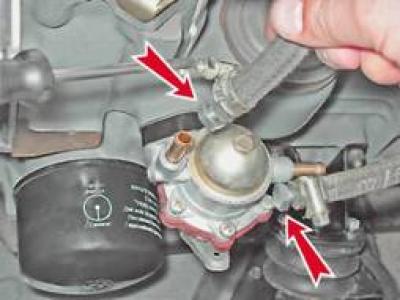
4. Using a 13 mm wrench, unscrew the two nuts securing the fuel pump to the cylinder block.
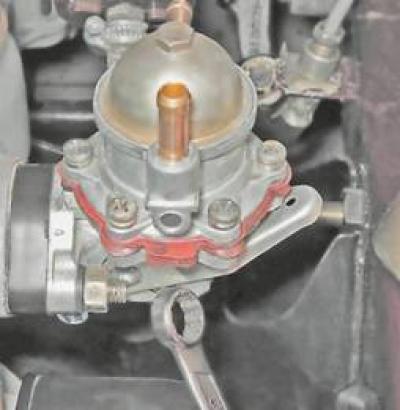
5. Remove the pump from the studs. Check the condition of the gasket and replace it if necessary. The thickness of the gasket is 0.3 mm.
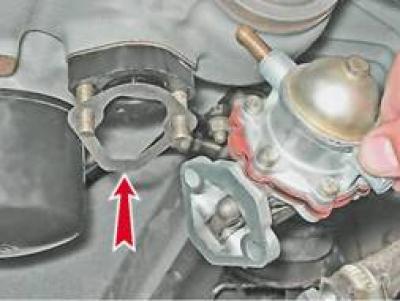
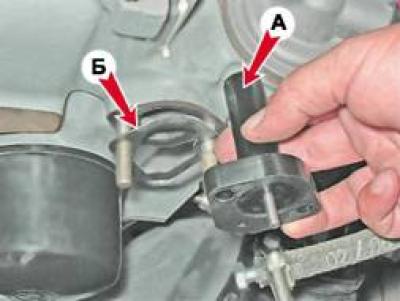
6. Remove and clean the heat-insulating spacer A from dirt. If necessary, replace the gasket B between the heat-insulating spacer and the cylinder block. The thickness of the gasket is 0.8 mm.
Installation
On a car with high mileage (more than 100 thousand km) and when replacing the gaskets, before installing the fuel pump, you should check the minimum pushrod protrusion value. The stroke and correct position of the pump diaphragm unit depend on it. Otherwise, the fuel supply by the pump decreases or there is a possibility of diaphragm rupture. The pushrod protrusion value is changed by selecting gaskets between the spacer and the cylinder block.
1. We check the minimum protrusion of the tappet above the mating plane of the heat-insulating spacer taking into account the gasket between the fuel pump and the spacer. To increase the accuracy of the measurement, we temporarily install both gaskets between the spacer and the block. We set the minimum protrusion by slowly turning the engine crankshaft. We press the spacer to the block and measure the protrusion of the tappet.
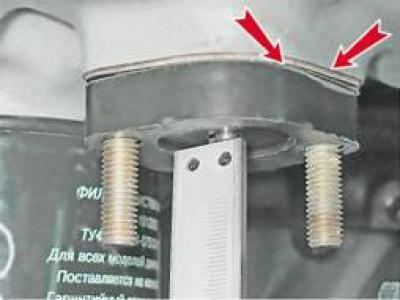
The protrusion value should be within 0.8-1.3 mm.
2. If the tappet protrudes more than 1.3 mm, then replace the gasket between the spacer and the cylinder block with a thicker one (1.25 mm); if the tappet protrudes less than 0.8 mm, then replace it with a thinner one (0.3 mm).
3. Install the gasket between the fuel pump and the spacer in place.
4. Further installation of the removed parts is carried out in the reverse order.