




Examination
Insufficient filling of the carburetor with gasoline may be caused by a malfunction of the fuel pump, as well as clogging or damage to the fuel lines. To determine the cause of the malfunction, disconnect the hose from the discharge pipe 1 (see fig. 31) and using the manual pumping lever check whether fuel is supplied. If fuel is not supplied, check the vacuum at the suction pipe 4. If there is no vacuum, the pump is faulty.
The fuel pump can be tested on a bench. When the shaft, having an eccentricity of (1.25±0.02) mm, rotates at a frequency of (2000±40) rpm, the fuel supply should be no less than 54 l/h at (20±5)°C. The injection pressure at zero fuel supply should be 2.3-3 m of water column.
Disassembly, cleaning and inspection of parts. Unscrew the cover mounting bolt 5 (see fig. 31), remove the cover and filter 2, then unscrew the screws securing the housings, separate them, take out the diaphragm unit and spring. Wash all parts with gasoline and blow with compressed air. Check the elasticity of the diaphragm spring, which should be compressed to 24 mm under a force of 3.2+0,15-0,10 kgf. Check the integrity of other springs and parts.
The diaphragm must not have any cracks or hardening.
Installing the pump on the engine
For correct installation (Fig. 38), two of the three gaskets are used: A - 0.27-0.33 mm thick, B - 0.70-0.80 mm thick; C — 1.10-1.30 mm thick. Gasket D is always placed under the heat-insulating spacer to the cylinder block. Gasket B is placed on the plane in contact with the Pump. Then the value d is checked (the minimum amount by which the pushrod protrudes when the crankshaft is slowly turned). If d = 0.8-1.3 mm, the pump is finally fixed to the engine. If d is less than 0.8 mm, gasket B is replaced with gasket A; if more than 13 mm, gasket B is replaced with gasket C. Dimension d is checked again, and the pump is secured to the engine.
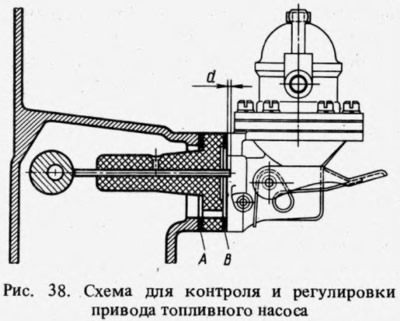
When installing the pump, the gaskets are replaced with new ones.