




2. Check the tightness of all threaded connections of the rear suspension parts and tighten any loose connections.
3. Check the operation of the shock absorbers by applying force vigorously from top to bottom to the rear left and right wings in turn. The body should return to its original position, making only one upward movement. If the efficiency of vibration damping decreases, as well as fluid leaks from at least one shock absorber, both should be replaced. There should be no play in the places where the shock absorbers are attached. The shock absorber cushions should not have cracks or signs of rubber aging.
4. Inspect the suspension springs - any that are sagging or have cracks must also be replaced in pairs.
5. Check the rods for mechanical damage.
To check the rubber-metal hinge of the rod, we insert a mounting blade between the rod eye and its mounting bracket, trying to move the rod.
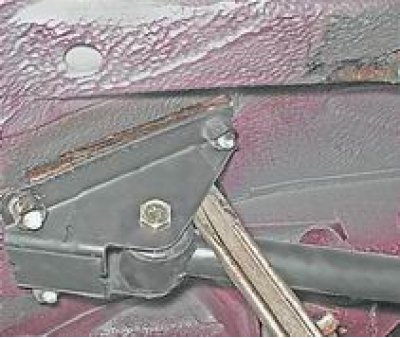
A rod that shifts relative to the rubber bushing of the hinge must be replaced. Rods with a cracked or squeezed out to one side rubber-metal hinge must also be replaced.