




2. In the car, check the free travel of the clutch pedal, which should be within 0.4-2 mm from the upper position of the pedal to the stop of the pusher against the piston of the master cylinder. If necessary, make adjustments. To do this, use a 10 mm wrench to loosen the lock nut of the clutch pedal travel limiter and, by rotating the limiter A, set the required gap.
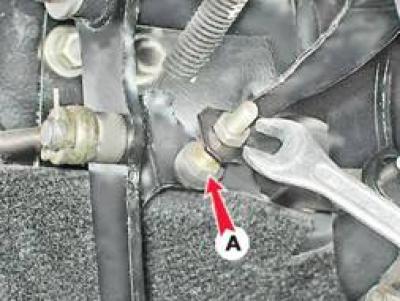
3. On a vehicle with an injection system, remove the additional mudguard (see "Mudguard - Removal and Installation").
4. Clean the plunger from dirt and apply penetrating lubricant to its threads.
5. Check the free travel of the working cylinder pusher, which determines the free travel of the release bearing. To do this, manually push the clutch fork back to the stop, while the free travel of the pusher should be within 4-5 mm. If the spring force is too strong, then for convenience it can be disconnected from the lever.
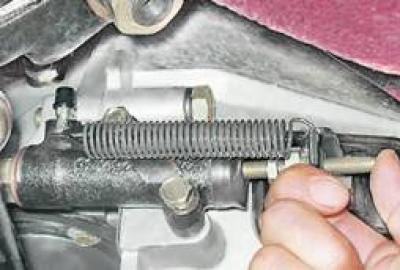
6. To adjust the free travel of the pusher, use a 17 mm wrench to hold the adjusting nut of the pusher from turning, and use a 13 mm wrench to loosen the lock nut.
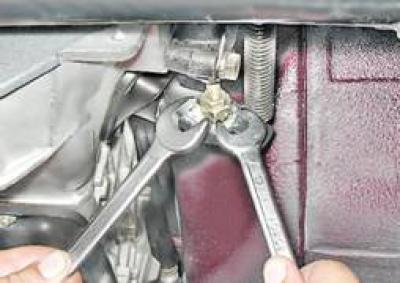
7. Holding the pusher by the flats from turning with an 8 mm wrench, turn the adjusting nut with a 17 mm wrench and set the required free travel of the pusher (4-5 mm).
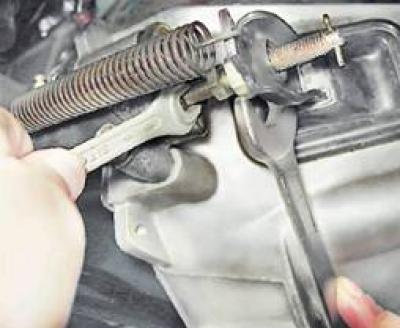
8. While holding the pusher adjusting nut, tighten the lock nut.
9. In the passenger compartment, check the total free travel of the clutch pedal, which should be within 25-35 mm from its upper position to the start of disengaging the clutch. If necessary, repeat operations 2-8.
The material is posted on the online resource VAZBOOK.RU