




Contents: Instrument cluster model 2105 ↓ Instrument cluster model 2107 ↓ Key switches (instrument panel model…↓
Instrument cluster model 2105
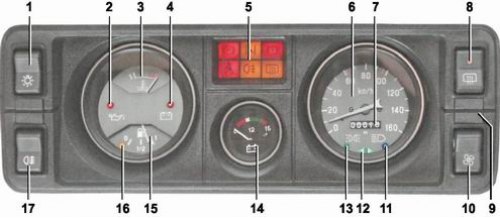
1 - outdoor lighting switch. The three-position switch has three fixed positions. In the first one, the external lighting is off; in the second - the side lights and instrument lighting are on; in the third - the low beam headlights are additionally turned on;
2 - low oil pressure indicator lamp. When the ignition is turned on, it lights up red and goes out after the engine starts. If the lamp continues to light after the engine starts, this indicates low pressure in the lubrication system. To avoid engine failure, it should be turned off and the cause of the malfunction eliminated;
3 - temperature indicator of the liquid in the cooling system. The pointer of the indicator moves into the red sector of the scale, indicating that the engine is overheating. You should stop and eliminate the cause of the overheating;
4 - battery charge indicator lamp. When the ignition is turned on, it lights up red and goes out after the engine starts. If the lamp continues to light after the engine starts, this indicates insufficient tension of the alternator drive belt, a malfunction of the alternator or the control lamp circuit;
5 - signaling unit:
- engaging the parking brake (lights up red when the ignition is on and the parking brake lever is raised);
- carburetor air damper cover (lights up orange when the ignition is on and the choke control handle is pulled out);
- emergency condition of the service brake system (lights up red when the fluid level in the brake hydraulic reservoir drops below the permissible level and the ignition is on);
- seat belts are not fastened (lights up red when the ignition is switched on, if the driver's seat belt is not fastened; installed on some cars);
- turning on the fog lights in the rear lights (lights up orange when the corresponding key switch is pressed with the headlights on);
- turning on rear window heating (lights up orange when the rear window heating is turned on and the ignition is on);
6 - speedometer (vehicle speed indicator);
7 - odometer (trip meter);
8 - rear window heating switch. The rear window heating is switched on by pressing the button with the ignition on;
9 - instrument panel mounting screw plug;
10 - heater fan operating mode switch. The switch provides two fan speeds - low and high;
11 - high beam indicator lamp. Lights up blue when the high beam headlights are turned on;
12 - indicator lamp for direction indicators and hazard warning lights. Lights up with a flashing green light when the turn signal switch is moved to the down position (left turn) or top (right turn) position, as well as when the hazard warning lights are on;
13 - control lamp for switching on external lighting. Lights up green when the outside lights are turned on;
14 - voltmeter. When the ignition is on and the engine is not running, it shows the voltage at the terminals of the battery, and when it is running, it shows the voltage produced by the generator. The voltmeter needle in the green zone indicates normal voltage in the on-board network. If the voltmeter needle with the engine running is in the red zone of the scale, this indicates weak tension of the generator belt or a malfunction of the generator itself, and in the white zone - an unsteady charge-discharge mode;
15 - fuel level indicator;
16 - fuel reserve indicator lamp. Lights up yellow when there is less than 6.5-4 liters of fuel left in the fuel tank;
17 - rear fog light switch. The fog light is turned on by pressing the button while the headlights are on.
Instrument cluster model 2107
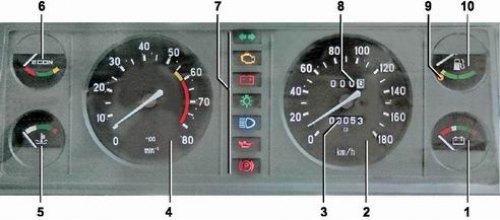
1 - voltmeter;
2 - speedometer (vehicle speed indicator);
3 - odometer (trip meter);
4 - tachometer. Indicates the crankshaft speed. The yellow zone of the scale indicates the engine operating mode with a high crankshaft speed, the red zone - unacceptable modes. The maximum permitted engine speed is 6000 rpm;
5 - coolant temperature indicator. The arrow in the green zone of the scale indicates normal coolant temperature. The red zone indicates engine overheating. It is prohibited to operate the car with a coolant temperature above 118°C;
6 - econometric. Helps to choose the most economical (in terms of fuel consumption) engine operating mode when the car is moving. The instrument needle is in the green zone of the scale;
7 - signaling unit:
 - direction indicators (lights up with a green flashing light when the right or left turn signal is on);
 - engine management system malfunctions (connects to a car with an injection system. Lights up orange when the ignition is on and goes out after the engine starts). If there is a fault in the system, the indicator will flash or light continuously. Operation of the vehicle is not prohibited, as the system will switch to the backup mode (with loss of power and increased fuel consumption). Fix the problem yourself or take it to a specialized workshop;
 - battery charge. When the ignition is turned on, it lights up red and goes out after the engine starts. If the indicator continues to light after the engine starts, this indicates that the battery is not charged. The cause may be insufficient tension of the alternator drive belt, a malfunction of the alternator or the control lamp circuit. Further movement with the indicator on may lead to a complete discharge of the battery and engine shutdown, as well as a fire (if the fault is caused by a short circuit in the electrical wiring);
 - turning on the side lights (lights up green when the parking lights are turned on);
 - turning on high beam headlights (lights up blue when the high beam headlights are turned on);
 - insufficient oil pressure. When the ignition is turned on, it lights up red and goes out after the engine starts. If the lamp continues to light after the engine starts, this indicates low pressure in the engine lubrication system. To avoid engine failure, it should be turned off and the cause of the malfunction eliminated;
 - engaging the parking brake (lights up red when the ignition is on and the parking brake lever is raised).
Note: Additional indicator blocks are installed on the central console of the instrument panel:
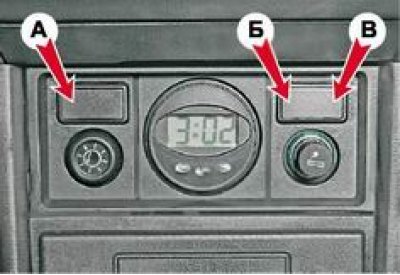
- a) unfastened seat belts (lights up red when the ignition is switched on, if the driver's seat belt is not fastened; installed on some cars);
- b) turning on the rear window heating (lights up orange when the rear window heating is turned on and the ignition is on);
- v) emergency condition of the service brake system (lights up red when the fluid level in the brake hydraulic reservoir drops below the permissible level and the ignition is on).
8 - daily distance traveled counter.
9 - fuel reserve indicator lamp. Lights up yellow when there is less than 6.5-4 liters of fuel left in the fuel tank;
10 - fuel level indicator.
Key switches (instrument panel model 2107)
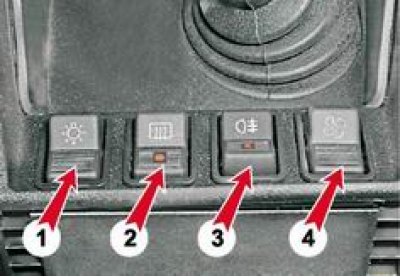
1 - outdoor lighting switch. The three-position switch has three fixed positions. In the first one, the external lighting is off; in the second - the side lights and instrument lighting are on; in the third - the low beam headlights are additionally turned on;
2 - rear window heating switch. The rear window heating is switched on by pressing the button with the ignition on;
3 - rear fog light switch. The fog light is switched on by pressing the button when the low beam headlights are on;
4 - heater fan operating mode switch. The switch provides two fan speeds - low and high.