




Open large image in new tab »
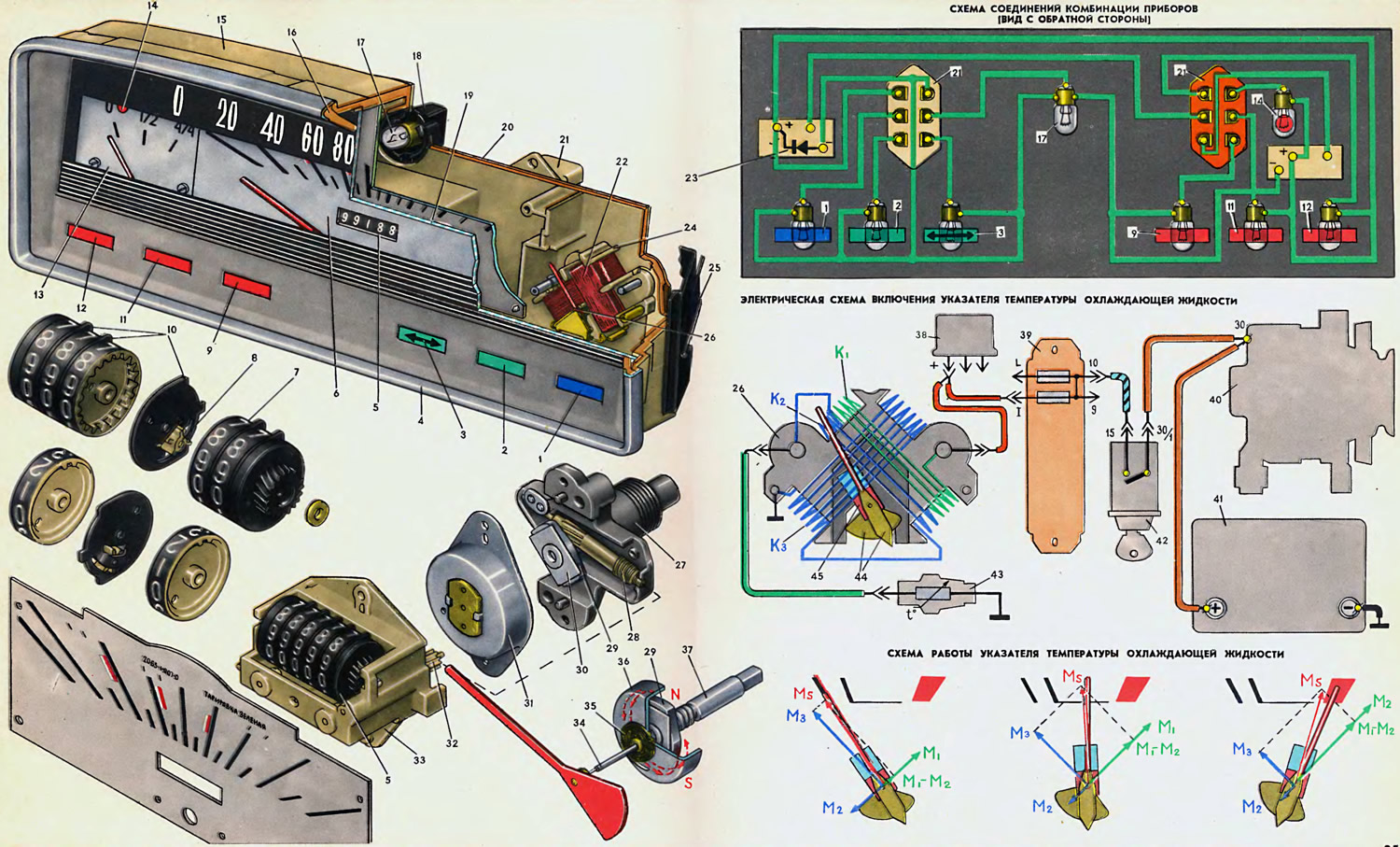
1. High beam indicator lamp. 2. Exterior lighting indicator lamp. 3. Direction indicator lamp. 4. Bezel. 5. Trip meter. 6. Speedometer. 7. Drum. 8. Six-tooth gear. 9. Battery charge indicator lamp. 10. Cheeks. 11. Oil pressure indicator lamp. 12. Handbrake indicator lamp. 13. Fuel gauge. 14. Fuel reserve indicator lamp. 15. Housing. 16. Frame. 17. AMN12-3 instrument lighting lamp 18. Lamp socket. 19. Dial. 20. Printed circuit board. 21. Connector block. 22. Temperature indicator coils. 23. D-226B diode. 24. Coil frame. 25. Instrument cluster holder. 26. Coolant temperature gauge. 27. Base. 28. Primary counter drive shaft. 29. Magnet. 30. Temperature compensator. 31. Screen. 32. Secondary counter drive shaft. 33. Bridge. 34. Axle. 35. Return spring. 36. Rosemount. 37. Drive shaft. 38. Handbrake indicator lamp flasher relay. 39. Fuse box. 40. Generator. 41. Battery. 42. Ignition switch. 43. Temperature gauge sensor. 44. Magnet and pointer balance arms. 45. Permanent magnet.
The instrument cluster type KP-191 combines a fuel level indicator 13, a speedometer 6, a coolant temperature indicator 26, and seven control lamps, one of which (14 fuel reserves) installed in the fuel level indicator.
The instrument cluster is installed in the instrument panel socket and secured with two spring holders 25. It has a plastic housing 15 with compartments in which the instruments and control lamps are located. The housing is covered from the outside with a plastic frame with a dial and multi-colored light filters for the control lamps. The frame is attached to the housing with a metal chrome-plated edge 4.
The printed circuit board 20 of the electrical connections of the instruments and control lamps is riveted to the back of the case. The board is made of foil-clad getinax and covered with varnish. Together with the printed circuit board, plastic sockets 21 of the plugs are riveted to the case, and the plugs themselves are connected to the printed circuit board also with rivets. Control lamps of the AMN12-3 type are inserted into plastic sockets 18, and those into the holes of the printed circuit board.
Between the "+" and "ground" conductors of the supply voltage, a diode 23 of the D-226B type or a similar diode manufactured by VNR is installed. Through it, the pulses of reverse currents are closed to ground, which prevents the permanent magnets of the fuel level and coolant temperature indicators from demagnetization.
Speedometer
The speedometer consists of a pointer indicator of the vehicle's speed and a final counter 5 of the distance traveled by the vehicle. It is attached to the housing 15 with two screws, one of which is sealed.
The speedometer mechanisms are driven by a flexible shaft from a gearbox mounted on the rear cover of the gearbox.
The original is on the portal [vazbook.ru]
The speed indicator mechanism consists of a permanent magnet 29 mounted on a drive shaft 37 and an aluminum card 36 secured together with an arrow on an axis 34. The shaft rotates in a metal cast base 27, to which a steel screen 31 and a plastic bridge 33 of the counter are attached with two screws. The screen covers the card and is designed to increase the magnetic flux passing through it, which increases the sensitivity of the speed indicator.
When the magnet rotates, the magnetic lines of force penetrate the card and induce an EMF in it, under the action of which eddy currents arise in the card. These currents create the card's own magnetic field. As a result of the interaction of the rotating magnetic field of the permanent magnet and the magnetic field of the card, a torque acts on it, which turns the card, and with it the arrow, in the direction of rotation of the magnet. The torque acting on the card is balanced by the counteracting torque of the spiral spring 35. The higher the rotation frequency of the magnet, the greater the torque, the greater the deflection of the arrow.
As the temperature increases, the electrical resistance of the card to eddy currents increases. Therefore, its magnetic field decreases and, if appropriate measures are not taken, the card with the arrow will rotate at a smaller angle. The speedometer speed indicator readings will be incorrect. To reduce the effect of temperature on the arrow deflection, a temperature compensator 30 or magnetic shunt is attached next to the magnet on the drive shaft. It is a thin steel plate. The magnetic flux of the permanent magnet is divided into two parts. One part of it closes through the card, and the other through the temperature compensator. As the temperature increases, the magnetic resistance of the temperature compensator increases, the magnetic flux through it decreases, and through the card increases. The EMF induced in the card increases and compensates for the increase in its resistance. Therefore, the eddy currents of the card change insignificantly with an increase in temperature and the speedometer arrow deflects almost the same amount.
The counter mechanism consists of six plastic drums 7 mounted on a common axis. Five of them have numbers from zero to nine indicating kilometers, while the primary drum has no numbers. Fixed cheeks 10 with plastic six-toothed gears 8 are mounted between the drums. The drums with numbers have a full internal engagement ring on one side and only two teeth on the other side. The primary drum also has only two teeth. Rotation from shaft 37 is transmitted to the primary drum through shafts 28 and 32 with three worm gears. When one of the drums rotates a full revolution, its two teeth on the left side rotate gear 8 by 120: and the adjacent left drum rotates this gear by 1/10 of a revolution. The next number appears in the scale window. The maximum counter reading is 99999 km, after which it starts counting from zero again. One revolution of the drive shaft 37 corresponds to one meter of traveled distance.
Coolant temperature gauge
The KP-191 instrument cluster is equipped with a magnetoelectric coolant temperature indicator of the UK-191 type. It is used together with the TM-106 sensor and is attached to the printed circuit board with 20 three pins, which are also the contact terminals of the coils.
The device consists of a plastic frame 24 with coils and an axis with an arrow, a permanent magnet and balancers, and their center of gravity is located so that when the device is switched off, the arrow deviates to the left edge of the scale. The axis of the arrow rotates in two bearings, one of which is made in the form of a screw and with its help during assembly the play of the axis is adjusted. During assembly, the ends of the axis are lubricated with a special damping silicone liquid, which prevents vibration of the arrow when the car is moving.
The coils have three windings: K ₁, K ₂ and K ₃. Winding K ₃ is wound perpendicular to windings K ₁ and K ₂, and windings K ₁ and K ₂ are wound towards each other. Thus, three magnetic fluxes M ₁, M ₂ and M ₃, created by three windings, act on the permanent magnet. Their direction is determined by the gimlet rule. The current from the current source first passes through winding K ₁, and then branches into two circuits. One of them is closed to ground through sensor 43, the resistance of which changes depending on the temperature of the coolant. Due to the change in the resistance of the sensor, the current strengths in the windings and the magnetic fluxes created by them change.
Total magnetic flux MS, acting on a permanent magnet, is determined by the parallelogram rule.
If the engine is cold, the sensor resistance is significant, the current in the sensor circuit is small and the magnetic flux M ₁ is less than M ₃. In this case, the total magnetic flux MS holds the pointer at the beginning of the scale. As the coolant temperature increases after the engine is started, the resistance of the sensor decreases and, consequently, the current passing through it and the winding K ₁ increases, and the current through the windings K ₂ and K ₃ decreases. As a result, the magnetic flux M ₁ increases, the fluxes M ₂ and M ₃ decrease, and the total flux MS changes direction and turns the arrow to the middle of the scale. When the coolant is overheated, the resistance of the sensor decreases significantly, the current through the winding K ₁ and the magnetic flux M ₁ increase even more along with a decrease in the magnetic fluxes M ₂ and M ₃ and the total magnetic flux MS deflects the arrow into the red zone of the scale.
Fuel level indicator
The KP-191 instrument cluster is equipped with the UB-191 fuel gauge. Just like the coolant temperature gauge, it is magnetoelectric and has the same design and operating principle. It differs in winding data, mounting points to the printed circuit board and the mutual arrangement of the permanent magnet, pointer and balancers.
The UB-191 indicator is used in combination with the BM-150 type sensor (on VAZ-2101) or BM-154 (on VAZ-2102), which are installed in the fuel tank. These sensors also turn on the fuel reserve indicator lamp 14 if there are 4-6.5 liters of gasoline left in the tank (on VAZ-2101) or 5-7.5 l (on VAZ-2102).