




Contents: Master cylinder ↓ Slave cylinder ↓
Master cylinder
Master Cylinder Parts
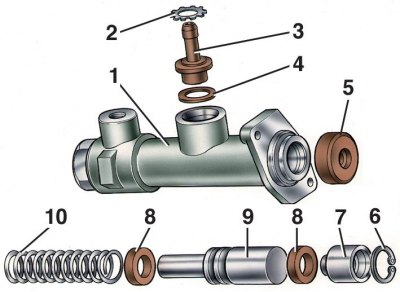
1 – body; 2 – lock washer; 3 – nipple; 4 – gasket; 5 – cap; 6 – retaining ring; 7 – pusher piston; 8 – sealing ring; 9 – master cylinder piston; 10 – spring
1. Unscrew the plug, remove the protective cap 5 of the cylinder body and the retaining ring 6. This will allow you to remove the piston 7, the sealing ring 8, the floating piston 9 with the sealing ring and the piston return spring 10 from the body.
2. The cylinder bore and the outer surface of the piston must be free of damage and scratches. The internal diameter of a serviceable master cylinder must be 19.05+0,025–0,015 mm.
3. Check the condition of the piston return spring and replace it if it has lost elasticity.
4. Replace the O-rings.
5. Check the protective cap on the rear end of the cylinder and if the cap is damaged, replace it with a new one.
6. Before assembly, carefully clean and rinse the parts with brake fluid. Do not allow mineral oil, gasoline, kerosene or diesel fuel to come into contact with the parts, as these substances will cause the rubber seals to swell.
7. After checking all parts, assemble the master cylinder in the reverse order of disassembly; and lubricate all parts of the cylinder with brake fluid or NG-213 preservation fluid.
Slave cylinder
Clutch Release Cylinder Parts (working cylinder)
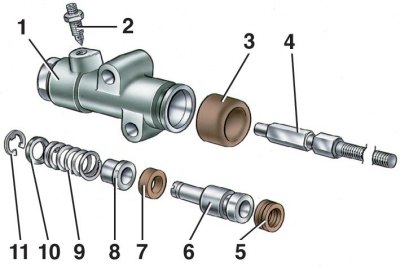
1 – body; 2 – nipple; 3 – cap; 4 – pusher; 5 – sealing ring; 6 – piston; 7 – sealing ring; 8 – plate; 9 – spring; 10 – washer; 11 – retaining ring
Original source is on the resource www.VAZbook.ru
1. Unscrew the plug, remove the protective cap 3 together with the pusher 4, take out the piston and disassemble it, having first removed the retaining ring 11.
2. After disassembly, carefully wash and check all parts as specified for the master cylinder. Do not install a deformed tappet.
3. After checking, proceed with assembly (the order is the reverse of disassembly), lubricate the parts with hydraulic fluid.