




Wiring diagram for the electric motor of the engine cooling system fan
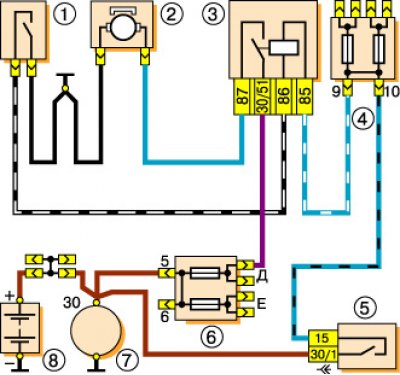
1 – electric motor start sensor; 2 – fan electric motor; 3 – electric motor start relay; 4 – main fuse box; 5 – ignition switch; 6 – additional fuse box; 7 – generator; 8 – battery.
Some cars are equipped with an electric fan to blow air through the radiator of the cooling system. It is switched on when the sensor-switch 37101B, installed in the lower part of the right radiator tank, is triggered. Previously, power was supplied to the electric motor of the fan through a relay. In this case, the TM-108 temperature sensor was used. Currently, the electric fan circuit has been simplified and the electric motor is powered directly through the contacts of the sensor-switch. The sensor is non-separable - in case of a malfunction, it is subject to replacement.
Electric motor ME-272 (or something similar) - direct current with excitation from permanent magnets. Installed in a casing, fixed on radiator brackets. During operation, the electric motor does not require maintenance, a faulty one is subject to replacement.
(The text is taken from the online resource: «VAZBOOK.RU»)
Technical data of the electric fan and sensor 37101B (TM-108)
| Nominal speed of rotation of the electric motor shaft with impeller, min⁻¹ | 2500 – 2800 |
| Electric motor current consumption, A | 14 |
| Sensor contact closure temperature,°C | 82±2 (82 ±2) |
| Sensor contact opening temperature,°C | 87±2 (87±2) |
The engine overheats, the electric fan does not turn on.
To check the fan electric motor, apply 12 V from the battery to the electric motor terminals – a working motor will start working.
To check the electric fan temperature sensor, disconnect the wires from the temperature sensor and connect them together with the ignition on. If the fan starts working, the sensor is faulty.
Having connected an ohmmeter to the sensor terminals and lowered it into the water by the length of the thread, we measure the temperature of the sensor on and off with a thermometer. To do this, we heat the water almost to boiling, and then monitor the cooling. The temperature characteristic of a working sensor should not differ from that given above.