




Contents: Coolant pump ↓ Radiator and expansion tank ↓ Electric fan ↓ Thermostat and operation of the…↓
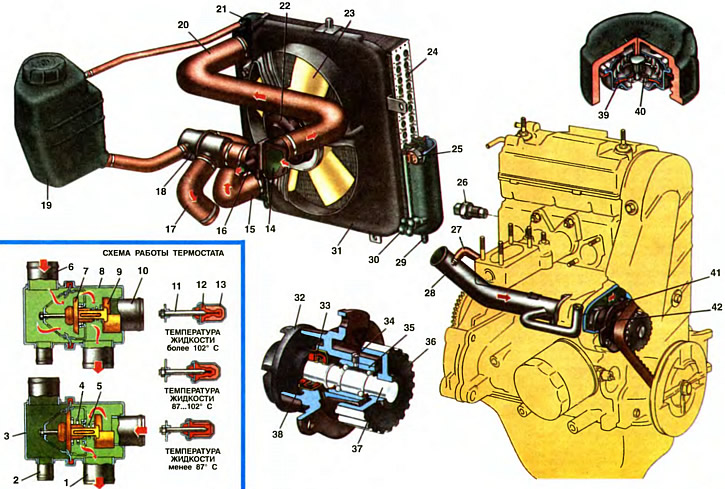
1. Outlet pipe (to the pump). 2. Pipe (to the expansion tank). 3. Thermostat cover. 4. Main valve spring. 5. Bypass valve spring. 6. Inlet pipe (from the radiator). 7. Main valve. 8. Thermostat housing. 9. Bypass valve. 10. Inlet pipe (from the engine). 11. Piston. 12. Rubber insert. 13. Heat-sensitive solid packing. 14. Cylinder head outlet pipe. 15. Radiator hose. 16. Pipe (to the interior heater). 17. Pump fluid supply hose. 18. Thermostat. 19. Expansion tank. 20. Radiator hose. 21. Left radiator tank. 22. Electric motor. 23. Fan impeller. 24. Radiator core. 25. Electric fan switch. 26. Coolant temperature gauge sensor. 27. Inlet pipe heater fluid drain hose. 28. Pump pipe. 29. Lower radiator support. 30. Drain plug. 31. Fan casing. 32. Pump impeller. 33. Oil seal. 34. Bearing lock screw. 35. Bearing. 36. Toothed pulley. 37. Pump shaft. 38. Oil seal thrust ring. 39. Outlet (steam) valve. 40. Inlet valve. 41. Outlet pipe of the interior heater. 42. Coolant pump.
The engine cooling system is liquid, closed type, with forced circulation of liquid, with expansion tank 19. The cooling system includes the following elements: coolant pump 42, cooling jackets of the block and cylinder head, non-separable thermostat 18, radiator with expansion tank 19, electric fan, drain plugs, pipelines and hoses.
When the engine is running, the liquid heated in the cooling jackets enters through the outlet pipe 14 via hoses 20 and 17, respectively, into the radiator or thermostat, depending on the position of the thermostat valves. Then the coolant is sucked in by the pump 42 via the supply pipe 28 and fed back into the cooling jacket. The liquid circulates and the combustible mixture is heated in the intake pipe via hose 27.
The cooling system uses Tosol-A40 liquid, which does not freeze at temperatures down to -40°C and prevents scale formation in the system. The liquid is an ethylene glycol mixture with anti-corrosion and anti-foam additives. The density of the Tosol-A40M cooling liquid is 1.078...1.085 g/cm³. When the density of the liquid decreases, Tosol-A liquid is used to restore it.
The capacity of the cooling system, including the interior heater, is 4.8 liters.
Checking the filling of the system with coolant is carried out on a cold engine (+15...+20°C) by the liquid level in the expansion tank, which should be 25...30 mm above the "MIN" mark. The translucent expansion tank allows visual control of the level. If necessary, the liquid is added through the filler neck of the expansion tank.
To control the temperature of the coolant, there is a sensor 26 installed in the cylinder head, and an indicator on the instrument cluster in the car's interior. The temperature of the liquid in the cooling system of a warmed-up engine at an ambient temperature of 20...30°C with full load and when driving at a speed of 80 km/h should be no more than 95°C.
During normal engine operating temperature, the pointer is at the beginning of the red field of the scale. When the pointer moves into the red zone of the scale, it indicates an increased engine operating temperature, which may be caused by problems in the cooling system (insufficient coolant, faulty thermostat or electric fan), as well as difficult road conditions.
The fluid is drained from the system through drain holes closed with plugs: one 30 at the bottom of the right radiator tank, the other in the cylinder block on the radiator side.
The car's interior heater is connected to the cooling system. Heated liquid from the cylinder head enters through the supply pipe 16, hoses and heater tap, and is sucked out by pump 42 through the hose and outlet pipe 41.
Coolant pump
The coolant pump is of the centrifugal type and is driven by a toothed belt on the camshaft drive.
Pump 42 is bolted to the cylinder block from the front through a sealing gasket.
The pump body is made of aluminum alloy. In the body, a roller 37 is installed in a double-row ball bearing 35. The bearing is locked with a screw 34. To prevent the screw from loosening, the contours of the screw seat are peened after assembly. The role of the inner race of the ball bearing is performed by the pump roller. During assembly, the cavity of the ball bearing is filled with Litol-24 grease for the entire service life of the engine.
On one side of the roller 37, a cast iron impeller 32 is pressed, and on the other side, a toothed pulley 36 made of a metal-ceramic composition. Each time the pulley is removed from the roller, it is recommended to replace it with a new one so that the pulley cannot turn on the roller when it is reinstalled.
The sealing ring 38 of the gland 33 is pressed against the end of the impeller 32, hardened by high-frequency currents to a depth of 2...3 mm. The ring is made of graphite composition.
The gland 33 is non-separable, consists of an external brass collar, a rubber cuff and a spring, it is pressed into the pump body. The gland seals the shaft 37 of the pump. In case of passage of the coolant through a damaged gland for its drainage in the body under the bearing there is a drain hole.
To relieve the axial load on the shaft and ball bearing during pump operation, two through holes are made on the discharge cavity side of the impeller, which connect the cavities on one and the other side of the impeller, equalizing the pressure of the cooling liquid in these cavities.
The pump assembly is interchangeable with the pump of the VAZ-2108 vehicle.
Radiator and expansion tank
The radiator is detachable, with plastic tanks, tubular-plate, with two rows of tubes.
The core of the 24 radiator consists of 36 aluminum round tubes and aluminum heat-transfer fins of the tubes, the core is attached to the plastic tanks through rubber sealing gaskets. To improve the efficiency of liquid cooling, the cooling fins are stamped with a notch that provides turbulent air movement through the radiator. The radiator is two-pass, the left tank has a partition dividing it in half.
The use of aluminum and plastic in the manufacture of the radiator significantly reduced its weight.
The radiator does not have a filler neck, the liquid is poured into the expansion tank. The upper branch pipe of the left tank 21 of the radiator is connected by a hose to the expansion tank 19. The left tank also has inlet and outlet pipes. The right tank of the radiator has a drain plug 30 and a sensor 25 for turning on the electric fan.
The radiator assembly is mounted on three rubber supports: two at the bottom are inserted into the holes in the front of the body, the third at the top is pressed by a plate using two nuts. Rubber core gaskets and rubber radiator supports dramatically reduce the impact of vibration loads on it.
Expansion tank 19 is made of translucent polypropylene, is fastened with a belt to the brackets of the front body shield. The lower branch pipe of the expansion tank is connected with a hose to the thermostat 18. To prevent the formation of steam locks in the cooling system, the upper branch pipe of the tank is connected with a hose to the left tank 21 of the radiator.
The expansion tank has a filler neck closed by a plastic plug with an outlet (steam) 39 and an inlet 40 valve. The valves are installed in the plug in a separate non-separable brass block.
The plug is interchangeable with the expansion tank plug of the VAZ-2108 car.
With the engine running, if the coolant temperature rises sharply or boils, the pressure and heat output of the radiator increase. When the pressure rises to 1.1 kgf/cm², the outlet (steam) valve 39 opens and the vapors exit the tank into the atmosphere.
When the liquid in the system cools down or when the liquid is drained, the pressure in the system decreases and atmospheric air is sucked into the system through the inlet valve 40. The opening pressure of the inlet valve is 0.03...0.13 kgf/cm². To completely drain the liquid from the system, the expansion tank plug must be removed.
Electric fan
The impeller 23 of the fan is four-bladed and made of plastic. The impeller blades have a variable twist angle along the radius and, to reduce noise, a variable angular pitch along the hub. The impeller of the fan is installed on the shaft of the electric motor 22 and is pressed with a nut. For better efficiency, the impeller is located in a casing 31, which is fastened with bolts to the radiator nuts.
The electric motor assembled with the impeller is mounted on three rubber bushings and secured with nuts to the studs of the fan casing 31.
The electric fan is switched on and off automatically depending on the coolant temperature using sensor 25 of the TM-108 type, installed in the right radiator tank. The sensor contact closing temperature should be within 96... 102°C, and opening temperature within 91...97°C.
The electric fan is interchangeable with the electric fan of the VAZ-2106 car.
Thermostat and operation of the cooling system
The cooling system thermostat accelerates engine warm-up and maintains the required thermal mode of engine operation. At the optimal thermal mode, the coolant temperature should be 85...95°C.
Thermostat 18 consists of body 8 and cover 3, which are rolled together with seat of main valve 7. Thermostat has inlet pipe 6 for cooled liquid from radiator, pipe 10 for bypass hose for bypassing liquid from cylinder head to thermostat, pipe 1 for supplying coolant to pump and pipe 2 for hose to expansion tank.
The main valve 7 is installed in the thermoelement cup, in which the rubber insert 12 is rolled. In the rubber insert there is a polished steel piston 11, fixed on a fixed holder. Between the walls of the cup and the rubber insert there is a heat-sensitive solid filler. The main valve 7 is pressed against the seat by spring 4. Two posts are fixed on the valve, on which the bypass valve 9 is installed, pressed by spring 5.
The thermostat is interchangeable with the thermostat of the VAZ-2108 car.
Depending on the temperature of the coolant, the thermostat automatically turns the cooling system radiator on or off and bypasses the liquid either through the radiator or bypassing it.
On a cold engine, when the coolant temperature is below 87°C, the main thermostat valve 7 is closed, the bypass valve 9 is open. In this case, the liquid circulates through the bypass valve 9 along the hose 17 and the supply pipe 28 to the pump 42, bypassing the radiator (in a small circle). This ensures rapid engine warm-up.
If the temperature of the liquid exceeds 102°C, the temperature-sensitive thermostat filler expands, compresses the rubber insert 12 and pushes out the piston 11, moving the main valve 7 to full opening. The bypass valve 9 closes completely. The liquid in this case circulates in a large circle: from the cooling jacket through the hose 20 to the radiator and then through the hose 15 through the main valve 7 and the branch pipe 1 enters the pump, which again directs it to the cooling jacket.
In the temperature range of 87...102°C, the thermostat valves are in intermediate positions, and the coolant circulates in the small and large circles. The opening value of the main valve ensures gradual mixing of the cooled liquid in the radiator, which achieves the best thermal mode of engine operation.
The temperature at which the main thermostat valve begins to open must be within the range of 85...95°C, and the stroke of the main valve must be at least 8 mm when the temperature rises to 102°C.
The start of opening of the main valve is checked in a tank with technical glycerin. The initial temperature of the glycerin should be 78...80°C. The temperature of the glycerin is gradually increased by 1°C per minute. The temperature at which the stroke of the main valve is 0.1 mm is taken as the start of opening of the valve.
The simplest check of the thermostat operation can be carried out by touch directly on the car. If the thermostat is in good condition, after starting a cold engine, the lower hose 15 begins to heat up when the liquid temperature indicator arrow on the instrument cluster is approximately 3...4 mm from the red zone of the indicator scale.