




Contents: General Provisions ↓ Elements of the cooling system ↓ Thermostat and operation of the…↓ Cooling system with electric fan ↓
General Provisions
Engine cooling system - liquid, closed (hermetically sealed), with forced circulation of coolant.
The system is filled with all-season cooling liquid TOSOL A-40, which has anti-corrosion and anti-foaming additives. The temperature of the beginning of liquid thickening is not higher than -40°C.
The cooling system is filled with this amount of coolant (approximately 9.6 l), so that after warming up the engine to a temperature of 80-90°C and after cooling it down, the coolant level in the expansion tank is set at least 3 cm above the MIN mark (minimum). The plant sets a coolant replacement period of two years of operation or after 60,000 km of vehicle mileage. During this period, the coolant retains all the necessary properties to ensure the normal operation of the cooling system.
In case of unexpected loss of antifreeze (for example, due to a leak or when performing work on the engine involving disconnecting elements of the cooling system, etc.) the plant recommends adding TOSOL A-40 to the cooling system so that when the cold season comes, there are no doubts about the freezing temperature of the coolant added to the system.
The engine thermal regime is considered normal when the coolant temperature in the engine is between +80 and +100°C (the temperature indicator arrow is at the beginning of the red field of the scale). The transition of the needle to the red zone of the scale indicates an increased engine temperature. Under normal driving conditions, this may be caused by problems in the cooling system (insufficient coolant, faulty thermostat, loose fan belt tension). With a functioning cooling system, the temperature regime increases due to difficult driving conditions (overcoming a steep, prolonged climb, moving on sand, towing, etc.).
The arrow moving to the right side of the red field of the scale indicates excessive engine overheating. In this case, you must immediately stop driving without stopping the engine (it should run at idle speed). If overheating is not eliminated, it is necessary to turn off the engine, find out the cause of overheating, and eliminate it.
To drain the antifreeze in the cooling system, drain plugs are installed: one in the left corner of the lower radiator tank, the other in the cylinder block, on the left in the direction of vehicle movement.
Elements of the cooling system
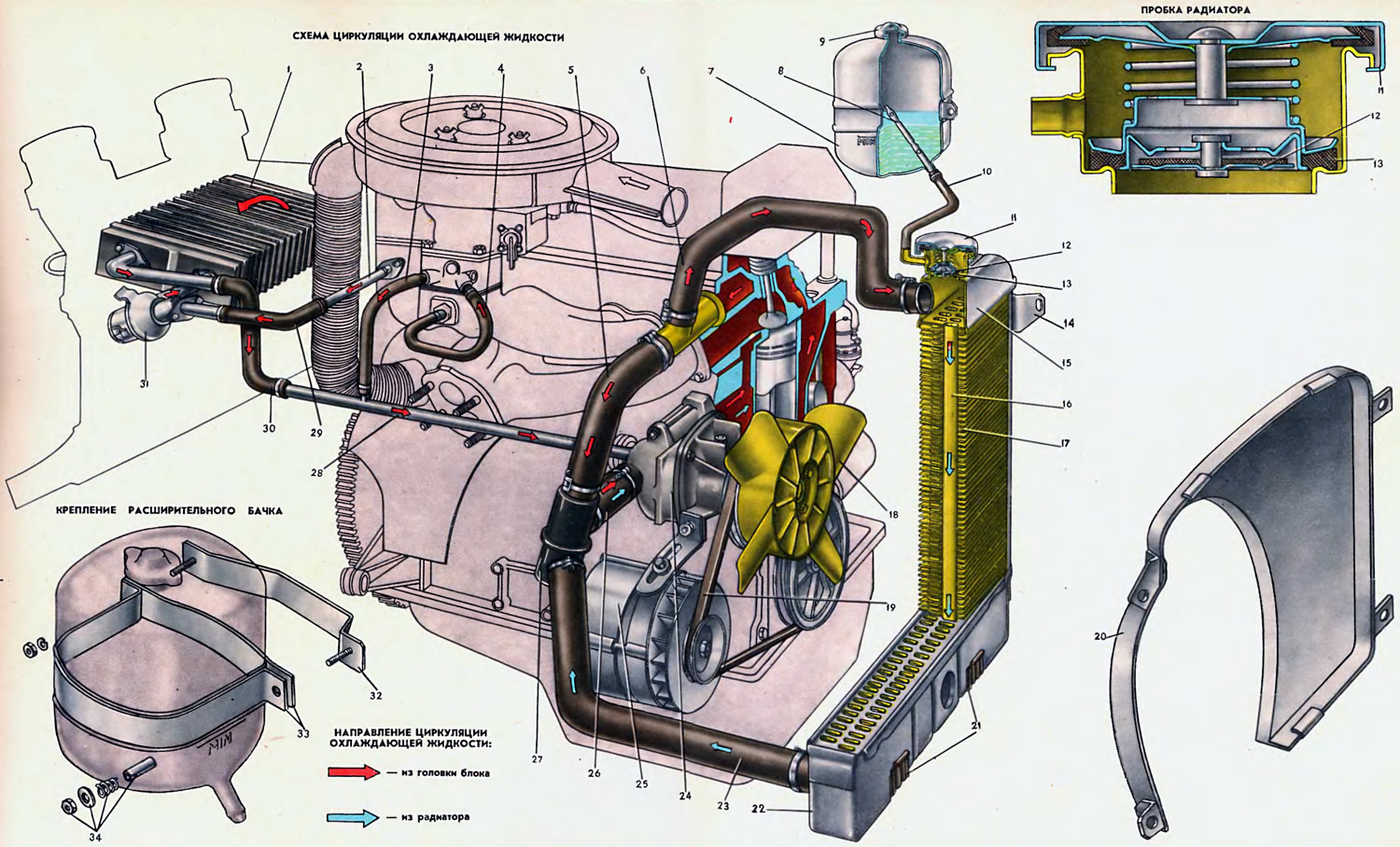
Open large image in new tab »
1. Heater radiator. 2. Heater radiator fluid supply pipe. 3. Fluid drain hose from the carburetor mixing chamber heating system. 4. Fluid supply hose to the carburetor mixing chamber heating system. 5. Fluid supply hose to the thermostat bypass valve. 6. Radiator inlet hose. 7. Expansion tank. 8. Expansion tank tube. 9. Expansion tank plug. 10. Fluid drain tube into the expansion tank. 11. Radiator plug. 12. Plug inlet ventilation valve. 13. Plug outlet valve. 14. Radiator mounting bracket. 15. Upper radiator block. 16. Radiator cooling tube. 17. Radiator cooling plate. 18. Fan. 19. Fan drive belt. 20. Fan shroud. 21. Radiator cushion. 22. Lower radiator tank. 23. Radiator drain hose. 24. Water pump. 25. Generator. 26. Water pump inlet hose. 27. Thermostat. 28. Heater radiator fluid drain pipe. 29. Heater radiator fluid supply hose. 30. Heater radiator fluid drain hose. 31. Heater valve. 32. Expansion tank mounting bracket. 33. Inner and outer expansion tank mounting clamps. 34. Expansion tank mounting parts.
The radiator is a vertical tubular-plate type with two rows of brass tubes 16 and tinned steel plates 17. The upper 15 and lower 22 tanks and their bottoms are made of brass and are connected by soldering to each other, as well as to the tubes and plates. The plates and brackets 14 for fastening the radiator and casing 20, fan 18 are steel and are connected to the flanges of the radiator bottoms by contact welding. The radiator is mounted on the body brackets on two rubber cushions 21 and is secured with two bolts through steel spacers and rubber bushings.
Radiator cap 11 has an outlet 13 and an inlet (ventilation) 12 valves. When heated, the cooling liquid, expanding, flows through the ventilation valve and the outlet pipe 10 into the expansion tank 7. The liquid level in it increases. When the temperature decreases, the reverse process occurs.
When the coolant boils, the capacity of the ventilation valve holes is not enough and under the influence of the increased pressure difference on the valve plate, it closes, disconnecting the cooling system from the expansion tank. The pressure in the system increases, providing a higher coolant temperature and, consequently, greater heat transfer through the radiator.
When the pressure in the system increases above 0.5 kgf/cm², the outlet valve opens and the coolant is discharged into the expansion tank. In this case, excess steam can escape into the atmosphere through a slit in the rubber gasket of the expansion tank plug 9.
Expansion tank 7 is plastic, translucent, and is attached to bracket 32 of the body with two clamps 33, one of which (the outer one) is spring-loaded.
The expansion tank serves to compensate for changes in the volume of coolant that occur when its temperature changes during engine operation, to control the amount of coolant in the system, and also contains a certain reserve of liquid for its natural loss and possible losses during operation.
The expansion tank is connected to the radiator with a plastic tube 10, which is placed on the pipes of the tank and the radiator filler neck when heated and secured with tape clamps.
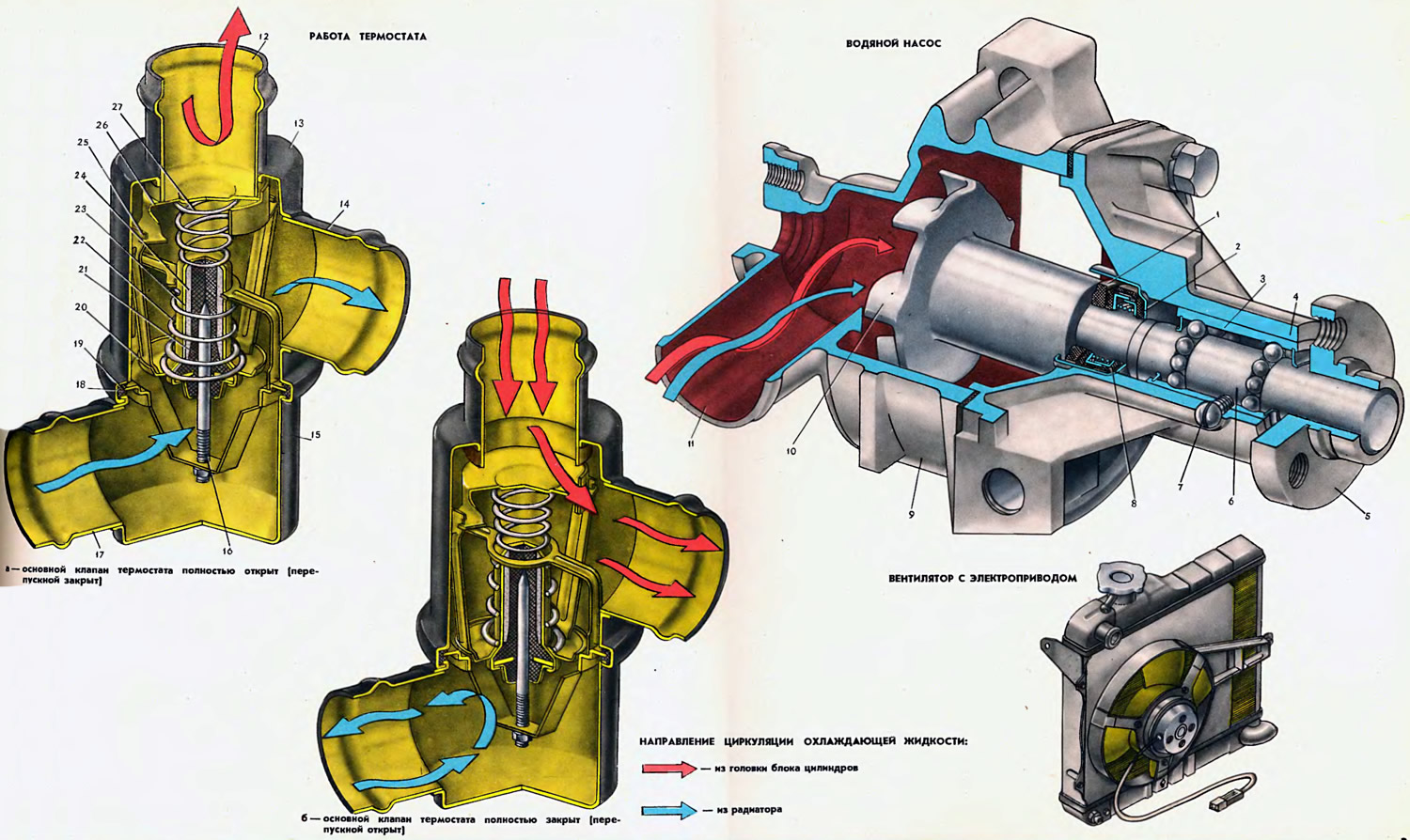
Open large image in new tab »
1. Oil seal ring. 2. Oil seal housing. 3. Bearing outer race. 4. Water pump cover. 5. Fan hub. 6. Water pump shaft. 7. Lock screw. 8. Oil seal cuff. 9. Water pump housing. 10. Water pump impeller. 11. Water pump inlet pipe. 12. Thermostat bypass pipe. 13. Upper thermostat housing. 14. Thermostat outlet (to the pump) pipe. 15. Lower thermostat housing. 16. Thermostat piston. 17. Inlet (from the radiator) thermostat pipe. 18. Main valve seat. 19. Seal. 20. Main valve. 21. Rubber insert. 22. Main valve spring. 23. Thermosensitive element cup. 24. Solid filler. 25. Bypass stand (bypass) valve. 26. Bypass valve. 27. Bypass valve spring.
The water pump is a centrifugal type with a cast iron impeller 10. The end of the impeller, which comes into contact with the sealing ring 1 of the seal, is subjected to high-frequency hardening.
The body 9 and the cover 4 of the pump are cast from an aluminum alloy. The body is cast together with the inlet pipe 11 and the flange for connecting the pipe that drains liquid from the heater radiator.
The pump seal is non-separable and consists of a housing 2, a rubber cuff 8 placed on two telescopic brass collars, and a sealing ring 1 made of graphite composition, pressed to the impeller end by a cylindrical spring through the side walls of the cuff. The seal is pressed into the water pump cover.
The pump bearing is a double-row ball bearing, non-separable. The role of the inner bearing race is performed by the shaft 6, onto which the impeller is pressed on one side, and on the other - the hub 5 of the fan and water pump drive pulley. The bearing is installed in the pump cover and fixed in it with a locking screw 7. The bearing is filled with grease during assembly, and no further lubrication is required.
The fan is plastic and has four blades. The blades are of a wing profile and are unevenly distributed along the hub. The fan is attached to the hub together with the drive pulley with three bolts. To increase the efficiency of the fan, it is equipped with a steel casing that is attached to the radiator and has a cutout at the bottom for mounting and assembly.
The fan and water pump are driven by a V-belt from the crankshaft pulley.
The belt tension is achieved by rotating the generator and is controlled by the deflection value. The deflection should be within 10-15 mm with a force of approximately 10 kgf.
Thermostat and operation of the cooling system
The required thermal mode of the engine is provided by a thermostat. The thermostat of a non-separable design has two inlet pipes: one (lower 17) is connected to the lower tank of the radiator, and the other (top 12) — with a branch pipe that drains the coolant from the cylinder head to the radiator inlet. The thermostat outlet pipe 14 is connected to the pump inlet.
The temperature-sensitive element of the thermostat consists of a cup 23 with a rubber insert 21 rolled into it, wherein a solid filler 24 is placed between the walls of the cup and the insert, and inside the insert there is a polished steel piston 16, fixed in the seat post 18 of the main valve 20. The main valve is put on the cup of the thermoelement and is pressed together with it to the seat by a conical spring 22. Two posts 25 of the bypass valve 26 are fixed to the main valve, which is supported on them in the extreme upper position by a spring 27, resting against the bottom of the cup of the temperature-sensitive element. The seat of the main valve assembled with the temperature-sensitive element, springs 22, 27 and valves 20, 26 is rolled through a rubber seal 19 in two housings: the upper 13 and the lower 15.
When the coolant temperature is below 80 C, the main valve closes the liquid outlet from the radiator. The bypass valve is open and the coolant circulates in a small circle, bypassing the radiator, which ensures rapid engine warm-up.
At temperatures above 80°C, the solid filler, expanding, compresses the rubber insert, forces it to come off the piston and, overcoming the resistance of the main valve spring, moves the thermoelement cup up together with the main valve. The bypass valve also moves up and is pressed by the spring to the end of the inlet pipe. In this case, the direct passage of liquid from the block head to the pump (in a small circle) closes and the liquid begins to circulate through the radiator, cooling intensively.
At temperatures above 94°C the main valve is fully open, the bypass valve is closed and all liquid passes through the radiator; at intermediate temperatures (80-94°C) the coolant circulates through both the main and bypass valves, the degree of opening of which ensures the gradual mixing of the cooled liquid in the radiator with the hotter one coming out of the engine. This achieves the best operating conditions for the engine in terms of temperature conditions.
The engine cooling system includes a body heater 1 and a carburetor throttle body heating system, into which liquid enters through hose 4 from the intake pipe heating jacket and is discharged into the pump through hose 3 and outlet pipe 31 of the heater.
Liquid enters the heater from the cylinder head through pipe 2 and tap 31, and is discharged into the pump through hose 30 and steel pipe 28.
Cooling system with electric fan
On VAZ-2103 vehicles, a fan driven by an individual electric motor is installed in the engine cooling system instead of a fan located on the water pump shaft and driven by a V-belt from the engine crankshaft pulley.
The material is posted on the online resource: www.VazBook.ru
The electric motor with the fan is mounted on three rubber bushings with spacers in a specially designed casing. The casing is attached at three points directly to the radiator, which, unlike a conventional radiator, has modified mounting brackets to the body.
The electric fan is switched off automatically by a sensor installed in the lower radiator tank and a relay. The sensor calibration is selected in such a way that it switches on (when tested on a special stand) at a temperature of 92°C and switches off at 84±2°C.
It should be remembered that the coolant temperature gauge sensor is installed in the cylinder head and its temperature conditions during engine operation are different. Therefore, it is impossible to check the operating temperature of the electric fan switch sensor using the vehicle instrument. The check must be carried out (if necessary) at service stations using special equipment and devices.