




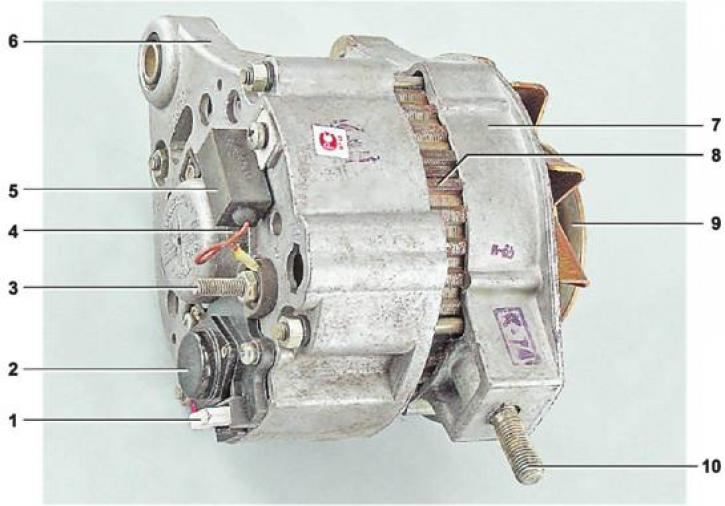
Generator 372.3701: 1 - terminal "B" of the voltage regulator; 2 - voltage regulator; 3 - terminal "30" of the generator; 4 - output "61" (common terminal of additional diodes); 5 - capacitor; 6 - generator rear cover; 7 - Generator front cover; 8 - stator; 9 - pulley; 10 - generator mounting stud to tension bar
The car is equipped with an alternator model 372.3701. It is a three-phase synchronous electric machine with electromagnetic excitation. The generator is mounted on the engine on the right side and is driven by a V-belt from the crankshaft pulley. The generator is bolted to the engine bracket through the holes in the cover lugs and is fastened to the tension bar with a stud.
Some cars are equipped with the 9412.3701 generator, which has a number of design differences: the rectifier unit is located outside the rear cover, the fan impeller is located inside the generator. To reduce brush wear, the contact rings are made of a smaller diameter. The "B+" terminal of the generator is connected to the positive terminal of the battery.
Technical characteristics of generators 372.3701/9412.3701:
| Nominal voltage, V | 14 |
| Maximum output current at 13 V and rotor speed of 5000 rpm, A | 55/80 |
| Power, W | 770/1120 |
| Weight, kg | 4,4/4,9 |
The main parts of the generator 372.3701 are the rotor, stator and covers, cast from aluminum alloy.
Rotor consists of a shaft, on the corrugated surface of which a steel sleeve and steel beak-shaped poles are pressed, which together with the shaft and the rotor sleeve form the core of the electromagnet. The rotor winding is placed on the sleeve between the poles in a plastic frame (excitation winding). The winding terminals are soldered to contact rings mounted on a plastic bushing located on the shaft. At the front end of the rotor shaft, a pulley and impeller of the cooling fan are secured with a nut using a segment key. The rotor shaft rotates in two ball bearings installed in the generator covers. The rear bearing is pressed onto the rotor shaft, and the front bearing is held in the cover by special washers secured with four bolts and nuts.
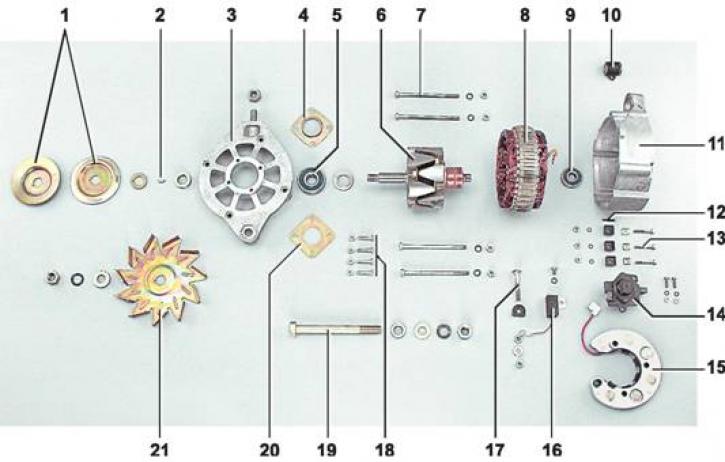
Generator details 372.3701: 1 - pulley; 2 - segment key; 3 - Generator front cover; 4 - outer bearing mounting washer; 5 - Front rotor bearing; 6 - rotor; 7 - tie bolt; 8 - stator; 9 - rear rotor bearing; 10 - buffer bushing; 11 - back cover; 12 - insulating bushings; 13 - bolt; 14 - voltage regulator; 15 - rectifier block; 16 - capacitor; 17 - contact bolt; 18 - bolt; 19 - bolt; 20 - inner bearing mounting washer; 21 - fan impeller
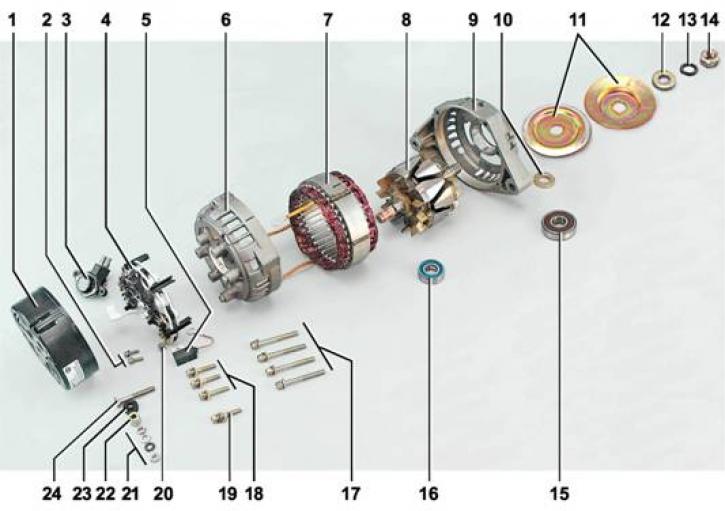
Generator details 9412.3701: 1 - protective cover of the rectifier unit; 2 - voltage regulator mounting screws; 3 - voltage regulator; 4 - rectifier block; 5 - capacitor; 6 - back cover; 7 - stator with windings; 8 - rotor; 9 - front cover; 10 - spacer sleeve; 11 - pulley; 12 - washer; 13 - spring washer; 14 - pulley mounting nut; 15 - front bearing; 16 - rear bearing; 17 - cover tightening bolts; 18 - bolts (with insulating gaskets) fastenings of the rectifier block and stator winding terminals; 19 - bolt (without insulating lining) rectifier block fastenings; 20 - Capacitor mounting screw; 21 - contact bolt fastening elements; 22 - spacer sleeve; 23 - insulating sleeve; 24 - contact bolt
Stator is assembled from 1 mm thick electrical steel plates. A three-phase winding is placed in the grooves on the inner surface of the stator. Each winding consists of six series-connected coils. Some terminals of the phase windings are connected in a star, while others are connected to pairs of diodes of the rectifier unit.
To convert alternating current to direct current, the generator has a built-in rectifier block on six silicon diodes, installed in the rear cover of the generator and secured to it with three bolts. The diode housings are pressed into two aluminum holders for positive and negative diodes, isolated from each other, assembled into a single block. Three diodes have a plus on the housing (positive diodes), the other three are minus (negative diodes). The positive diode holder is equipped with a contact bolt for the generator terminal "30"; the holder is also connected by a wire to the "B" terminal of the voltage regulator. The holder of the negative diodes is connected to the rear cover of the generator - "ground".
[Information taken from the website: VAZbook.ru]
Voltage regulator with a brush holder is made as a non-separable unit and is attached with two screws to the rear cover of the generator. It is designed to maintain the nominal voltage in the vehicle's electrical network regardless of the shaft rotation speed.
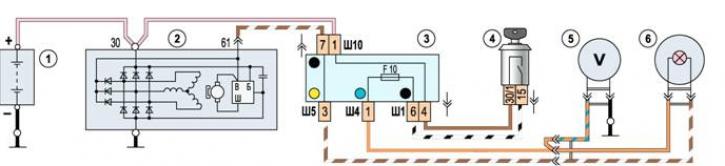
Electrical connection diagram of generator 372.3701: 1 - battery; 2 - generator; 3 - mounting block; 4 - ignition switch (lock); 5 - voltmeter; 6 - Battery charge indicator lamp
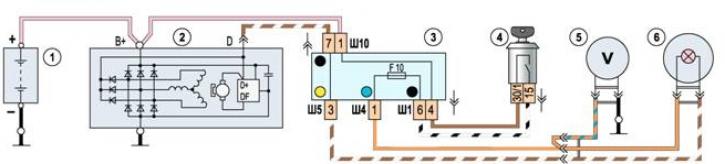
Electrical connection diagram of generator 9412.3701: 1 - battery; 2 - generator; 3 - mounting block; 4 - ignition switch (lock); 5 - voltmeter; 6 - Battery charge indicator lamp
When the ignition is turned on, the voltage to the excitation winding is supplied to the terminal "B" of the regulator through the control lamp of the battery charge. After the engine is started, the excitation winding is powered by three additional diodes located on the rectifier unit. In this case, the current does not pass through the charge lamp and it does not light. A burning lamp signals a malfunction of the generator circuit. The terminals of the additional diodes are connected to terminal "61" of the generator.
A capacitor, secured with a screw on the back cover, is connected to the generator's electrical circuit to suppress radio interference.
Warning! Do not operate the generator with the battery disconnected. This will cause short-term voltages to appear at the "30" terminal of the generator, which may damage the generator voltage regulator and electronic devices in the vehicle's on-board network.