




The internal cavity of the main brake cylinder is divided into two separate chambers by pistons. Each of the chambers serves its own circuit. When the brake pedal is pressed, the pistons of the main brake cylinder begin to move, displacing fluid under pressure from the chambers into the brake pipes, and then into the wheel brake cylinders. Due to the fact that the chambers of the main brake cylinder do not communicate, if one of the circuits is depressurized, the second brake circuit remains operational.
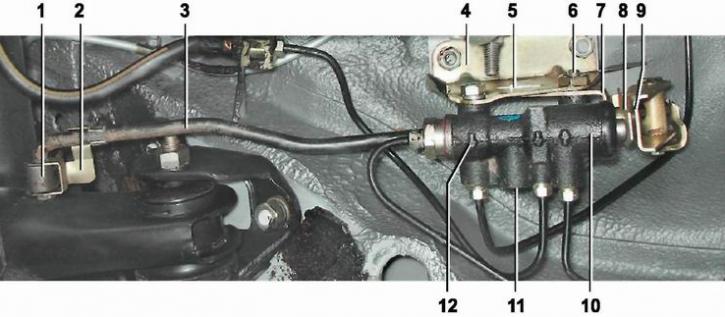
Rear brake fluid pressure regulator: 1 - earring for fastening the elastic lever to the rear axle; 2 - elastic lever retainer in the earring; 3 - elastic lever; 4 - regulator mounting bracket; 5 - protrusion of the plate adjustment bracket; 6 - front regulator mounting bolt; 7 - plate adjustment bracket; 8 - plate; 9 - lever; 10 - regulator; 11 - inspection hole, closed with a plug; 12 - arrow on the regulator body indicating the direction of liquid flow in the connected tube
The force applied to the brake pedal is increased by a vacuum booster, using the vacuum created in the receiver when the engine is running. If the engine stalls while the car is moving, you will have to apply significantly more force to the brake pedal to stop the car.
The tubes leading to the working cylinders of the rear brake mechanisms pass through the pressure regulator. During sharp braking, the load on the front axle of the car increases and the load on the rear axle decreases. At the same time, the grip of the front wheels with the road improves, and the rear wheels deteriorate, and they easily lock, which makes the rear axle of the car prone to skidding. To prevent this from happening, the pressure regulator, when unloading the rear axle, limits the fluid pressure in the cylinders of the rear brake mechanisms and prevents their instant locking.
The regulator body has a control hole closed with a plug. Liquid leakage from this hole indicates that the regulator cuffs are not tight and need to be repaired or replaced.