
English Русский
Български
Беларускі
Український
Српски
Hrvatski
Română
Polski
Slovenský
Magyar
| Articles | Contacts | Sitemap |   
Repair and maintenance Lada Repair and maintenance Mazda Repair and maintenance Mitsubishi Repair and maintenance Toyota Repair and maintenance Land Rover Repair and maintenance Hyundai Repair and maintenance Nissan
VAZbook.ru


Main     1111   2101   2105   2106   2107   2109   2110   2115   2121  
VAZ-2114 (2004-2013) VAZ-2115 (1997-2012)
  • Main
  • «Samara-2»
  • VAZ-2114
  • Chassis
  • Brake system
  • Hydraulic brake drive — bleeding

Hydraulic brake drive — bleeding (VAZ-2114)

            0

We bleed the hydraulic drive of the brake system after its repair, which resulted in a breach of the tightness of the system and if there is a suspicion of air entering the system. In the latter case, you should first determine and eliminate the cause of air entering the hydraulic drive, and only then begin bleeding it. The presence of air in the hydraulic drive of the brake system is determined by the "behavior" of the brake pedal - it becomes "soft" (there is no feeling of support at the end of the pedal stroke) and drops below its normal position.

To complete the work you will need an assistant, as well as:
  • a special key for the bleed nipple or a socket wrench by 8 mm;
  • clear vinyl tube of suitable diameter;
  • brake fluid drain container;
  • new brake fluid recommended by the manufacturer (see "Reference data").
  • inspection pit or overpass (desirable).

Sequence of execution


1. Prepare the car for work (see "Preparing the car for maintenance and repair").

2. Disconnect the wiring harness connector from the low brake fluid level sensor connector and remove the reservoir cap (see "Low Brake Fluid Sensor - Checking and Replacing").

Warning! To prevent air from entering the hydraulic drive of the brake system during bleeding the drive, make sure that the brake fluid level in the reservoir does not fall below the "MIN" mark.


Warning! If the rear axle of the vehicle is suspended (the car is on a lift or supported by stands), the pressure regulator will block the path of brake fluid to the rear wheel cylinders. Therefore, to bleed the rear wheel cylinders, it is necessary to open the regulator valve.


3. To open the pressure regulator valve, insert the blade of a slotted screwdriver between the lever and the plate, pressing the regulator stem down.
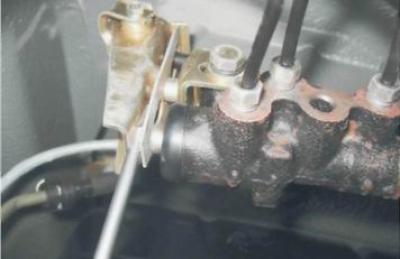
3. To open the pressure regulator valve, insert the blade of a slotted screwdriver between the…


4. Clean the nipple of the rear right wheel brake cylinder and the surface around it from dirt.

5. Remove the protective rubber cap from the bleed nipple.

6. Put a special wrench or open-end wrench on the bleed nipple by 8 mm, and then a clear vinyl tube (the diameter of the tube should be such that it fits tightly on the fitting). We lower the other end of the tube into a transparent container partially filled with brake fluid.
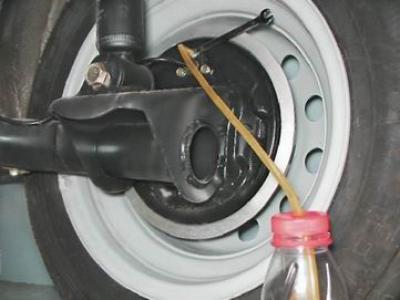
6. Put a special wrench or open-end wrench on the bleed nipple by 8 mm, and then a clear vinyl tube…


7. The assistant presses the brake pedal several times and, after the last press, holds the pedal in the lower position.

8. After loosening the nipple, unscrew it approximately half a turn until liquid begins to come out of the nipple.


9. After the brake fluid stops coming out of the tube, tighten the nipple.

10. The assistant presses the pedal several times again and holds it in the pressed position.

11. Repeat the steps described in points 7 and 8 (see above).

12. Continue bleeding until the brake fluid with air bubbles stops escaping from the cylinder nipple, after which we finally tighten the nipple.

13. Remove the vinyl tube and open-end wrench from the fitting and put a protective rubber cap on the fitting.

14. Next, we bleed the brake cylinder of the front left wheel.
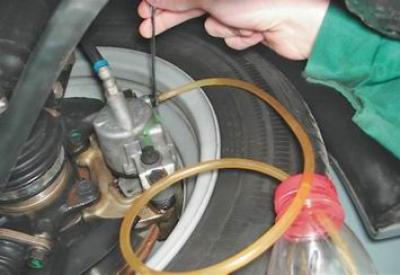
14. Next, we bleed the brake cylinder of the front left wheel.


15. Similarly, we bleed the cylinders of the second circuit: the rear left and front right wheels in the specified order, monitoring the fluid level in the reservoir of the main brake cylinder.

16. Press the brake pedal, check the operation of the hydraulic drive and the absence of fluid leakage from the bleeding nipples. If the pedal is "soft" or it drops below its normal operating position, then re-check the tightness of the system and repeat bleeding the hydraulic drive.


This article is available at russian, bulgarian, belarusian, ukrainian, serbian, croatian, romanian, polish, slovak, hungarian
The text was reviewed by the specialist: Grigory Vologodtsev

Share with friends:

Previous articles
VAZ-2114: Brake system
Next articles

Service brake system drive
Rear Brake Hose — Replacement
Rear Brake Shield — Removal and Installation
Rear Brake Slave Cylinder — Replacement
Rear brake pads — removal and installation
Hydraulic brake drive — brake fluid replacement
Master Brake Cylinder — Removal and Installation
Vacuum brake booster — removal and installation
Brake pedal free play — adjustment
Rear Brake Fluid Pressure Regulator — Adjustment

More articles from other manuals on VAZ cars:
➠ Adjusting the free travel of the brake pedal, bleeding air from… VAZ-2101 (1970-1983)
➠ Hydraulic brake drive — bleeding and replacing brake fluid VAZ-2104 (1984-2012)
➠ Hydraulic brake drive — bleeding and replacing brake fluid VAZ-2106 (1976-2006)
➠ Hydraulic brake drive — bleeding and replacing brake fluid VAZ-2107 (1982-2012)
➠ Hydraulic brake drive — bleeding VAZ-2112 (1999-2007)
Link in different formats to this page


Visitor comments

No comments yet


How much will 19 + 33 ?


VAZ-2114 (2004-2013) 
  • General information
  • Operation and maintenance
  • Power unit
  • Engine repair
  • Cooling system
  • Supply system
  • Control system
  • Exhaust system
  • Transmission
  • Clutch
  • Car gearbox
  • Front wheel drives
  • Chassis
  • Wheels and tires
  • Front suspension
  • Rear suspension
  • Steering
  • Brake system
  • Body
  • Exterior
  • Interior
  • Doors and glass
  • Tailgate
  • Ventilation and heating
  • Electrical equipment
  • Equipment and devices
  • Headlights and lighting
  • Engine electrics
  • Electrical circuits


VAZ-2115 (1997-2012) 
  • General information
  • Vehicle device
  • Operation manual
  • Vehicle malfunctions
  • Car care
  • Power unit
  • Engine repair
  • Cooling system
  • Supply system
  • Control system
  • Exhaust system
  • Transmission
  • Clutch
  • Car gearbox
  • Front wheel drives
  • Chassis
  • Front suspension
  • Rear suspension
  • Steering
  • Brake system
  • Body
  • Exterior
  • Interior
  • Doors, covers and windows
  • Electrical equipment
  • Equipment and devices
  • Headlights and lighting
  • Engine electrics
  • Anti-theft system


VAZbook.ru © 2017 · Mobile version · Contact with administration · Sitemap: EN BG BY UA RS HR RO PL SK HU · Site search · News and articles VAZ-1111 · VAZ-11113 · VAZ-2101 · VAZ-21011 · VAZ-2104 · VAZ-2105 · VAZ-21051 · VAZ-2106 · VAZ-21061 · VAZ-2107 · VAZ-21099 · VAZ-2109 · VAZ-2108 · VAZ-2110 · VAZ-2112 · VAZ-2114 · VAZ-2115 · VAZ-2121 · VAZ-21213 · VAZ-21214 ·
The site stores technical data using cookies to improve the service.