




Open large image in new tab »
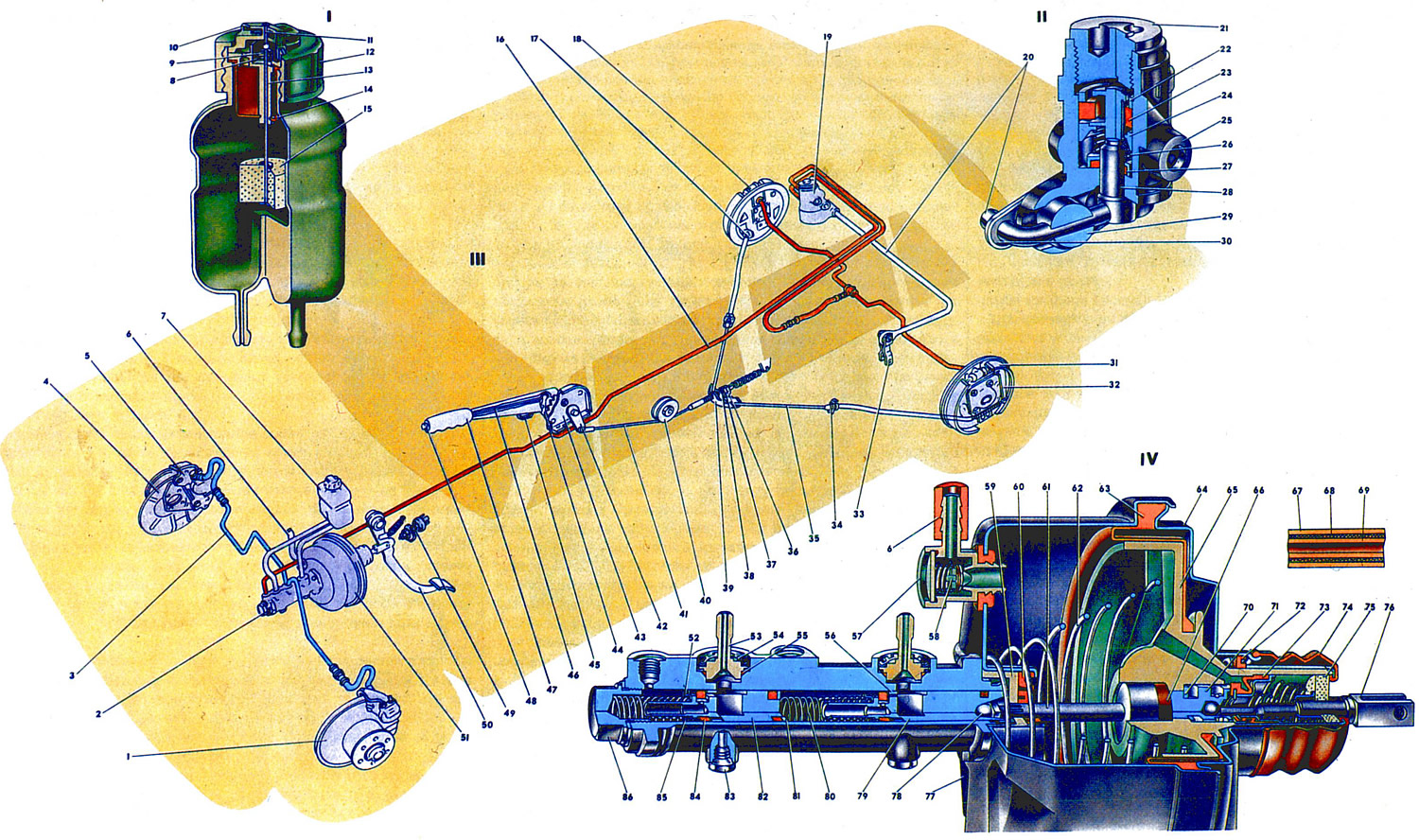
Fig. 27: 1. Brake disc. 2. Brake master cylinder. 3. Front brake drive circuit line. 4. Front brake mechanism protective cover. 5. Front brake caliper. 6. Tip with line. 7. Master cylinder reservoir. 8. Fixed contact. 9. Movable contact. 10. Terminal device housing. 11. Pusher for checking the serviceability of the fluid level control device. 12. Reservoir cover. 13. Contact device housing. 14. Reflector. 15. Float. 16. Rear brake drive circuit line. 17. Flange of the rear end of the cable housing. 18. Rear brake wheel cylinder. 19. Rear brake pressure regulator. 20. Pressure regulator drive lever. 21. Pressure regulator housing plug. 22. Bushing. 23. Piston head seal. 24. Spring plate. 25. Pressure regulator housing. 26. Spring. 27. Piston sealing ring. 28. Pressure regulator piston. 29. Lever axis. 30. Lever plate. 31. Brake shoe. 32. Manual shoe drive lever. 33. Pressure regulator drive lever stand. 34. Cable sheath fastening bracket. 35. Rear cable. 36. Lock nut. 37. Adjusting nut. 38. Bushing. 39. Rear cable guide. 40. Guide roller. 41. Front cable. 42. Parking brake drive return lever. 43. Parking brake drive lever bracket. 44. Lever latch. 45. Parking brake indicator light switch stop. 46. Lever latch rod. 47. Parking brake drive lever. 48. Parking brake drive lever button. 49. Brake light switch. 50. Brake pedal. 51. Vacuum booster. 52. Sealing ring spring plate. 53. Fitting. 54. Lock washer. 55. Sealing gasket. 56. Spacer ring. 57. Vacuum valve housing. 58. Vacuum valve. 59. Rod seal collar. 60. Rod seal. 61. Rod. 62. Valve housing return spring. 63. Diaphragm. 64. Vacuum booster housing cover. 65. Vacuum booster valve housing. 66. Rod buffer. 67. Hose outer casing. 68. Thread casing. 69. Inner casing. 70. Piston thrust plate. 71. Valve piston. 72. Vacuum booster housing cover seal. 73. Vacuum booster valve. 74. Valve housing protective boot. 75. Air filter. 76. Vacuum booster valve tappet. 77. Valve return spring. 78. Valve spring. 79. Vacuum booster housing. 80. Adjusting bolt. 81. Front brake actuator piston. 82. Piston return spring. 83. Thrust washer. 84. Rear brake actuator piston. 85. Piston limit screw. 86. Sealing ring. 87. Sealing ring spring. 88. Master cylinder housing plug. I - Master cylinder reservoir. II - Pressure regulator. III - Brake drive diagram. IV - Master cylinder and vacuum booster.
The vehicle braking system, according to its purpose and functions, is divided into working, spare and parking.
The service brake system ensures the regulation of the vehicle speed and its stopping with the required efficiency, the spare brake system ensures the vehicle stops with the required efficiency in the event of failure of the service brake system, and the parking brake system serves to hold the vehicle when it is parked. It can also be used as an emergency brake system in the event of failure of the service or spare brake system.
The service brake system has a dual-circuit separate hydraulic drive to the brake mechanisms of the front and rear wheels, which significantly increases the safety of the vehicle. If one of the circuits fails, the other is used as a spare brake system, i.e. it is part of the service brake system.
Brake drive
The hydraulic drive includes a brake pedal 50, a vacuum booster 51, a master cylinder 2 of the brake hydraulic drive, a reservoir 7, a rear brake pressure regulator 19, wheel (working) cylinders of the brake mechanisms, pipelines and hoses.
Pedal 15 (see fig. 15) the brake is suspended from the bracket 4 together with the clutch pedal by means of the axis 8. In the pedal hub, split plastic bushings 9 are installed, through which the internal metal bushing 5 passes. The brake pedal rotates relative to this bushing. The pedal is pivotally connected to the vacuum booster pusher and returns to its original position by the force of the release spring. In this position, the pedal stop rests against the buffer of the switch 49 (see fig. 27) brake light.
The vacuum booster reduces the force applied to the brake pedal when braking. It is attached to the clutch and brake pedal bracket plate with four studs and nuts. A rubber insulating gasket is installed between the vacuum booster and the bracket plate.
Between the body 77 and the cover 64 of the vacuum booster body, the outer belt of the rubber diaphragm 63 is clamped, dividing the booster into vacuum and atmospheric cavities. The vacuum cavity is connected to the engine intake pipe via a hose 6 with a tip and valve 58. To seal the connection, the tip 6 is connected to the vacuum booster via a rubber flange.
Inside the vacuum booster there is a plastic valve body 65, the tail of which is sealed with a seal 72 at the outlet from the vacuum booster body. It is installed in the socket of the booster body and is pressed against the flange of the socket by a spacer ring, which is locked by a locking ring. To protect the movable tail of the valve body from contamination, a corrugated protective cover 74 is put on the flanged part of the booster body and on the tail of the valve body.
The valve body 65 contains: buffer 66, piston 71 with pusher 76, rubber valve 73, springs with support cups and air filter 75.
A thrust plate 70 enters the groove of piston 71, the other end of which rests against the belt of diaphragm 63, which prevents it from falling out. Plate 70 fixes the piston in the housing 65 in assembly with pusher 76 and valve 73. Rod 61 of the master cylinder piston drive rests against buffer 66. At the outlet from the vacuum booster housing, the rod is compressed with seal 60, which is pressed by collar 59 to the socket of the booster housing. Bolt 78 is screwed into the end hole of the rod, which regulates the exit of the rod from the booster housing (1.05-1.25 mm) The ball head of the pusher 76 is compressed in the piston seat.
The rubber valve 73 is assembled on a pusher. The movable head of the valve, reinforced with a metal washer, is pressed by a spring through a support cup to the rear end of the piston (when fully released). For the movable head of the valve in the housing 65 there is a seat. The fixed flange of the valve 73 is pressed by a spring through the support cup to the inner wall of the valve housing tailpiece, creating a reliable seal. To clean the atmospheric air, a foam air filter 75 is installed in the valve housing tailpiece. The valve housing 65 is constantly pressed by the spring 62 towards the cover 64. The housing 77 and the amplifier cover are connected to each other by inserting the cover projections into the housing recesses and then turning the cover until its edges are inserted under the housing projections. The connector of the cover and the amplifier housing is sealed by the flange of the rubber diaphragm 63, clamped between them.
A plastic hose tip 6 is attached to the amplifier body through a rubber flange, in which a vacuum valve 58 is mounted, preventing the flammable mixture from entering the vacuum cavity of the amplifier.
The main cylinder 2 of the brake hydraulic drive is attached to the vacuum booster with two studs. Three threaded holes are made in the top of its body for the pipe fittings that drain fluid into the front and rear brake drive circuits, and two sockets in which the fittings connected by hoses to the brake hydraulic drive reservoir are secured with lock washers. The inner cylindrical bore of the cylinder is machined with great precision and high surface purity. On one side, the cylinder cavity is closed with a threaded plug 86. Two pistons are installed in series in the cylinder, one of which actuates the rear brakes, the other - the front ones. Between the plug and piston 82, as well as between pistons 82 and 79, return springs 80 are installed, under the action of which they return to their original position when releasing the brakes. In this case, the stroke of the pistons in the cylinder is limited by screws 83, the tails of which enter the longitudinal grooves of the pistons. Piston 82 of the rear brake drive is sealed in the cylinder by two rings 84. The front ring is pressed to the end surface of the groove by spring 85. The other end of the spring rests against plate 52. The rear ring is pressed to the end of the piston by spring 80 through washer 81.
Piston 79 of the front brake actuator has a similar seal, only the rear ring is located in the piston groove and has a different shape.
Spacer rings 56 are loosely mounted on both pistons. In the initial position of the piston, the spacer ring, resting against the locking screw, moves the sealing ring away from the end of the groove. At the same time, through the resulting gap, the working cavity of the cylinder communicates with the brake hydraulic drive reservoir.
The groove of the front sealing ring communicates with the working cavity of the cylinder through the radial hole and the axial channel in the piston. Therefore, when the fluid pressure in the working cavity increases, the sealing ring is pressed more tightly against the cylinder mirror.
The sequential arrangement of the pistons in the cylinder provides separate drive of the front and rear brakes.
The hydraulic cylinder tank is two-section, made of translucent plastic, which provides visual control over the liquid level. In the lower part of the tank body there are two tips for connecting hoses. A cover 12 is screwed onto the filler neck of the tank, which presses the housing 10 of the terminal device and the reflector 14 to the end of the neck. In the housing 10, a device for monitoring the liquid level in the tank is mounted. It consists of a float 15, on the rod of which a movable contact 9 is located, and a fixed contact 8, fixed in the plastic housing 10. When the liquid level decreases, the float goes down, the contacts close the circuit of the control lamp, and it lights up.
The original source is published on the website [vazbook.ru]
A pusher 11 is installed in the central hole of the terminal device housing; when pressed, the operability of the control lamp circuit is checked when the fluid level in the tank is full.
Pressure regulator 19 is included in the rear brake drive to prevent pressure increase in this circuit when the load on the rear axle of the wheels decreases. Otherwise, the rear wheels may lock and skid. The pressure regulator is attached with two bolts with spring washers to the body bracket, and one hole in the bracket is made oval, which allows you to adjust the position of the pressure regulator.
The pressure regulator is activated by a torsion lever 20, which is attached to the body by a collar 32 (see fig. 23) through the rubber support bushing 33. The long arm of the lever 31 of the pressure regulator drive is pivotally connected through the stand 13 to the rear axle beam, and the short arm passes through the hole in the axle 29 (see fig. 27) and enters the cutout in the lower part of the piston 28 of the pressure regulator. This shoulder transmits the oscillatory movement of the rear axle beam to the piston.
The fittings of two pipelines are screwed into the pressure regulator body: the lower one for supplying fluid from the master cylinder, the upper one for supplying fluid to the wheel cylinders of the rear brakes.
The piston 28 of the pressure regulator at the outlet of the housing is sealed by the ring 27, located in the metal cage. This ring is pressed to the lower part of the housing by the spring 26. The upper end of the spring rests against the floating plate 24 and through it against the piston shoulders. The spring tends to press the piston until it stops against the plug 21, which is screwed into the housing of the pressure regulator. A sealing gasket is installed under the plug. The bushing 22 is loosely put on the piston head. It limits the rise of the seal 23 upwards to the piston head.
The high-pressure hose is three-layered. The inner 69 and outer 67 hose shells are rubber, with a thread shell 68 placed between them. When operating the vehicle, cracks and other damage to the outer shell of the hose are not allowed.