




Contents: Removal ↓ Installation ↓
We replace the cylinder when brake fluid is leaking and when the piston(s) in the cylinder are "sanded", as a result of which one or both pistons stop moving in the cylinder.
To complete the work you will need special key for bleed nipples of working cylinders and nipples of brake pipes.
Removal
1. Prepare the car for work (see "Preparing the car for maintenance and repair").
2. Remove the brake drum (see "Brake drum - removal and installation").
3. Raise the parking brake lever until it stops.
4. Remove the protective rubber cap from the bleed nipple of the working brake cylinder and use a special or open-end wrench by 8 mm (a socket wrench of the same size will also work) we completely unscrew the fitting.
5. Treat the brake pipe nipple with penetrating lubricant.
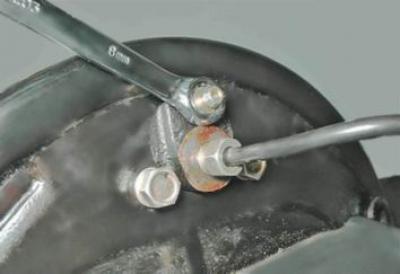
Warning! When performing the following operation, make sure that when unscrewing the nipple, the tube does not rotate with it. If the tube is "stuck" in the nipple, replace it.
6. With a special key by 10 mm loosen the brake pipe fitting.
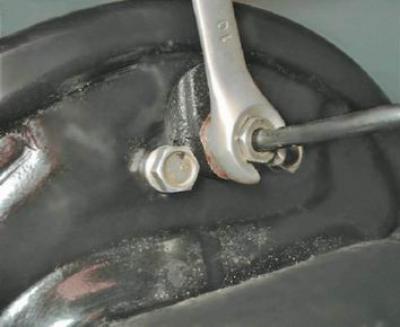
7. Finally, unscrew the fitting with an open-end wrench by 10 mm.
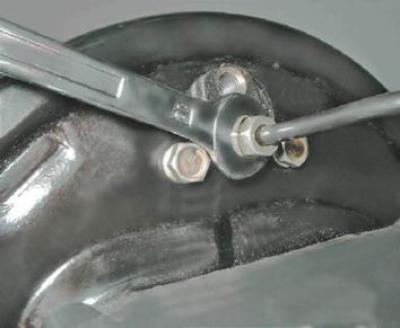
8. Key by 10 mm we unscrew the two bolts securing the working cylinder.
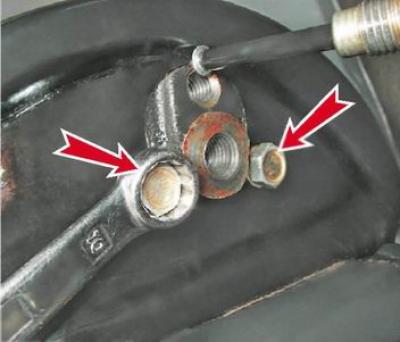
9. To prevent brake fluid from leaking out of the tube, put a rubber cap on the bleed nipple.
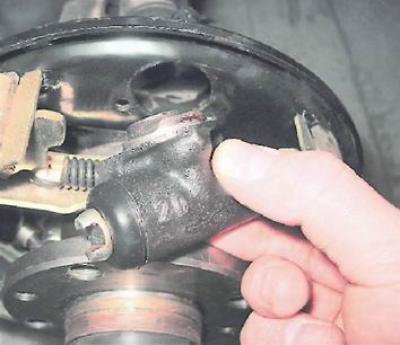
10. Remove the cylinder from the shield.
Installation
1. We clean the brake mechanism parts from dirt and rust, degrease the working surface of the drum, and remove minor oiling of the brake shoe linings using sandpaper.
2. Install the new cylinder in reverse order.
3. Install the brake drum (see "Brake drum - removal and installation")
4. Bleed the brake system (see "Hydraulic brake drive - bleeding") and make sure that the connection between the brake pipe and the working cylinder is tight.