




2. Disconnect the wire from the negative terminal of the battery (see "Battery - Removal and Installation").
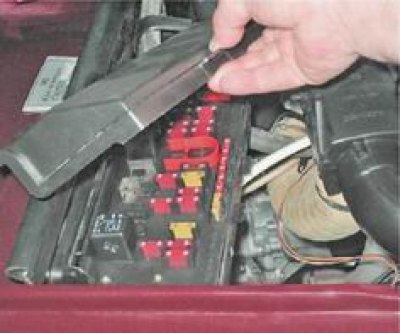
3. To gain access to the fuses and relays, open the cover of the mounting block, overcoming the resistance of the clamps.
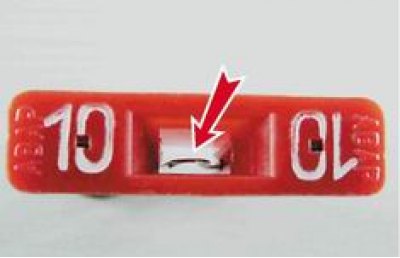
4. A faulty fuse can be identified by a burnt-out thread.
5. Using the tweezers located in the mounting block, we hook the blown fuse and remove it from the contact connector.
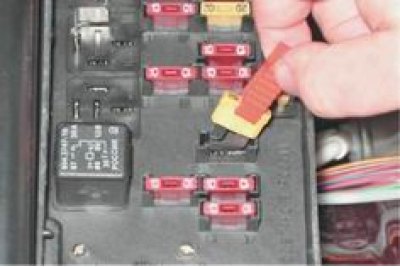
6. We install a working fuse into the contact connector of the unit and, pressing it with a finger, push it in until it stops.
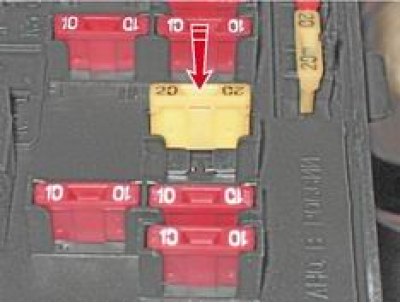
Attention! Before replacing a fuse, it is necessary to check the circuits it protects and eliminate the cause of the fuse blowing. To avoid failure of system elements, fuses with an increased rating or homemade ones cannot be installed.
7. To replace the relay, use tweezers to hook it onto the protrusions on the body and remove it from the contact connector.
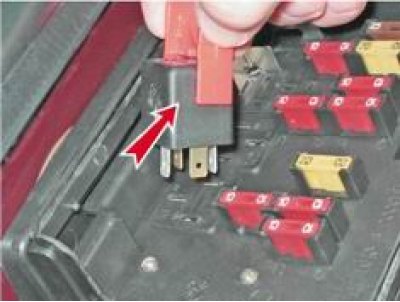
8. We install a working relay into the contact connector of the unit in the same way as a fuse.