




Contents: Key switches ↓ Reverse light switch ↓ Three-lever switch ↓ Brake light switch ↓ Relay ↓ Ceiling light switch ↓ Hazard warning switch ↓ Direction indicator and hazard…↓
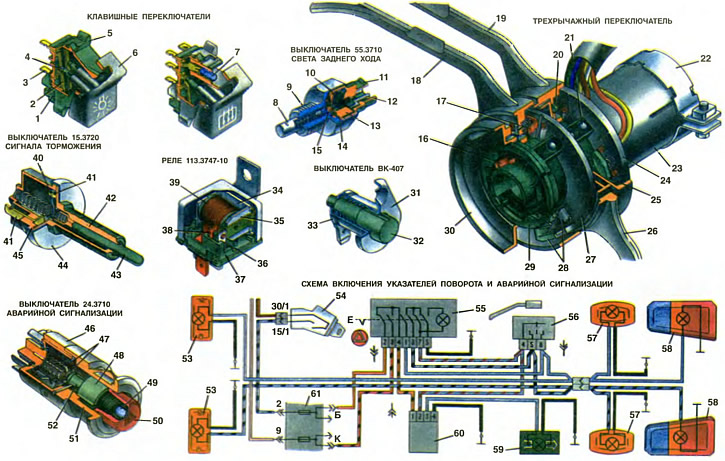
1, 11. Base. 2, 10. Sliding contact plate. 3, 12. Fixed contact plug. 4. 15. Pusher. 5, 9. Housing. 6. Key. 7. Lamp A12-1.2. 8. Rod. 13. Spacer. 14. Membrane. 16. Horn switch contact. 17. Sliding contact of turn signal switch. 18. Turn signal switch lever. 19. Headlight switch lever. 20. Windshield washer switch jumper button. 21. Ball lock. 22. Switch mounting clamp. 23. Bushing. 24. Fixed ring with contacts of headlight switch, windshield wiper and washer. 25. Jumper button of the light signaling switch. 26. Lever of the windshield wiper and washer switch. 27. Fixed ring with contacts of the turn signal switch. 28. Pawls. 29. Hub. 30. Driver ring. 31. Switch housing. 32. Button. 33. Tip. 34. Relay yoke. 35. Relay anchor. 36. Limit post. 37. Relay base. 38. Post connected to the "87" plug. 39. Relay coil. 40. Sliding contact plate. 41. Fixed contacts-plugs. 42. Rod guide. 43, 48. Rod. 44. Casing. 45. 51. Switch housing. 46. Switch base. 47. Contact jumpers. 49. 12 V 1.1 W bulbs. 50. Button. 52. Sleeve. 53. Front direction indicators. 54. Ignition switch. 55. Hazard warning light switch. 56. Direction indicator switch. 57. Side direction indicators. 58. Tail lights. 59. Direction indicator indicator lamp. 60. Direction indicator and hazard warning light flasher relay. 61. Fuse box.
Key switches
On Oka cars, unified key switches of the P147 or 26.3710 type are used. They consist of identical, interchangeable parts and differ only in the number of fixed contacts, contact plates, pushers, and symbols on the keys. The switches can be divided into two groups. The first group is three-position switches (in the picture on the left), having three positions of the key. These include switches: external lighting, heater, and also wiper and washer of the rear window. The second group - two-position switches with a control lamp (in the picture on the right). These are the rear fog light and rear window heating switches. The switches are mounted on the instrument panel and are secured in the socket using spring clips on the housing. To remove the switch, pull it toward you and overcome the force of the spring clips.
The switch has a plastic housing 5, into which a plastic base 1 with fixed contacts 3 is inserted. On the cylindrical projections of the housing, a key 6 swings, having two tubular guides in which pushers 4 with springs are located. The pushers press on the contact plates 2 and, depending on the position of the key, press the upper or middle part of the contact plate to the fixed contacts.
For two-position switches (in the picture on the right) in the upper part of the housing there is a socket into which a miniature baseless lamp A12-1.2 is inserted, and on the key opposite the lamp there is a hole covered with an orange light filter. These switches have only one contact plate and one pusher.
Reverse light switch
Switch 55.3710 is screwed into the gearbox housing, and its rod 8 rests against the reverse gear engagement fork (see chapter 20). The plastic base 11 of the switch with fixed contacts 12 and spacer 13 is rolled into the steel housing 9. A rubber membrane 14 is installed between the housing and the spacer, isolating the contacts from oil that may penetrate from the gearbox.
In the initial position, the movable contact plate 10 is pressed away from the fixed contacts 12 by the spring. When reverse gear is engaged, the fork 7 (see chapter 20) presses on the switch rod 8. The rod, in turn, through the membrane 14 and the pusher 15 presses the plate 10 to the fixed contacts, and they close, turning on the reversing lights in the rear lights.
Three-lever switch
Switch type 21011-3709310 is installed on the steering shaft mounting bracket pipe and is secured to it using clamp 22.
The following are placed on the hub 29 of the switch: a drive ring 30, three movable rings with levers 18, 19, 26 and two fixed rings 24 and 27. The rings are held on the hub 29 by a bushing 23 riveted to the hub 29 with two rivets. The fixed positions of the movable rings are provided by spring-loaded ball locks 21, which enter special sockets in the hub 29.
On the movable rings, sliding contacts 17 are mounted, pressed by springs, closing the fixed contacts mounted on the fixed rings. On the fixed ring 24, in addition, two spring-loaded jumper buttons 20 and 25 of the windshield washer and light signaling switches are mounted.
If you pull the end of the headlight switch lever 19, the opposite side of its movable ring will press button 25 and the light signaling will turn on - high beam headlights. When you release lever 19, its movable ring will take its previous position and the spring will press button 25 away from the fixed contacts - high beam headlights will turn off.
(The article is taken from the website: VAZbook.ru)
The windshield washer switch works in a similar way, with the tip of button 20 passing through a slot in the ring of lever 19 and resting against the ring of lever 26. If you pull the end of lever 26 towards you, the movable ring of the lever will press button 20 and the switch contacts will close - the windshield washer electric motor will turn on.
The turn signal switch has a device for returning the lever to its original position, i.e. for automatically switching off the turn signals after completing the turn. The device consists of a drive ring 30 and two pawls 28 mounted on a fixed ring 27. Two cylindrical projections of the drive ring 30 enter the holes of the steering wheel hub, and therefore the drive ring rotates together with the steering wheel. Pawls 28 are located in a groove of the ring of the lever 18 of the turn signals.
When the turn signals are turned on, the edge of the groove presses on one of the pawls and lifts it to a vertical position. In this case, the pawl allows the drive ring 30 to turn in the direction of the turn, but when the steering wheel returns to its original position, the protrusion on the lower side of the drive ring rests against the pawl and turns it to its previous position. The pawl, in turn, presses on the edge of the groove in the ring of the lever 18 and returns the ring with the lever to its original position - the turn signals are turned off.
Brake light switch
Switch 15.3720 is mounted on the clutch and brake pedal bracket so that rod 43, onto which the plastic buffer is placed, rests against a special pedal platform. Fixed contacts 41, made as a single piece with the plugs, are inserted into plastic housing 45. A movable contact plate 40, closing them, is pressed against them by a spring. The housing together with rod guide 42 is rolled into steel casing 44. Contact plate 40 is pressed away from the fixed contacts under the action of force transmitted through rod 43.
Relay
Relays of type 113.3747-10 are used to turn on the starter and ignition, low and high beam headlights, rear window heating element and to turn on the electric motor of the engine cooling system fan. All these relays are mounted on the bracket behind the fuse box.
On the plastic base 37 of the relay the yoke 34 with the coil 39 is fixed. The output plugs of the relay are also fixed on the base 37. The outputs of the coil winding are connected to the plugs "85" and "86", and the yoke is connected to the plug "30". The contact plate of the anchor 35 in the normal position is pressed against the limiting post 36. When the relay is triggered, the contact plate of the anchor closes with the contact of the post 38, connected to the plug "87". The relay response voltage is no more than 8 V, and the winding resistance is (85±8.5) Ohm.
Ceiling light switch
Switches of the VK-407 type are fixed with screws to the door pillars. They have a stamped steel body 31 and a plastic button 32 with a metal tip 33, to which a wire is connected. When the button is pressed, the tip moves away from the body 31, and the circuit is broken. The same switch, but with a plug turned 90°, is used to turn on the parking brake indicator lamp.
Hazard warning switch
On Oka cars, the hazard warning switch type 24.3710 is used. It is installed on the instrument panel on the left side of the steering column and is held in the socket by two spring-loaded retaining petals located on both sides of the switch housing.
The housing 51 and the base 46 of the switch are made of plastic and are connected to each other by four latches, which are part of the base and fit into the corresponding windows of the housing. Plugs and spring contact petals connected to them are riveted to the base. The rod 48 moves in the housing 51. A lamp 49 is installed in the rod from the front side, covered by a transparent red button 50. On the back side, contact jumpers 47 are fixed on the rod and a bushing 52 is put on with specially shaped grooves, into which a pin pressed into the housing fits. The bushing 52 can rotate freely on the rod. Its purpose is to hold the rod in the pressed position and release it when pressed again.
When the button is pressed, the switch rod moves, compressing the spring, and the contact jumpers 47 close the contact petals, performing the necessary switching. In this case, the end of the pin is hooked onto the shaped stop of the sleeve 52, and the rod is fixed in the pressed position. When the rod is pressed again, the end of the pin is released from the stop of the sleeve, and the spring returns the rod to its original position. Lamp 49 serves to monitor the operation of the emergency signaling system. It flashes synchronously with the direction indicator lamps after pressing the button.
Direction indicator and hazard warning flasher relay
Electronic flasher relay 231.3747 is used to obtain flashing of the turn signal lamps at a certain frequency both when the turn signal lamps are turned on and when the hazard warning lights are turned on, as well as to check the serviceability of the turn signal lamps. Flasher relay 60 is installed under the instrument panel behind the fuse box.
The electronic part of the flasher relay can be divided into two functional units: a rectangular pulse generator and a lamp health control unit. The generator operates both when the turn signal is turned on and when the hazard warning lights are turned on. It produces pulses with a frequency of 90±30 min⁻¹, which are fed to the winding of the electromagnetic relay included in the flasher relay. The contacts of this relay turn the turn signal lamps on and off with the pulse frequency of the generator.
The lamp health monitoring unit operates only when the turn signal is switched on and controls the operation of the 59 turn signal indicator lamp located in the instrument cluster. If the turn signal lamps are in good condition, the indicator lamp flashes synchronously and in phase with the turn signal lamps. If the lamp (21 W) of the front 53 or rear 58 turn signal burns out, the indicator lamp will flash at double the frequency. Burnout of the lamp (4 W) of the side turn signal 57 does not affect the operation of the indicator lamp.