




Elements of the cardan transmission
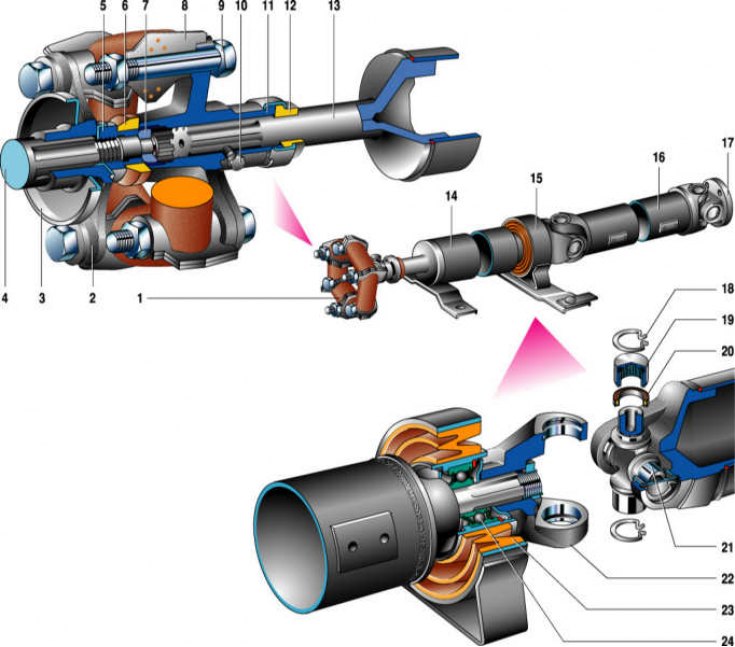
1 – elastic coupling; 2 – secondary shaft flange of the gearbox; 3 – mud deflector; 4 – secondary shaft of the gearbox; 5 – nut; 6 – centering ring seal; 7 – centering ring; 8 – elastic coupling liners; 9 – bolt; 10 – cork; 11 – front propeller shaft flange; 12 – cuff; 13 – splined end of the front propeller shaft; 14 – front propeller shaft; 15 – intermediate support; 16 – rear propeller shaft; 17 – flange fork; 18 – retaining ring; 19 – cardan joint bearing; 20 – cuff; 21 – crosspiece; 22 – fork; 23 – elastic pillow; 24 – intermediate support bearing.
Description of the design
The cardan transmission consists of front and rear cardan shafts, an intermediate elastic support, an elastic coupling, a movable splined connection and two cardan joints. The presence of two cardan joints and a splined connection makes it possible to transmit torque from the gearbox to the main gear at an angle that constantly changes when the suspension is operating.
The cardan shafts are made of thin-walled steel tube. The front shaft has splined ends at both ends, and the rear shaft has cardan joint forks.
The flexible coupling is designed to absorb vibrations and jerks in the cardan transmission. It connects the gearbox and the front cardan shaft through two flanges. Their alignment is ensured by a centering ring on the gearbox shaft and a centering sleeve in the cardan shaft flange.
The intermediate support consists of a radial ball bearing mounted in a bracket inside a rubber insulating cushion. The bracket is secured to the body by a crossbar through vibration-insulating bushings.
The cardan joint consists of two forks fixed on shafts, which are connected to each other by a crosspiece. Needle bearings with sealing cuffs are put on the hollow pins of the crosspiece. The bearings are fixed in the forks by retaining rings.
Currently (since 1988.) cardan shafts are equipped with hinges of increased durability. They are equipped with crosspieces with spikes of increased diameter, stamped housings of needle bearings, radial-end type seals without a metal cage and forks of increased thickness. Modern and previously produced crosspieces are interchangeable, but it is not recommended to install "new" crosspieces in forks of "old" cardan shafts, since this reduces the overall rigidity of the hinges.
Below we will discuss the technology for replacing only the hinges that are currently installed.