




Contents: Cylinder block ↓ Piston ↓ Piston rings ↓ Piston pin ↓ Connecting rod ↓ Crankshaft ↓ Flywheel ↓
The crank mechanism consists of a cylinder block, a piston with a connecting rod, and a crankshaft with a flywheel.
Cylinder block
Cast iron, cast. Block cylinders are divided into 5 classes by diameter (through 0.01 mm). Cylinder class (latin letter) is stamped on the lower plane of the block opposite each cylinder. It is possible to bore the cylinders for repair pistons.
The crankshaft main bearing caps are machined together with the cylinder block, so they are not interchangeable and have marks on the outer surface to differentiate them (see figure 36). The main bearing caps are attached to the block with self-locking bolts, which cannot be replaced with any other ones.
Piston
Cast from aluminum alloy. Pistons are divided into five classes by outer diameter (A, B, C, D, E) through 0.01 mm. The outer surface of the piston has a complex shape: it is conical in height and oval in cross-section. Therefore, it is necessary to measure the piston diameter only in the plane perpendicular to the piston pin, at a distance of 51.5 mm from the piston bottom.
According to the diameter of the hole under the piston pin, pistons are divided into three classes (1, 2, 3) through 0.004 mm. Piston diameter classes 4 (figure 5) and the holes for the piston pin 5 are stamped on the bottom of the piston.
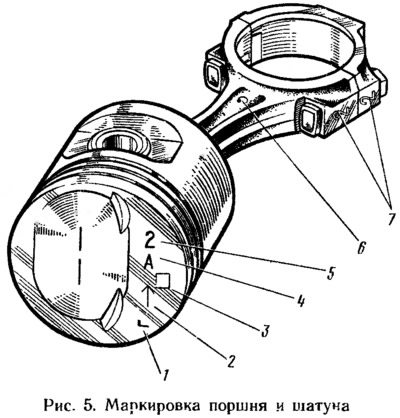
The pin hole is offset from the piston axis by 1.2 mm, so arrow 2 on the piston bottom shows how to correctly orient the piston when installing it in the cylinder. It should be directed toward the camshaft drive, just like hole 6 on the connecting rod for oil outlet.
By weight, pistons are sorted into three groups: normal, increased by 5 g and decreased by 5 g. These groups correspond to marking 1 on the piston crown: "G", "+" and "-". On each engine, both pistons must be of the same group by weight. Pistons of repair sizes are manufactured with an outer diameter increased by 0.4 and 0.8 mm. On the piston crowns, markings in the form of a triangle or square 3 are placed. The triangle corresponds to an increase in the outer diameter by 0.4 mm, and the square - by 0.8 mm.
Spare parts are supplied with pistons of classes A, C, E. These classes are sufficient to select a piston for any cylinder, since pistons and cylinders are divided into classes with some overlapping sizes. For example, a piston of class C can fit cylinders of classes B and D. When repairing engines, pistons are usually replaced in worn cylinders, so a piston of class C can fit a slightly worn cylinder of class B. The main thing when selecting a piston is that the installation gap between the piston and the cylinder is as close as possible to the calculated one (0.025-0.045 mm).
Piston rings
Made of cast iron. Upper compression ring — with chrome-plated barrel-shaped outer surface. Lower compression ring — scraper type. Oil scraper ring — with chrome-plated working edges and expansion spiral spring.
Piston pin
Steel, pressed into the upper head of the connecting rod and rotates freely in the piston bosses. According to the outer diameter, the pins are divided into three classes through 0.004 mm. The class is marked with paint on the end of the pin: blue mark - 1st class, green - 2nd, and red - 3rd class.
Connecting rod
Steel, processed together with the cover, and therefore they are not interchangeable separately. To avoid mixing up the covers and connecting rods during assembly, they are stamped with the number of the 7th cylinder (see figure 5), in which they are installed.
Crankshaft
Cast, cast iron, 3-bearing. It is possible to regrind the crankshaft journals during repairs with a diameter reduction of 0.25; 0,5; 0.75 and 1.00 mm.
The axial movement of the crankshaft is limited by two steel-aluminum thrust half rings. They are inserted into the cylinder block sockets on both sides of the central main bearing. The half rings are manufactured in two sizes - normal and increased by 0.127 mm.
Crankshaft bearing liners are thin-walled, steel-aluminum. Main bearing liners with a groove on the inner surface, connecting rod liners without a groove. Repair liners are made of increased thickness for crankshaft journals, reduced by 0.25; 0,5; 0.75 and 1.00 mm.
Flywheel
Cast iron, with a pressed-on steel toothed rim for starting the engine with a starter. The flywheel is centered by a cylindrical protrusion on the crankshaft flange. Relative to the crankshaft, the flywheel must be installed in a strictly defined position, since it has a balancing lug on one side. Therefore, the flywheel has a hole through which the installation sleeve pressed into the crankshaft flange enters. To control the position of the flywheel, there is an installation mark in the form of a conical hole on its rear surface near the toothed rim. It must be opposite the axes of the connecting rod journals. The flywheel is balanced separately from the crankshaft.