




Note: Operation shown on a vehicle equipped with a closed-loop distributed fuel injection system (exhaust gas neutralizer is missing). Fastening the inlet pipe to the exhaust gas neutralizer see. "Replacing the catalytic converter."
You will need: a screwdriver, a 13 mm socket head, a ratchet, an extension, and a 13 mm wrench.
1. Place the vehicle on a lift.
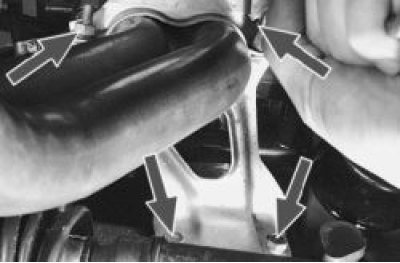
2. Unscrew the two nuts securing the intake pipe to the bracket under the car's bottom. Then unscrew the two bolts securing the bracket to the body and remove the bracket.
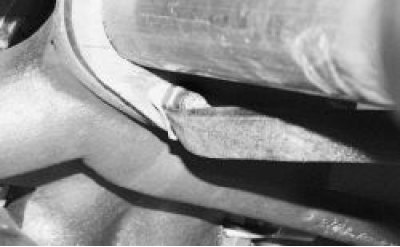
3. Bend back the ends of the locking plates of the nuts securing the inlet pipe to the exhaust manifold.
The original is available on the online resource: VazBook
4. Unscrew the four nuts securing the inlet pipe to the exhaust manifold.
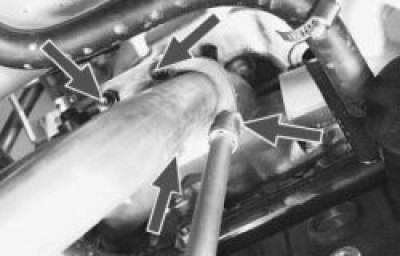
5. Unscrew the two nuts and remove the clamp.
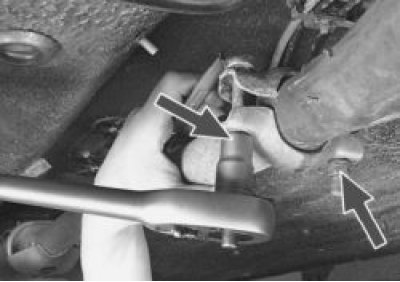
6. Disconnect the exhaust pipe and the resonator pipe by removing the sealing ring. Replace the damaged ring. Remove the exhaust pipe.
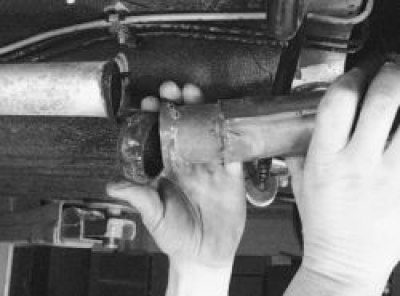
7. Replace the torn or burnt out intake pipe flange gasket.
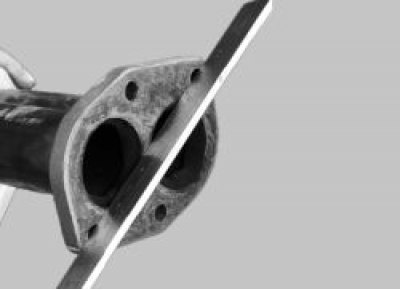
8. Check the flatness of the intake pipe flange. To do this, run the edge of a metal ruler along the surface of the flange. If the ruler does not fit tightly in certain places, the flange is warped and the intake pipe must be replaced.
9. Install the exhaust pipe in the reverse order of removal. When installing, replace the exhaust pipe-to-exhaust manifold mounting nuts and the exhaust pipe gasket. Tighten the exhaust pipe-to-exhaust manifold mounting nuts to a torque of 21–26 N·m (2.1–2.6 kgf·m).
10. After installing the pipe, lock the nuts that secure it by bending the edges of the locking plates.