




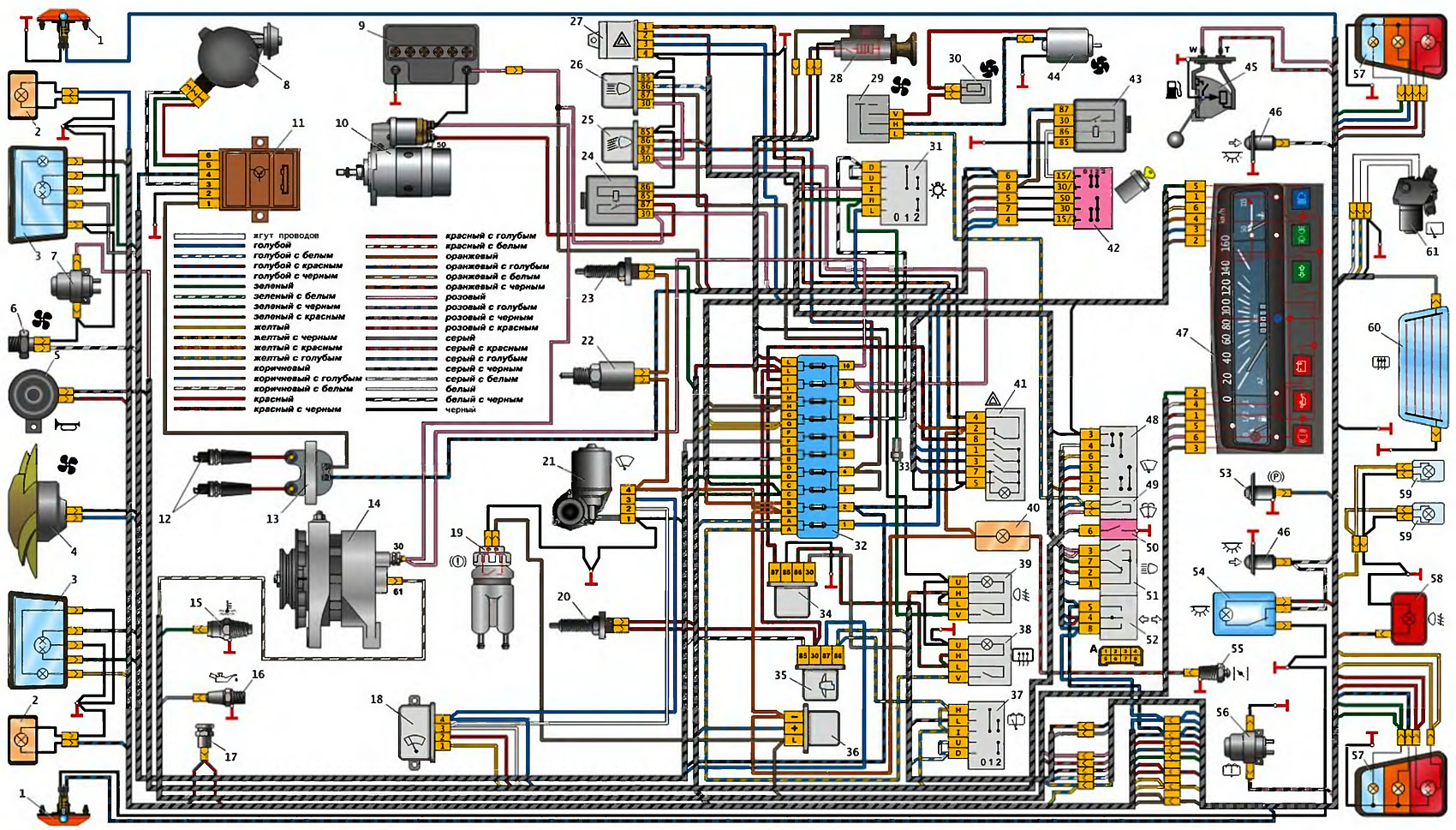
Open large image in new tab »
- 1 - side turn signal repeater
- 2 - front turn signal
- 3 - headlight
- 4 — electric motor of the cooling system fan
- 5 - sound signal
- 6 — fan motor switch sensor
- 7 — windshield washer motor
- 8 — spark timing sensor
- 9 — battery
- 10 — starter
- 11 — switch
- 12 - spark plugs
- 13 - ignition coil
- 14 — generator
- 15 — coolant temperature gauge sensor
- 16 — Low oil pressure warning lamp sensor
- 17 - socket for portable lamp
- 18 — windshield wiper relay
- 19 — brake fluid level sensor
- 20 — brake light switch
- 21 - Windshield wiper motor
- 22 — electromagnetic valve of the carburetor
- 23 — Reverse light switch
- 24 — starter relay
- 25 — low beam headlight relay
- 26 — high beam headlight relay
- 27 — emergency signal and direction indicator relay
- 28 — cigarette lighter
- 29 — Heater fan switch
- 30 — additional resistor of the heater electric motor
- 31 - Outdoor lighting switch
- 32 — fuse box
- 33 - Fog light circuit fuse
- 34 — rear window heating relay
- 35 — relay for switching on the electric motor of the cooling system fan
- 36 — parking brake indicator lamp relay-interrupter
- 37 — Rear window wiper and washer switch
- 38 — rear window heating switch
- 39 — Rear fog light switch
- 40 — carburetor air damper cover control lamp
- 41 — hazard warning switch
- 42 - ignition switch
- 43 — ignition relay
- 44 — heater fan electric motor
- 45 — fuel level indicator sensor
- 46 - Ceiling light switch in the door pillar
- 47 — instrument cluster
- 48 - Windscreen wiper switch
- 49 - Windshield washer switch
- 50 - Sound signal switch
- 51 — headlight switch
- 52 - direction indicator switch
- 53 — Parking brake indicator lamp switch
- 54 — interior light
- 55 — carburetor air damper cover control lamp switch
- 56 — rear door glass washer motor
- 57 — rear light
- 58 - rear fog light
- 59 — license plate light
- 60 — rear door glass heating element
- 61 — Rear door glass wiper motor
- A - the order of numbering of contacts in the connection blocks
Most circuits are activated by the ignition switch. They are always energized (regardless of the position of the key in the ignition switch) power supply circuits for the brake light horn, cigarette lighter, interior light, portable lamp socket, as well as power supply circuits for the hazard warning lights, side lights, license plate lights and high beam headlights.
Most of the vehicle's electrical power circuits are protected by fuses installed in the fuse box under the instrument panel to the left of the steering column. The fog light is protected by a separate fuse (8 A) located in the wire near the fog light switch. The battery charging circuit, ignition and engine starting circuits, and high and low beam headlight relays are not protected by fuses.
There are ten fuses in the block (seven for 8 A and three for 16 A - 1st, 9th and 10th). Their numbers are indicated on the plastic cover of the block. In addition to the fuses, the electrical system also has thermo-bimetallic fuses of multiple action in the windshield and rear window wipers, as well as headlights.
Before replacing a blown fuse, it is necessary to find out the reason for its blown fuse and eliminate it. Fuses that are not provided for by the vehicle design are not allowed to be used. When searching for a malfunction, it is recommended to look at the circuits specified in Table 18 that this fuse protects.
When repairing a vehicle and its electrical system, it is essential to disconnect the wire from the negative terminal of the battery.