




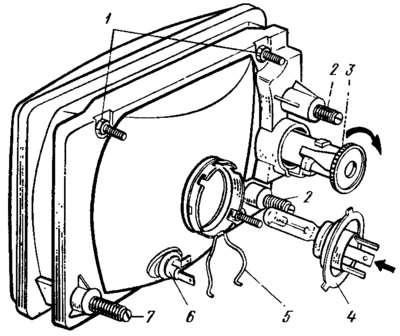
Figure 161. Adjusting screws and headlight bulb: 1 - headlight mounting screws; 2 — screws for adjusting the light beam in the vertical plane: 3 — set screw; 4 — headlight bulb; 5 - pressure latch; 6 — side light bulb socket; 7 — screw for adjusting the light beam in the horizontal plane.
I install a fully fueled and equipped vehicle with a load of 735 N on the driver's seat! on a flat horizontal platform 5 m from a smooth wall or any screen (shield size about 2X1 m) so that the axis of the car is perpendicular to it.
Before marking the screen, make sure the tire pressure is correct and then rock the car from the side to settle the suspension springs.
They draw on the screen (figure 162) vertical lines: axial 0 and lines A and B passing through the points corresponding to the centers of the headlights. These lines must be symmetrical relative to the center line of the car. At a height corresponding to the distance of the centers of the headlights from the floor, line 1 is drawn and below it by 65 mm line 2 of the centers of the light spots. Turn the adjusting screws 3 (see figure 161) to the far left position.
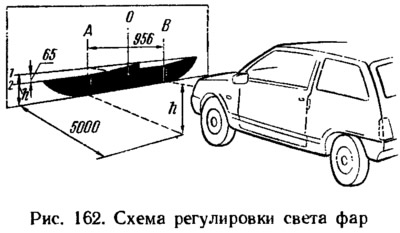
Turn on the low beam headlights. Sequentially, first for the right headlight (the left one is covered with a piece of cardboard or dark fabric or turned off), and then for the left (the right one is closed) adjust the light beams of the headlights with screws 2 and 7. For correctly adjusted headlights, the upper border of the light spots should coincide with line 2 (see figure 162), and the points of intersection of the horizontal and inclined sections of the light spots are with points E.
Three-lever switch
The switch is secured with a clamp to the steering shaft bracket. To remove a damaged switch, remove the steering wheel and then the two halves of the steering shaft trim. Remove the instrument cluster and disconnect the switch wires from the vehicle's wiring harness.
Loosen the mounting clamp and remove the switch.
Direction indicator and hazard warning flasher relay
Relay-breaker 8 (see figure 160) is designed to receive an intermittent light signal of the direction indicators both in the emergency signaling mode and in the direction indicator mode, as well as to check the serviceability of the direction indicator lamps. If the lamps are in good condition, then in the direction indicator mode the flasher relay creates a flashing of the control lamp 7.
If the lamps are faulty (burnout or break in the lamp circuit), then the flasher relay ensures the indicator lamp flashes at a double frequency. The flasher relay is installed under the instrument panel on the left side. A faulty flasher relay cannot be repaired and should be replaced with a new one. The flasher relay must ensure the direction indicator lamps flash at a frequency of 90±30 cycles per minute at a nominal load of 92 W, an ambient temperature of -40 to +55°C and a supply voltage of 10.8 to 15 V.
Relay for switching on headlights and other consumers
To turn on the headlights, relays of type 113.3747-10 are used, installed under the instrument panel on the left side together with other relays and fuses. The same relays are also used to turn on the starter, rear window heating and the electric motor of the engine cooling system fan, as well as to turn on the ignition. The relay turn-on voltage at a temperature of (23±5)°C is 8 V, and the winding resistance is (85±8.5) Ohm.