




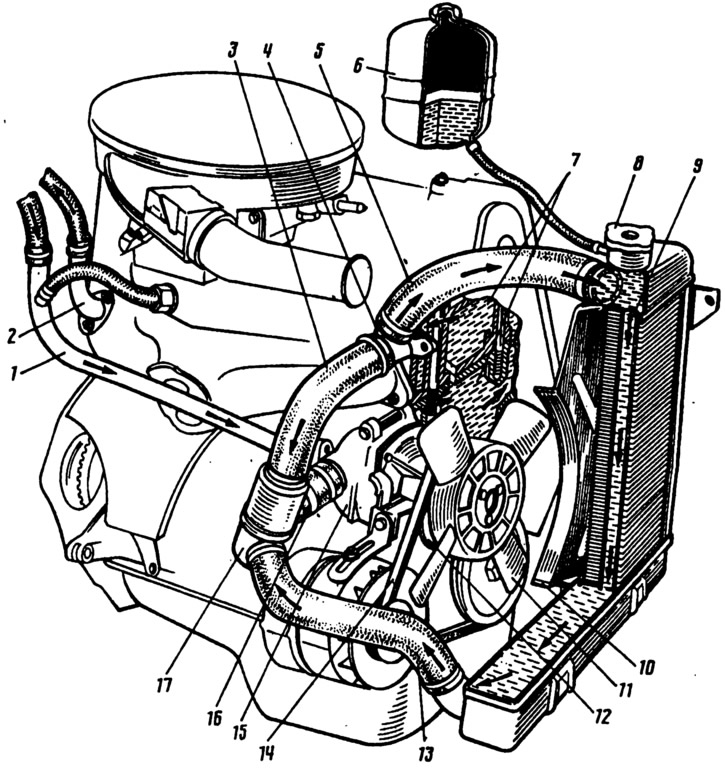
Fig. 27. Cooling system:
1 - pipe for draining liquid from the heater radiator and the heating jacket of the intake manifold; 2 - pipe for supplying liquid to the heater radiator; 3 - bypass hose; 4 - cooling jacket outlet pipe; 5 - radiator supply hose; 6 - expansion tank; 7 - cooling jacket of the cylinder head and block; 8 - radiator cap; 9 - radiator pipe; 10 - fan casing; 11 - fan; 12 - Coolant pump drive pulley; 13 - radiator drain hose; 14 - pump and generator drive belt; 15 - Coolant pump; 1b - coolant supply hose to the pump; 17 - thermostat.
To monitor the coolant temperature, there is a sensor installed in the cylinder head and an indicator on the instrument panel.
Coolant pump. Centrifugal pump (Fig. 28) with V-belt drive from the crankshaft pulley. On VAZ-2105, VAZ-2104 and their modifications, the 2101 engine coolant pump is installed.
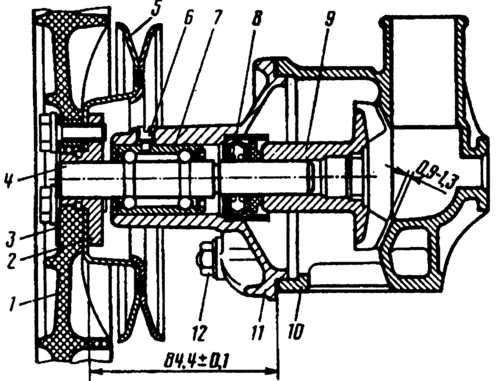
Fig. 28. Coolant pump:
1 - fan; 2 - pulley hub; 3 - overlay; 4 - shaft 6 - bearing lock screw; 7 - bearing; 8 - oil seal; 9 - impeller; 10 - body; 11 - lid; 12 - pump cover fastening nut.
Radiator. The radiator is mounted on two rubber supports (cushions) and is attached to the front of the body with four bolts. It consists of upper and lower stamped brass tanks, two rows of brass tubes and tinned cooling plates. The filler neck is closed with a plug and connected with a hose to the expansion tank. A drain plug is screwed into the lower tank of the radiator.
The radiator cap has an inlet and outlet valve, through which the radiator is connected by a hose to the expansion tank. The inlet valve is not pressed against the gasket (gap 0.5-1.1 mm) and allows the release and entry of coolant from the expansion tank during heating and cooling.
Since 1988, radiators with aluminum cores made of two rows of horizontal round aluminum tubes and aluminum cooling plates have been installed on the engines of VAZ-2105 and VAZ-2104 cars. The radiator is two-pass with plastic tanks and pipes for connecting hoses. One of the tanks has a partition. The radiator is disassemblable, the core is attached to the tanks through sealing rubber gaskets. To improve the efficiency of liquid cooling, the aluminum cooling plates are stamped with a notch, and plastic turbulators in the form of corkscrews are inserted into some of the tubes. All this ensures turbulent movement of air and liquid in the tubes.
It is important to remember that it is not recommended to use water as a coolant in the cooling system with aluminum radiators in order to prevent corrosion of the aluminum tubes.