

Cooling system - liquid closed type with forced circulation of liquid, with expansion tank 2 (pic. 31). It consists of a coolant pump 16, a non-separable thermostat 25, an electric fan, a radiator with an expansion tank 2, pipelines, hoses, drain plugs and cooling jackets for the cylinder block and block head. The rotation of the pump is carried out from the toothed belt 17 of the camshaft drive.
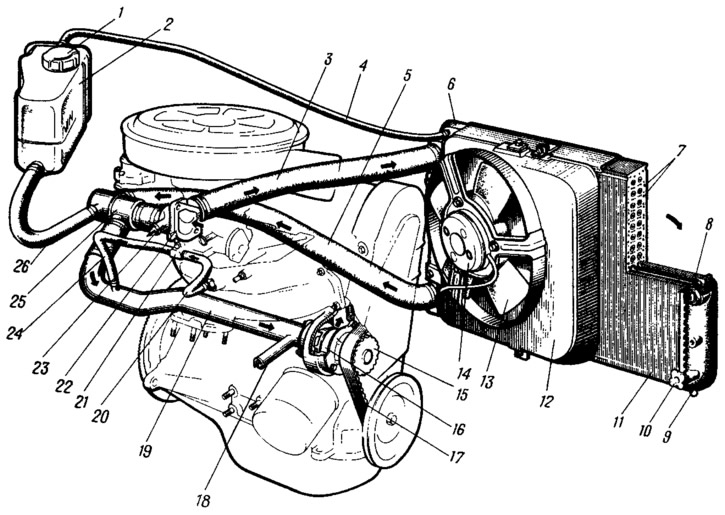
Pic. 31. Cooling system:
1 - plug of the expansion tank; 2 - expansion tank; 3 - radiator inlet hose; 4 - hose from the radiator to the expansion tank; 5 - radiator outlet hose; 6 - left radiator tank; 7 - radiator tubes; 8 - sensor for turning on the electric fan; 9 - right radiator tank; 10 - drain plug; 11 - radiator core; 12 - casing of the electric fan; 13 - electric fan impeller; 14 - electric motor; 15 - toothed pump pulley; 16 - coolant pump; 17 - toothed belt; 18 - outlet pipe of the heater radiator; 19 - inlet pipe of the pump; 20 - hose for removing fluid from the heating of the inlet pipeline to the carburetor heating unit; 21 carburetor heating block; 22 - outlet pipe; 23 - inlet pipe to the heater radiator; 24 - hose for draining liquid from the heating of the inlet pipeline and the carburetor heating unit; 25 - thermostat; 26 - hose from the expansion tank to the thermostat.
The cooling system is filled with liquid Tosol A-40M, which does not freeze up to a temperature of minus 40°C and excludes the formation of scale in the system. The fluid is an ethylene glycol mixture with anti-corrosion and anti-foam additives. The density of the coolant Tosol A-40M is 1.078... 1.085 g / cm3. If it is necessary to lower the freezing point, Tosol-AM or Tosol-A liquids are used, the addition of which increases the density of the liquid and lowers the freezing point.
The capacity of the system, including the interior heater, is 7.8 liters. The liquid level in the system must be 25... 30 mm above the mark «MIN» on the translucent expansion tank 2, which allows you to visually control the level. The check is carried out on a cold engine. If necessary, the liquid is added to the expansion tank.
The temperature of the liquid in the cooling system of a warm engine at an ambient temperature of 20... 30°C with full load and when driving at a speed of 90 km / h should not exceed 95°C. To control the temperature, there is a sensor that is screwed into the cooling jacket of the cylinder head. The liquid temperature gauge is installed on the instrument cluster in the cabin.
When the engine is running, the heated liquid enters through the outlet pipe 22 through the hose 3 into the radiator for cooling or into the thermostat 25, depending on the position of the valves of the latter. Next, the coolant pump 16 is sent to the engine cooling jacket. Through hoses 20 and 24, fluid circulates, the combustible mixture is heated in the inlet pipeline and the throttle zone of the first chamber of the carburetor is heated.
The heater radiator of the car interior is connected to the cooling system through pipes 18 and 23 with hoses.