




Open large image in new tab »
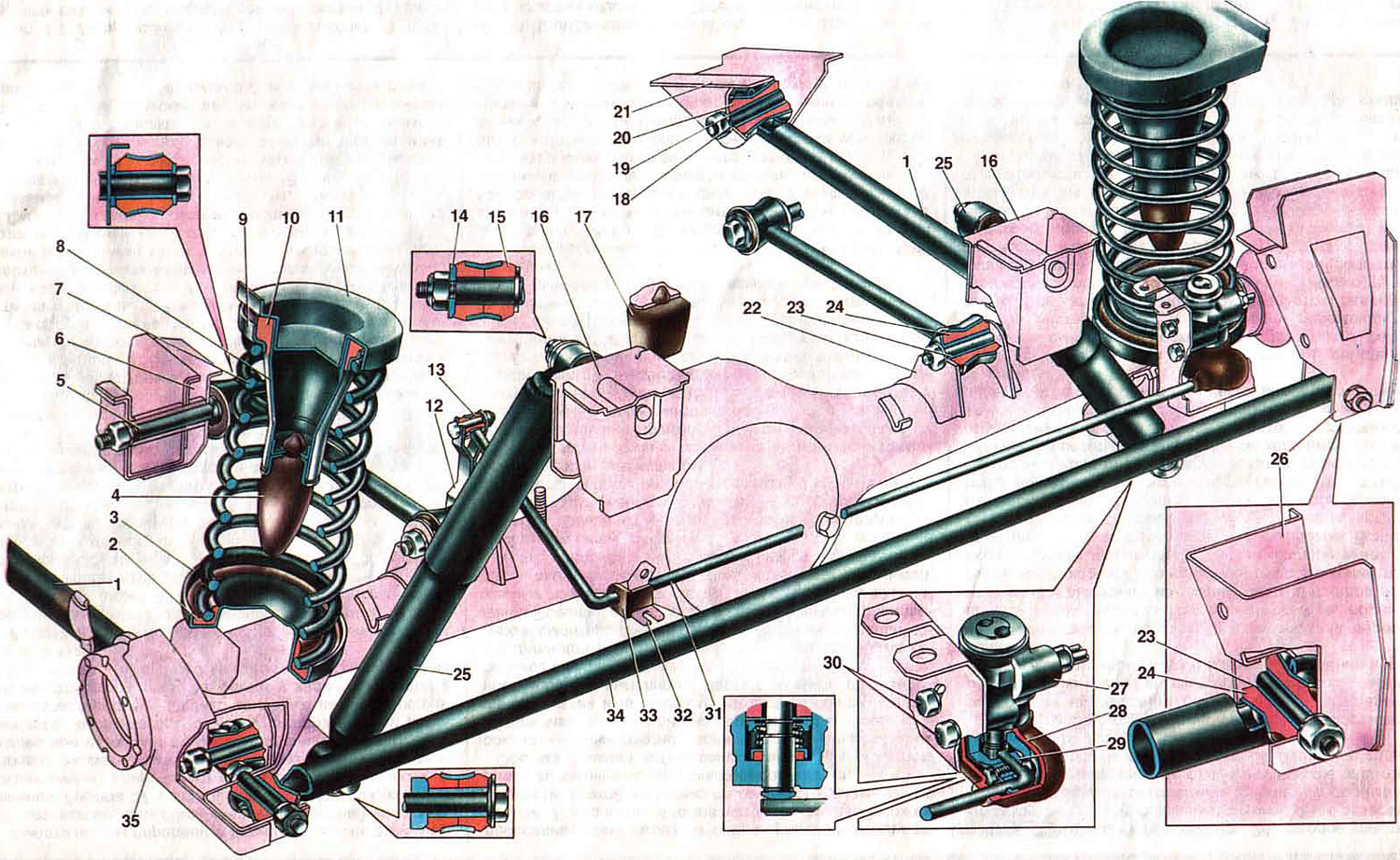
Fig. 22. Rear suspension.
1. Lower longitudinal bar; 2. Lower suspension spring isolator; 3. Lower support cup of suspension spring; 4. Compression stroke buffer; 5. Upper longitudinal rod mounting bolt; 6. Upper longitudinal rod mounting bracket; 7. Suspension spring; 8. Compression stroke buffer support; 9. Upper spring gasket race; 10. Upper spring insulating gasket; 11. Upper support cup of suspension spring; 12. Pressure regulator drive lever stand; 13. Rubber bushing of the pressure regulator drive lever; 14. Shock absorber mounting stud washer; 15. Rubber bushings of shock absorber eye; 16. Rear shock absorber mounting bracket; 17. Additional compression stroke buffer; 18. Spacer sleeve washer; 19. Lower longitudinal rod spacer sleeve; 20. Rubber bushing of the lower longitudinal rod; 21. Lower longitudinal rod mounting bracket; 22. Bracket for fastening the upper longitudinal rod to the bridge beam; 23. Spacer sleeve of transverse and longitudinal rods; 24. Rubber bushing of the upper longitudinal and transverse rods; 25. Rear shock absorber; 26. Bracket for fastening the crossbar to the body; 27. Brake pressure regulator; 28. Protective cover for pressure regulator; 29. Pressure regulator drive lever axis; 30. Pressure regulator mounting bolts; 31. Pressure regulator drive lever; 32. Lever support sleeve housing; 33. Support sleeve; 34. Crossbar; 35. Crossbar mounting bracket support plate.
1. Lower longitudinal bar; 2. Lower suspension spring isolator; 3. Lower support cup of suspension spring; 4. Compression stroke buffer; 5. Upper longitudinal rod mounting bolt; 6. Upper longitudinal rod mounting bracket; 7. Suspension spring; 8. Compression stroke buffer support; 9. Upper spring gasket race; 10. Upper spring insulating gasket; 11. Upper support cup of suspension spring; 12. Pressure regulator drive lever stand; 13. Rubber bushing of the pressure regulator drive lever; 14. Shock absorber mounting stud washer; 15. Rubber bushings of shock absorber eye; 16. Rear shock absorber mounting bracket; 17. Additional compression stroke buffer; 18. Spacer sleeve washer; 19. Lower longitudinal rod spacer sleeve; 20. Rubber bushing of the lower longitudinal rod; 21. Lower longitudinal rod mounting bracket; 22. Bracket for fastening the upper longitudinal rod to the bridge beam; 23. Spacer sleeve of transverse and longitudinal rods; 24. Rubber bushing of the upper longitudinal and transverse rods; 25. Rear shock absorber; 26. Bracket for fastening the crossbar to the body; 27. Brake pressure regulator; 28. Protective cover for pressure regulator; 29. Pressure regulator drive lever axis; 30. Pressure regulator mounting bolts; 31. Pressure regulator drive lever; 32. Lever support sleeve housing; 33. Support sleeve; 34. Crossbar; 35. Crossbar mounting bracket support plate.
The rear wheel suspension is dependent, since both wheels are connected to the body by the rear axle beam, which is attached to the body by four longitudinal and one transverse rod. The longitudinal rods transmit pushing and braking forces from the wheels to the body, and the transverse rod holds the body from lateral displacements. The beam assembled with the rods constitutes the suspension guide device.
Both the longitudinal and transverse rods are pivotally connected to the body brackets at one end, and to the rear axle beam brackets at the other. Each rod is made of a steel pipe, to the flattened ends of which the heads are welded. The rod heads have conical holes, into which rubber-metal hinges are pressed. The hinge joints are identical in design, differing only in size. Each hinge consists of a rubber bushing 24, into the hole of which a metal bushing 23 is installed, through the hole of which the rod mounting bolt passes. The front heads of the longitudinal rods are fastened with bolts with self-locking nuts to the body brackets. The rear heads of these rods, as well as the heads of the lower longitudinal rods, are fastened with bolts with nuts and spring washers.
Brackets for attaching the parking brake cable are welded to the lower longitudinal bars.
When tightening the rod mounting nuts, the spacer bushings 19 and 23 are tightly fitted to the bracket cheeks, which prevents the spacer bushings from turning on the mounting bolts. Rubber bushings 20 and 24 also cannot turn in the rod heads, as they have a tight fit in them.
To prevent premature wear of the rod joints, they are tightened to a torque of 80 N·m (8 kgf·m) under a load that ensures a distance of 125 mm from the rear axle beam casing to the body side member.
When the body or rear axle beam oscillates, the rods swing due to the elastic deformation of the rubber bushings without them slipping. The rubber bushings ensure silent operation of the suspension and do not require lubrication.
The elastic element of the suspension is the springs 7, installed between the body and the rear axle beam. The lower end of the spring rests against the lower support cup 3 through the plastic insulating gasket 2. The support cup is welded to the rear axle beam. The upper end of the spring rests against the upper support cup 11, welded to the body. Between the support cup and the spring, a rubber gasket 10 is installed, located in a stamped steel collar 9. Insulating gaskets 10 and 2 reduce the transmission of noise and vibrations from the rear axle beam to the body.
Rear suspension springs under a load of 2950 N (295 kgf) are divided into two groups: A - length over 273 mm, B - length equal to or less than 273 mm. Group A springs are marked with yellow paint on the outer side of the coils, and group B - with green paint.
[The material is posted on the online resource: VAZbook.ru]
Both suspensions must be equipped with springs of the same group. In exceptional cases, it is permissible to install springs of group B on the rear suspension, but only springs of group A must be installed on the front suspension.
The damping device of the suspension consists of two double-acting hydraulic shock absorbers. Each shock absorber is attached with one head to the body bracket, the other to the rear axle beam bracket. Two rubber bushings 15 are installed in the heads of the shock absorbers. In the lower head, a steel bushing passes through the hole in the rubber bushings, which is clamped between two steel washers.
When the suspension oscillates, the shock absorber hinges are elastically deformed and, like other hinge joints of this type, are not lubricated.
The upward travel of the rear axle beam is limited by two main buffers 4 of the compression stroke and an additional 17. The main buffer of the compression stroke is located inside the spring and is secured with a mushroom-shaped nipple in the upper support cup. The additional buffer is secured in the same way on a bracket, which is bolted to the bottom of the body. During the compression stroke, the main buffers rest against the lower support cups 3, the additional one - against the platform of the rear axle beam. The compression stroke of the suspension is 75 mm, and the recoil is 135 mm.
The torsion arm 31 of the pressure regulator drive is pivotally attached to the bracket of the rear axle beam through the pillar 12. The supports for the arm 31 are: on one side, the collar 32 with the support sleeve 33, attached to the cross member of the body floor, and on the other - the axle 29, which is installed in the holes of the lugs of the housing of the pressure regulator 27. The short arm of the lever 31 passes through the radial hole of the axle 29. To fix this arm of the lever, a plate is used, through the hole of which the lever 31 passes, and the plate itself is fastened with a bolt to the end of the axle 29. With such a connection of the parts, the lever 31 rotates together with the axle and the plate relative to the holes of the axle. The cavity of the pressure regulator is closed with a rubber protective cover 28.