




Open large image in new tab »
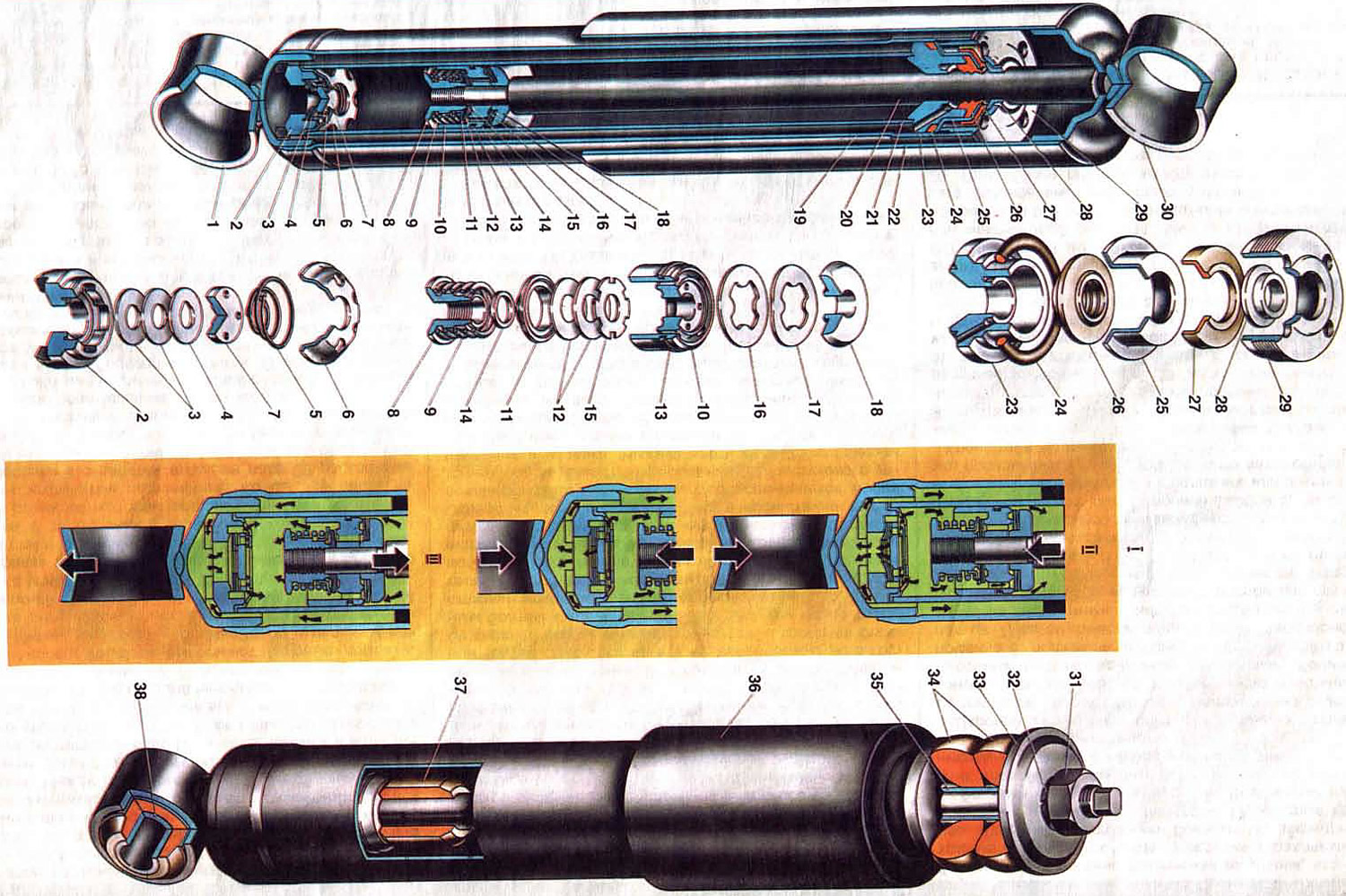
Fig. 23. Shock absorbers.
1. Lower head; 2. Compression valve body; 3. Compression valve discs; 4. Compression valve throttle disc; 5. Compression valve spring; 6. Compression valve cage; 7. Compression valve plate; 8. Recoil valve nut; 9. Recoil valve spring; 10. Shock absorber piston; 11. Recoil valve plate; 12. Recoil valve discs; 13. Piston ring; 14. Recoil valve nut washer; 15. Recoil valve throttle disc; 16. Bypass valve plate; 17. Bypass valve spring; 18. Limiting plate; 19. Reservoir; 20. Rod; 21. Cylinder; 22. Casing; 23. Rod guide bushing; 24. Reservoir sealing ring; 25. Rod seal race; 26. Rod seal; 27. Rod protective ring gasket; 28. Protective ring of the rod; 29. Reservoir nut; 30. Upper shock absorber head; 31. Front shock absorber mounting nut; 32. Spring washer; 33. Pillow washer; 34. Pillows; 35. Spacer sleeve; 36. Front suspension shock absorber housing; 37. Rod buffer; 38. Rubber-metal hinge; I. Shock absorber operation diagram; II. Compression stroke; III. Recoil stroke.
1. Lower head; 2. Compression valve body; 3. Compression valve discs; 4. Compression valve throttle disc; 5. Compression valve spring; 6. Compression valve cage; 7. Compression valve plate; 8. Recoil valve nut; 9. Recoil valve spring; 10. Shock absorber piston; 11. Recoil valve plate; 12. Recoil valve discs; 13. Piston ring; 14. Recoil valve nut washer; 15. Recoil valve throttle disc; 16. Bypass valve plate; 17. Bypass valve spring; 18. Limiting plate; 19. Reservoir; 20. Rod; 21. Cylinder; 22. Casing; 23. Rod guide bushing; 24. Reservoir sealing ring; 25. Rod seal race; 26. Rod seal; 27. Rod protective ring gasket; 28. Protective ring of the rod; 29. Reservoir nut; 30. Upper shock absorber head; 31. Front shock absorber mounting nut; 32. Spring washer; 33. Pillow washer; 34. Pillows; 35. Spacer sleeve; 36. Front suspension shock absorber housing; 37. Rod buffer; 38. Rubber-metal hinge; I. Shock absorber operation diagram; II. Compression stroke; III. Recoil stroke.
The shock absorbers of the front and rear suspensions differ in size, the method of fastening the upper part, the presence of a buffer 37 at the front shock absorber, which limits the length of the rod during the recoil stroke and thus prevents excessive downward movement of the front wheels when driving on very uneven roads. In addition, the shock absorbers differ in the parameters of the operating characteristics. However, the main parts of the front shock absorber are the same as those of the rear, so in the future, only the rear shock absorber will be considered.
The shock absorber consists of the following main parts: a reservoir with a head 1, a working cylinder 21, a compression valve and a rod 20 assembled with a piston and valves, a guide sleeve 23, a nut 29, seals and a casing. The cylinder 21 and the reservoir 19, made of a pipe, serve as a volume for the working fluid. The bottom is rolled in the lower part of the reservoir, on which the compression valve rests. A thread for nut 29 is cut in the upper part of the reservoir. The lower head of the shock absorber is welded to the bottom of the reservoir from the outside.
The compression valve consists of a body 2, disks 3 and 4, a plate 7, a spring 5 and a collar 6.
The compression valve body is metal-ceramic. In its upper part, a socket with a chamfer is machined, covered by disks, which are pressed to the socket by spring 5 through plate 7. The upper end of the spring rests against collar 6, which is put on the cylindrical belt of the valve body. In order to ensure the passage of liquid from reservoir 19 to cylinder 21 and back, a cylindrical groove and four vertical grooves of approximately the same depth as the groove are made in the lower part of the valve body. The same grooves are also present in the upper part of the compression valve body.
The disks 3 of the compression valve are flat, made of a steel strip 0.15 mm thick, and have holes in the center for the passage of liquid. In the central hole of the disk 4 there is a cutout through which the liquid is throttled at a low speed of movement of the piston 10. In the lower central part of the plate 7 there is a cylindrical protrusion that covers the central hole of the disks 3 and 4, but does not close the throttling cutout. When assembled, a gap is formed between the plate 7 and the disk 4 for the passage of liquid. For the same purpose, four through holes are made along the outer diameter of the plate.
The text is copied from the online portal VAZbook
The collar 6 has a flange and a cylindrical belt, onto which the cylinder 21 is tightly mounted, which ensures the necessary tightness between the compression valve and the cylinder. On the stamped surface of the collar, there are six side and one central opening for the passage of liquid.
In cylinder 21, a rod with piston 10 is installed, on which a bypass valve and a return valve are mounted. The piston has vertical channels located along two circles; the channels of each circle are connected to each other by an annular groove. The channels located closer to the center of the piston are blocked from below by discs 15 and 12 of the return valve, and from above - further from the center - by plate 16 of the bypass valve, pressed by spring 17. The stroke of the plate is limited by the spring stop in plate 18. The piston is sealed in the cylinder by ring 13.
The discs of the recoil valve are pressed to the lower end part of the piston by spring 9 through plate 11. In this case, the spring presses the outer part of the discs, and the inner part of discs 15 and 12 is tightly pressed to the piston by nut 8, screwed onto the threaded end of the rod. To protect the discs of the recoil valve from damage and to ensure stable operation of the valve, a washer 14 is installed between the discs and the nut. The throttle disc 15 of the recoil valve has six cutouts along the outer diameter for the passage of liquid during smooth recoil.
For the directed movement of the rod 20 relative to the cylinder, a metal-ceramic guide sleeve 23 is used, installed with a cylindrical belt in a calibrated hole of the cylinder. The sleeve has an inclined channel for draining the liquid that has passed through the gap between the rod and the guide sleeve, back into the reservoir. A seal 26 made of petrol-oil-resistant rubber is installed on top in the sleeve seat. The working edges of the seal cover the chrome-plated surface of the rod, preventing the liquid from escaping from the shock absorber. The seal together with the ring 24, which seals the gap between the guide sleeve 23 and the reservoir 19, is pressed by the collar 25. A metal-ceramic protective ring 28 and a rubber gasket 27 are installed between the collar and the nut 29. The protective ring removes dirt from the rod during the compression stroke.
Operation of the shock absorber
The principle of operation of the shock absorber is based on the creation of increased resistance to body swaying due to the forced flow of fluid through small flow sections in the valves.
During the compression stroke, when the car wheels move upward, the shock absorber is compressed, i.e. the piston moves downward and displaces liquid from the lower part of the cylinder, part of which, overcoming the resistance of the flat spring of the bypass valve, flows from the under-piston space to the above-piston space. All the displaced liquid cannot pass in this way, since the retracted rod occupies part of the volume released by the piston, therefore, part of the liquid, bending the inner edges of the compression valve disks, flows from the cylinder into the reservoir. With a smooth stroke of the rod, the force from the liquid pressure will be insufficient to press the inner edges of the disks away from the plate, and the liquid will pass into the reservoir through the cutout of the throttle disk 4.
During the recoil stroke, the car wheels move downwards under the action of the elastic elements of the suspension, and the shock absorber stretches, i.e. the piston moves upwards. In this case, fluid pressure is created above the piston, and vacuum is created under the piston. The liquid from the above-piston space, overcoming the resistance of the spring, bends the outer edges of the discs of the recoil valve and flows into the lower part of the cylinder. In addition, due to the vacuum, part of the liquid from the reservoir, bending the outer edges of the discs of the compression valve from the valve body, fills the lower part of the cylinder.
At low piston speed, when the fluid pressure is insufficient to push the recoil valve discs, the fluid will be throttled through the side cutouts of the throttle disc 15, creating resistance to the recoil stroke.