




Open large image in new tab »
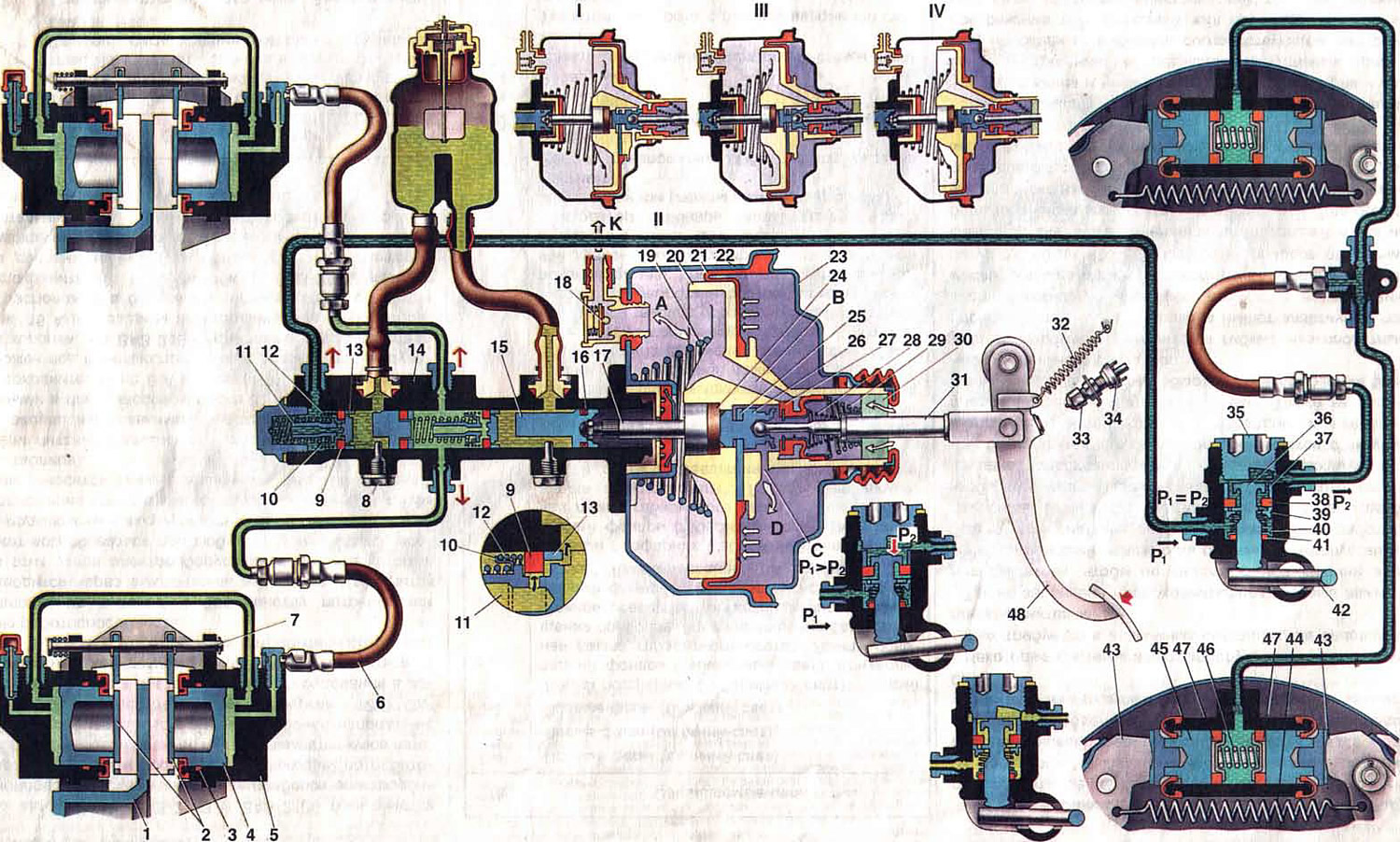
Fig. 27. Brake operation diagram.
1. Brake disc; 2. Front brake shoe; 3. Piston sealing ring; 4. Wheel cylinder piston; 5. Front brake wheel cylinder; 6. Front brake circuit brake hose; 7. Brake shoe mounting pin; 8. Piston stroke limiting screw; 9. Sealing ring; 10. Stubborn cup; 11. Rear brake actuator piston; 12. Sealing ring spring; 13. Bushing; 14. Master cylinder body; 15. Front brake actuator piston; 16. Seal; 17. Rod; 18. Vacuum valve; 19. Valve body return spring; 20. Valve body; 21. Diaphragm; 22. Vacuum valve body; 23. Vacuum booster housing cover; 24. Rod buffer; 25. Piston thrust plate; 26: Piston; 27. Vacuum booster valve; 28. Valve spring; 29. Valve return spring; 30. Air filter; 31. Valve tappet; 32. Pedal release spring; 33. Brake light switch tip; 34. Brake light switch; 35. Pressure regulator housing plug; 36. Pressure regulator piston; 37. Housing bushing; 38. Piston head seal; 39. Spring plate; 40. Piston spring; 41. Pressure regulator piston sealing ring; 42. Pressure regulator drive lever; 43. Rear brake shoe; 44. Brake shoe tension spring; 45. Rear brake wheel cylinder piston; 46. Piston spacer spring; 47. Wheel cylinder piston seals; 48. Brake pedal; A - Vacuum cavity; B - Channel connecting the vacuum cavity with the internal cavity of the valve; C - Channel connecting the internal cavity of the valve with the atmospheric cavity; D - Atmospheric cavity; K - Hose connecting the vacuum booster to the engine intake pipe; I - The pedal is not pressed; II - Braking; III - Pedal pressure suspended; IV - Disinhibition.
1. Brake disc; 2. Front brake shoe; 3. Piston sealing ring; 4. Wheel cylinder piston; 5. Front brake wheel cylinder; 6. Front brake circuit brake hose; 7. Brake shoe mounting pin; 8. Piston stroke limiting screw; 9. Sealing ring; 10. Stubborn cup; 11. Rear brake actuator piston; 12. Sealing ring spring; 13. Bushing; 14. Master cylinder body; 15. Front brake actuator piston; 16. Seal; 17. Rod; 18. Vacuum valve; 19. Valve body return spring; 20. Valve body; 21. Diaphragm; 22. Vacuum valve body; 23. Vacuum booster housing cover; 24. Rod buffer; 25. Piston thrust plate; 26: Piston; 27. Vacuum booster valve; 28. Valve spring; 29. Valve return spring; 30. Air filter; 31. Valve tappet; 32. Pedal release spring; 33. Brake light switch tip; 34. Brake light switch; 35. Pressure regulator housing plug; 36. Pressure regulator piston; 37. Housing bushing; 38. Piston head seal; 39. Spring plate; 40. Piston spring; 41. Pressure regulator piston sealing ring; 42. Pressure regulator drive lever; 43. Rear brake shoe; 44. Brake shoe tension spring; 45. Rear brake wheel cylinder piston; 46. Piston spacer spring; 47. Wheel cylinder piston seals; 48. Brake pedal; A - Vacuum cavity; B - Channel connecting the vacuum cavity with the internal cavity of the valve; C - Channel connecting the internal cavity of the valve with the atmospheric cavity; D - Atmospheric cavity; K - Hose connecting the vacuum booster to the engine intake pipe; I - The pedal is not pressed; II - Braking; III - Pedal pressure suspended; IV - Disinhibition.
When the system is released and the brake pedal is pulled back by the spring 32 until it stops against the brake light switch 34, then the pusher 31 with the piston 26 of the vacuum booster is pulled back together with the pedal. The valve body 20 and the rod 17 are pressed by the spring 19 to the extreme rear position. In this position, a gap is formed between the valve head 27 and the valve seat, since the piston presses the valve away from the seat. The vacuum cavity A communicates with the atmospheric cavity D through channel B, the gap between the seat and the valve, and then through channel C. Therefore, when the engine is running, the vacuum from the intake pipe is transmitted through valve 18 to cavity A and through the channels and gaps to cavity D.
Pistons 11 and 15 of the main cylinder under the action of return springs are pressed to the rear extreme position until they stop against locking screws 8, press sealing rings 9 away from the end of the piston groove and through the resulting gaps the working cavities of the cylinder communicate with the hydraulic cylinder reservoir and high-pressure pipelines. Thus, there is no pressure in the brake drive. Therefore, pistons 4 under the action of elastic deformation of sealing rings 3 are retracted into the cylinders and do not exert pressure on the brake pads of the front brakes, which will be in light contact with the surface of the brake disc.
When the car is moving without braking, i.e. when there is no pressure in the hydraulic drive, piston 36 is raised up under the action of spring 40 and torsion lever 42 until it stops against plug 35. Therefore, the cavities of the housing located above and below the piston head communicate freely. This opens a free passage of fluid to the wheel cylinders of the rear brakes. But since there is no pressure in the entire drive, brake shoes 43 are pressed away from the drums.
When braking, when the driver presses the brake pedal, the pusher 31 moves the piston 26. Following the piston, the valve 27 moves under the action of the spring 28 until it stops against the valve body seat. When the seat is closed, cavities A and D are disconnected. With further movement of the piston 26, a gap is formed between it and the flange of the valve 27, through which cavity D communicates with the atmosphere. Outside air enters cavity D through the air filter 30, through the gap between the pusher and the valve and then through channel C. Atmospheric air creates pressure on diaphragm 21. Due to the difference in pressure in cavities A and D, as well as the force of pressing the brake pedal, the valve body moves together with the rod 17, which in turn acts on the piston 15 of the master cylinder. The force acting on the valve body depends on the degree of vacuum in the engine intake pipe and on the force applied to the brake pedal.
When piston 15 moves, spacer sleeve 13 moves away from lock screw 8 and sealing ring 9 is pressed by spring 12 to the end face of the piston groove. Thus, the compensation gap is closed and the cavities of the cylinder and tank are separated. Therefore, with further movement of piston 15, fluid pressure is created in the working cavity of the front brake drive, which is transmitted through pipelines and hoses to the wheel cylinders of the front brakes. It also acts on floating piston 11, which, moving, creates pressure in the rear brake drive. Under the increasing pressure of the fluid in the working cavities, the front piston sealing rings expand and begin to fit more tightly to the surface of the cylinder and to the end face of the grooves, improving the sealing of the pistons in the cylinder.
Under the pressure of the liquid, pistons 4 and 44 of the wheel cylinders of the front and rear brakes extend, pressing the shoes to the brake disc 1 and to the drum. The created braking moments slow down the rotation of the front and rear wheels. At the same time, the load is redistributed along the axles of the car: the load on the front axle increases, and on the rear axle it decreases. This leads to the lifting of the rear of the body, i.e. the distance between the rear axle beam and the body increases. At the same time, the short arm of the lever 42 goes down, and the piston 36 of the pressure regulator under the pressure of the liquid begins to go down, compressing the spring 40. At the moment of full braking, the maximum load transfer from the rear axle to the front axle and the greatest lift of the body occur. The adhesion of the wheels to the road worsens, the pressure of the torsion lever 42 on the piston 36 decreases. Due to the larger end area, the piston moves down until the head contacts the seal 38. Further flow of fluid to the wheel cylinders of the rear brakes stops, i.e. the braking torque on the rear wheels does not increase, despite strong pressure on the brake pedal and a further increase in pressure Pv. Therefore, the rear wheels do not lock and the car does not skid.
When the brake pedal is released, it returns to its original position under the action of the return spring 32, dragging the pusher 31 and piston 26 along with it. The rear end of the piston is pressed against the valve head 27, which leads to the cessation of the flow of atmospheric air into cavity D. Then the valve head moves away from the seat and communication between cavities A and D occurs, i.e. the pressure in both cavities is equalized; under the action of spring 19, the valve body with the rod returns to its original position, stopping the pressure on piston 15 of the master cylinder. Pistons 11 and 15, under the force of the return springs, are pressed to the extreme position and rest against locking screws 8. Spacer bushings move sealing rings 9 away from the end of the grooves, and through the resulting gap, the working cavities of the master cylinder communicate with the cavities of the tank. Pistons 4 of the front brake are moved away from the pads due to the elasticity of sealing rings 3, and pistons 45 of the rear brake - by contraction of the tension springs.
If the rear brake drive circuit fails due to leakage, piston 11 moves under fluid pressure until it hits the plug of the master cylinder, after which the pressure in the front brake drive circuit begins to increase. Due to the free movement of piston 11, the free travel of the brake pedal increases and only the front brake drive operates.
When the front brake drive circuit fails, piston 15 moves forward until it stops against piston 11, after which the rear brake drive circuit begins to operate. The free travel of the brake pedal also increases.
If any circuit is damaged, the liquid level control lamp lights up, signaling a drop in the liquid level in the tank.