




The rear suspension beam consists of two longitudinal arms connected by a U-shaped cross-member. This cross-section provides the connector (crossbar) greater bending rigidity and less torsional rigidity. The connector allows the levers to move relative to each other within small limits. The levers are made of a variable cross-section pipe, which provides the necessary rigidity. Brackets for attaching the shock absorber, rear brake shield and wheel hub axle are welded to the rear end of each lever. At the front, the beam levers are bolted to removable brackets on the body side members. The mobility of the levers is provided by rubber-metal hinges (silent blocks), pressed into the front ends of the levers.
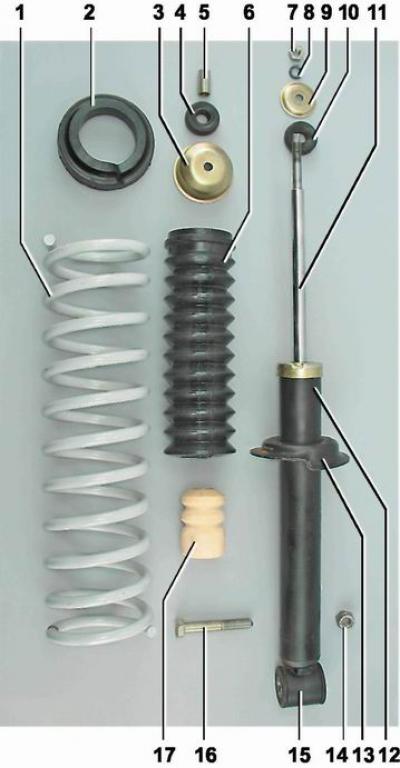
Rear suspension spring and shock absorber parts: 1 - spring; 2 rubber gasket; 3 - casing cover; 4, 10 - shock absorber rod cushions; 5 - spacer sleeve; 6 - shock absorber casing; 7 - rod nut; 8 spring washer; 9 - support washer; 11 - shock absorber rod; 12 - shock absorber housing; 13 - lower spring support cup; 14 - nut of the lower shock absorber mounting bolt; 15 - eye; 16 - lower shock absorber mounting bolt; 17 - compression stroke buffer
The lower shock absorber eye is attached to the beam arm bracket. The shock absorber rod is attached to the body with a nut. The elasticity of the upper and lower shock absorber connections is provided by the rod cushions and the rubber-metal bushing pressed into the eye. The shock absorber rod is covered with a corrugated casing, protecting it from dirt and moisture. In case of suspension breakdowns, the shock absorber rod travel is limited by a compression stroke buffer made of elastic plastic.
The suspension spring rests with its lower turn on the support cup (a stamped steel plate welded to the shock absorber body), and the upper one rests against the body through a rubber gasket.
The rear wheel hub axle is mounted on the beam arm bracket flange (it is fastened with four bolts). The hub with a double-row bearing pressed into it is held on the axle by a special nut. The nut has an annular flange that locks the nut when it is pressed into the groove of the axle. The hub bearing is of a closed type and does not require adjustment or lubrication during the operation of the car.