




Helpful Hint: To avoid getting dirty when changing a tire, wear gloves and protective clothing if your vehicle has them.
2. On the opposite side, the car must be secured by placing wheel chocks under the front and rear wheels so that the raised car cannot move forward or backward.
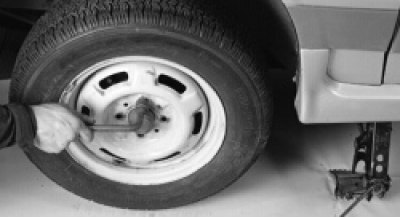
Wheel replacement
3. Using a jack, lift the car slightly, but so that the wheel that needs replacing does not come off the road. Remove the decorative hubcap (if there is one) and use a wheel wrench to loosen the four wheel mounting bolts.
Helpful Hints: To make it easier to unscrew the wheel bolts, you can use your foot instead of your hands, stepping on the handle of the wheel wrench from above. To make this operation easier, you need to buy a special wheel wrench with a telescopic handle.
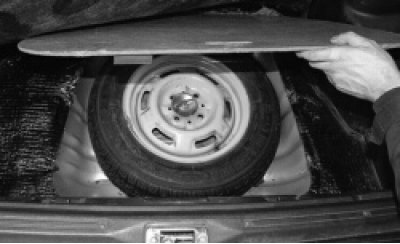
Remove the spare tire
4. Remove the spare tire from the trunk and place it on the ground next to the tire being replaced.
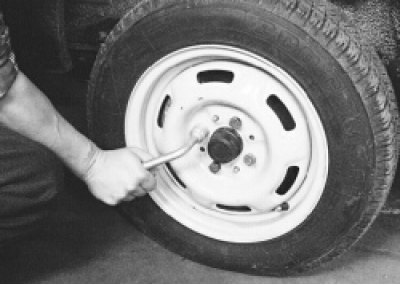
Raise the car
5. Jack up the car until the wheel is clear of the road, then completely loosen the bolts and remove the wheel.
Helpful advice: Try to keep the car suspended with the wheel removed for as little time as possible.
6. Install the spare wheel in place of the removed one, screw in the mounting bolts, lower the car and tighten the bolts completely. Tighten the wheel bolts crosswise. To avoid damaging the wheel disk, do not try to "tighten" the wheel mounting bolts by pressing the wrench handle with your foot.
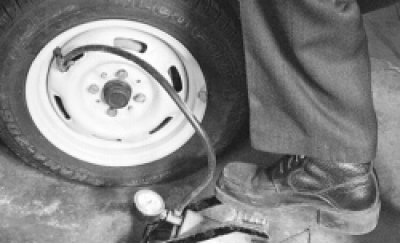
Check the pressure
7. Before continuing driving, be sure to check the air pressure in the tire of the installed wheel.
As a rule, tubeless tires are installed on front-wheel drive cars of the Volga Automobile Plant. If you do not have sufficient tire mounting skills, we advise you not to try to do this work yourself. One damage to the sidewall - and you will have to buy a new tire or install a tube. In a desperate situation, you can use a special first aid kit for repairing tubeless tires without dismounting or tire sealant. They must be used in accordance with the attached instructions.
Why is a tubeless tire better than a tubed tire? Firstly, a tubeless tire "deflates" very slowly when punctured: you can drive for weeks with a nail in the wheel, pumping it up, until you have an opportunity to repair it. Secondly, when wires of the metal cord start sticking out of a tubeless tire after a very significant mileage, it can still be used as a spare tire. There is no point in inserting a tube into such a tire - its puncture is guaranteed already at the first inflation.