




Open large image in new tab »
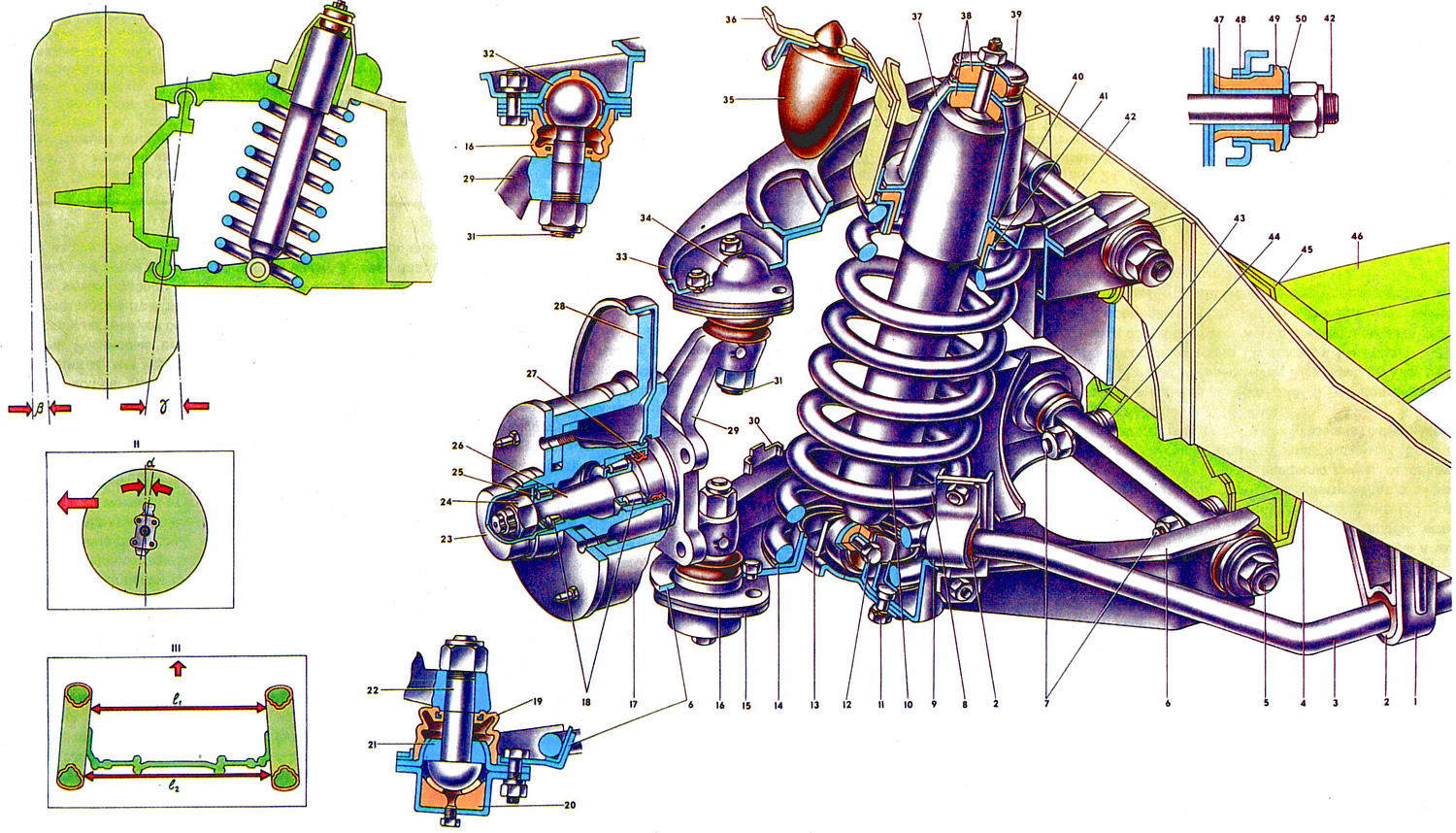
Fig. 22: 1. Bracket for fastening the stabilizer bar to the body side member. 2. Stabilizer bar cushion. 3. Anti-roll bar bar. 4. Body side member. 5. Lower arm shaft. 6. Lower suspension arm. 7. Bolts for fastening the lower arm shaft to the suspension cross member. 8. Stabilizer bar mounting collar. 9. Suspension spring. 10. Shock absorber. 11. Bolt for fastening the shock absorber bracket to the lower arm. 12. Shock absorber mounting bolt. 13. Bracket for fastening the shock absorber to the lower arm. 14. Lower support cup of the spring. 15. Sleeve of the lower support liner. 16. Protective boot of the upper ball joint. 17. Front wheel hub. 18. Front wheel hub tapered roller bearings. 19. Ball pin protective boot. 20. Lower support cage insert. 21. Lower support bearing. 22. Lower support ball pin. 23. Hub cap. 24. Adjusting nut. 25. Washer. 26. Steering knuckle journal. 27. Hub oil seal. 28. Brake disc. 29. Steering knuckle. 30. Front wheel turning limiter. 31. Upper support ball pin. 32. Upper support bearing. 33. Upper suspension arm. 34. Ball joint. 35. Compression buffer. 36. Compression buffer bracket. 37. Shock absorber support cup. 38. Shock absorber piston rod mounting cushion. 39. Shock absorber piston rod cushion washer. 40. Suspension spring insulating gasket. 41. Suspension spring upper support cup. 42. Upper suspension arm shaft. 43. Adjusting washers. 44. Spacer washer. 45. Crossmember-to-body side member mounting bracket. 46. Front suspension crossmember. 47. Inner ball joint bushing. 48. Outer ball joint bushing. 49. Rubber ball joint bushing. 50. Ball joint thrust washer. I - Camber (β) and steering axis tilt (γ) angles. II - Steering axis tilt angle (α). III - Wheel toe-in (L ₂ -L ₁).
The connecting link between the wheels and the body is the front and rear suspensions of the car. They transmit the forces acting on the wheels to the body. The elements included in the suspension soften the loads, reduce body vibrations, provide good stability and smooth running of the car. These elements include the guide device, elastic elements, shock absorbers and anti-roll bar.
Suspension guide device determines the nature of the wheel's movement relative to the road and the body and transmits forces and moments from the wheel to the body. This device includes the upper 33 and lower 6 suspension arms and the pivot knuckle 29, which is pivotally connected to them.
The upper arm is connected by axle 42 to the front pillar of the body using rubber-metal hinges. The axle, made in the form of a bolt with a hexagonal head, passes through the eyes of the arm 33 and through the bushing of the front pillar of the body. Rubber-metal hinges are pressed into the eyes of the upper arm, each of which consists of a rubber bushing 49, pressed between the inner 47 and outer 48 metal bushings with a large tension. The outer bushing 48 is pressed into the eye of the upper arm, and the inner 47 is mounted on axle 42. The hinge is clamped on the axle with a nut between the shelf of the upper arm and the thrust washer 50. The swing of the upper arm occurs within the deformation limits of the rubber bushing 49. The rubber bushing should not slip relative to the metal bushings or the hinge on the axle and in the arm. This design of the hinge ensures a tight connection between the axle and the suspension arm.
The ball joint 34 of a non-detachable design is attached to the upper suspension arm with three bolts. The bearing 32 is located in the support housing, the base of which is resin, and the friction surface is Teflon fabric, tightly fitting the spherical surface of the pin 31. The parts of the ball joint are protected from contamination by a rubber reinforced cover 16. The pin 31 is installed in the conical hole of the steering knuckle 29 and secured with a self-locking nut. During the operation of the car, the parts of the ball joint are not lubricated.
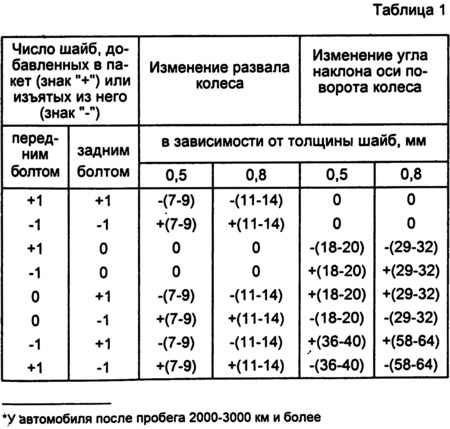
The lower arm 6 is suspended on the axle 5, which is attached to the crossmember 46 of the suspension with two bolts 7. The latter is attached to the body side members. Between the axle and the crossmember, a distance 44 and adjusting 43 washers are installed. By changing the number of washers 43, the longitudinal angle a of the turning axis and the camber angle β of the front wheels are adjusted. The rubber-metal hinges of the lower arm are of the same design as the upper one, differing only in the size and shape of the bushings.
The lower ball joint is attached to the suspension arm from below with three bolts. Its design differs from the upper joint. The joint housing contains a pin 22 with a hemispherical head. A bearing 21 with a hemispherical surface is placed on the pin rod. A liner 20 made of oil-resistant rubber is inserted into the lower part of the housing with tension. A plastic layer is vulcanized on its surface, which contacts the hemisphere of pin 22 (nylon molybdenum sulfide blend). The rubber insert eliminates the gaps between the ball joint parts, and the bearing 21 is pressed against the hemispherical surface of the upper part of the support housing. There is a hole in the support housing at the bottom, through which the joint is lubricated. The hole is closed with a conical plug. The ball joint parts are protected from contamination by a protective cover 19. The lower ball joint is connected to the steering knuckle in the same way as the upper one.
The lower suspension arm is connected to the lower head of the shock absorber using bracket 13 and bolt 12. Bracket 13 is attached to the suspension arm with two bolts 11. The shock absorber rod passes through the opening of the support cup 37 welded to the front pillar of the body and is secured with a nut. Insulating rubber cushions 38 are installed between the shock absorber casing and the cup, as well as between the support washer 39 and the cup.
The suspension arms are pivotally connected to the steering knuckle 29, on the journal of which the hub 17 of the front wheel is mounted. The bracket for mounting the caliper and the protective casing of the brake mechanism, as well as the steering gear steering arm, are attached to the flange of the steering knuckle.
Elastic suspension elements — these are springs 8, working together with shock absorbers and anti-roll bar. The upper end of the suspension spring rests through support cup 41 with rubber gasket 40 in the front pillar of the body.. The lower end of the spring rests in support cup 14 of the lower suspension arm. Front suspension springs are sorted by length under a load of 4350 N (435 kgf) into groups A and B and are marked for distinction: group A — with a yellow stripe, group B — with a green one. The stripes are applied with paint on the outer side of the coils.
The upward travel of the front wheel is limited by the stop of the upper arm 33 in the rubber buffer 35 of the compression stroke, installed with its tail in the hole of the bracket 36, which is welded to the front pillar of the body.
Anti-roll bar reduces the lateral roll of the body when turning the car. It is a rod 3 made of spring steel. The curved ends of the rod are attached to the brackets of the lower suspension arms with clips 9 through rubber cushions 2, put on the ends of the rod. The middle part of the rod is attached with brackets 1 with rubber cushions 2 to the side members of the body. When the body rolls laterally, the load on one wheel suspension increases, on the other decreases; at the same time, the stabilizer bar twists and begins to work as a torsion bar. By twisting, it transfers the load from one suspension to another, leveling the position of the body.
Front wheel hub 17 is mounted on the journal 26 of the steering knuckle on two tapered roller bearings 18, which are pressed by an adjusting nut. Between the nut and the outer bearing, a thrust washer with a tendril entering the groove of the journal is installed. The tendril prevents the washer from turning when tightening the nut. The direction of the thread in the nuts is different: on the left journal there is a right-hand thread, on the right - a left-hand thread. The nut is fixed on the threaded end of the journal by pressing the cylindrical belt into two grooves of the journal. On the inside, in the hub socket, a self-tightening oil seal 27 is installed, the working edge of which covers the ground surface of the journal belt.
The inner cavity of the hub is protected from the outside by a cap 23 pressed into the hub bore. Bearings 18 are lubricated with Litol-24 grease, which is added to the hub and cap during assembly. The brake disc and pressure ring are attached to the hub flange with two guide pins. The wheel disc is centered on the guide pins and is attached to the hub with four bolts. The hexagonal heads of these bolts have conical belts that fit tightly into the conical holes of the wheel disc, ensuring a tight fit.
The angles of the steering wheels have a great influence on the stability of the car, the wear of the tires and the fuel consumption. The camber angle (β) is the tilt of the wheels in the vertical plane relative to the center line of the car. The angle β mainly affects the uniformity of the tire tread wear. If it is violated, then increased wear of the inner or outer tracks of the tread will occur.
If the camber angle of one wheel is positive (outward tilt), and the other one is negative (tilt inward), then the car will pull to the side when driving straight. The camber angle is adjusted by changing the number of washers 43.
(The material is posted on the website VAZBOOK)
Wheel toe-in (L ₂ -L ₁) is the difference in the distance between the side surfaces of the tires at the rear (L ₂) and the front (L ₁). Insufficient or negative wheel toe-in causes premature wear of the inner part of the tire tread, while large toe-in causes wear of the outer part of the tread. Wheel toe-in is adjusted by changing the length of the steering linkage.
The longitudinal tilt angle of the steering axis is the tilt of the axis relative to which the wheel turns. It should be positive, i.e. the lower part of the axis is tilted forward. With a positive angle, the self-return of the steering wheel to the middle position after turning is improved. The longitudinal tilt angle of the steering axis is adjusted by moving washers 43 from one bolt to another.
The front wheel alignment angles must comply with the following data:
- Camber angle — 0°-1°10' (0°30'±20')*
- Toe-in: 1-7 mm (2-4)*
- Angle of longitudinal tilt of the pivot axis — 2°30'-5° (4°±30')*
The change in the camber angle and longitudinal tilt of the wheel pivot axis depending on the thickness and number of removed or added washers 43 are shown in Table 1.
The transverse angle (γ) of the wheel pivot axis is not adjustable, as it is specified by design.