




To replace the rear parking brake cable, hang up and remove the rear wheels (better at the same time).
Lower the parking brake lever to its lowest position.
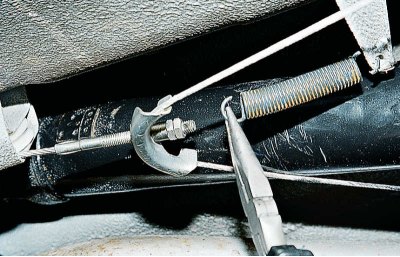
Using pliers, disconnect the spring from the front (short) cable.
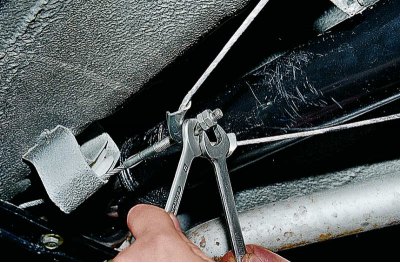
Using two 13 mm wrenches, loosen the adjusting and locking nuts and...
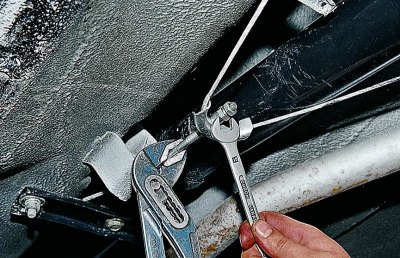
...we unscrew them, holding the tip of the front cable with pliers.
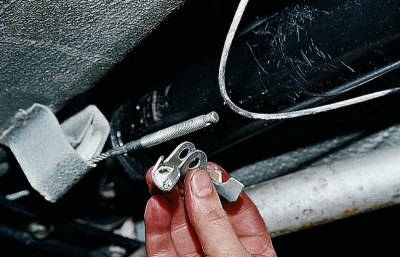
We remove the equalizer.
Remove the brake drum and shoe from its support (see Replacing rear brake pads).
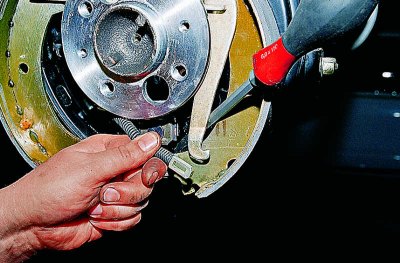
We disconnect the cable tip from the lever.
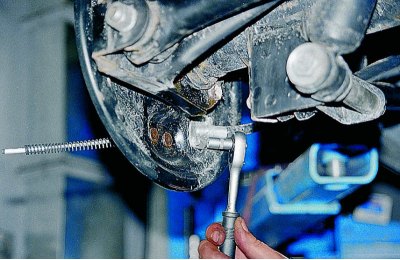
Using an 8 mm spanner, unscrew the two bolts securing the cable to the brake shield and...
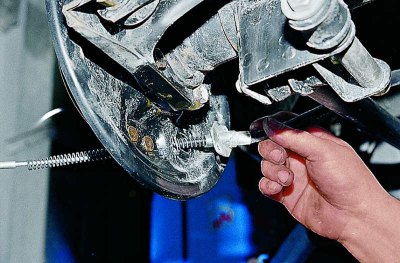
...we remove the cable from the shield.
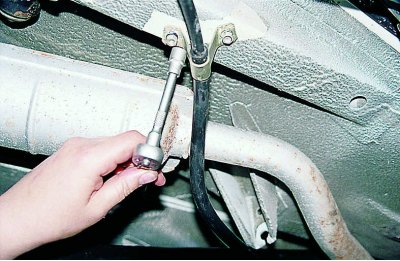
Using a 10 mm spanner, unscrew the two nuts securing the cable bracket to the body and...
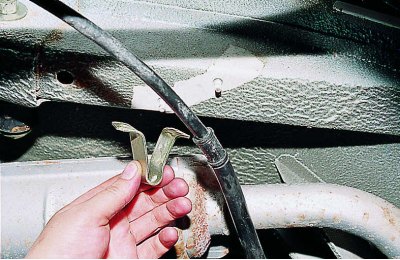
...after removing the bracket, we release the cable.
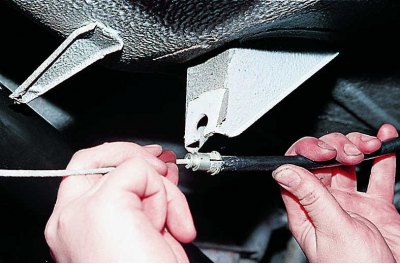
We disconnect the end of the cable sheath from the bracket by moving it back and down.
Similarly, we remove the second branch of the rear parking brake cable.
To replace only the front parking brake cable, perform the work shown in photos 1–4.
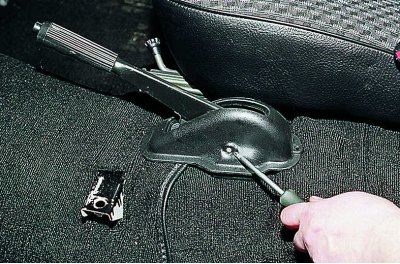
In the passenger compartment, use a Phillips screwdriver to unscrew the screw securing the protective cover.
For convenience, it is advisable to remove the driver's seat (see Replacing the front seat).
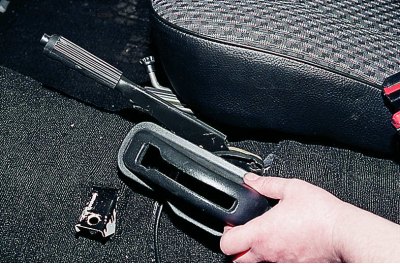
We remove the casing.
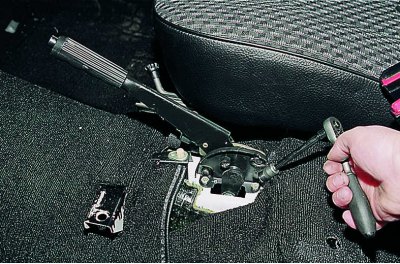
Using a 10 mm spanner, unscrew the four screws securing the lever mechanism to the body.
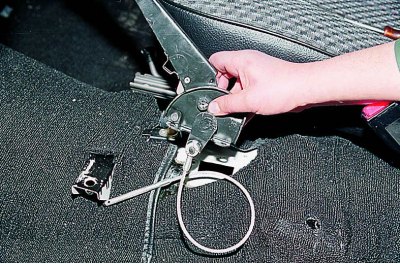
We remove the lever assembly with the cable.
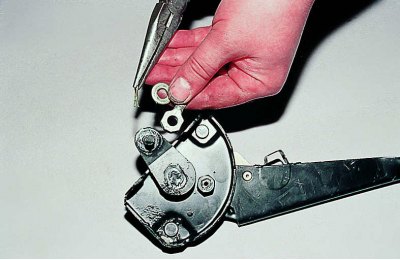
Having unpinned the axle, we remove the cable from it.
We assemble the parking brake system units in the reverse order of removal or disassembly, and check the drive adjustment.
We lower the lever to the stop. We tighten the cable with the adjusting nut so that the full upward stroke of the lever with a force of 40 kgf is 2–4 teeth ("clicks") per sector.
With the lever fully lowered, the wheels should rotate freely without binding.