




Front suspension elements
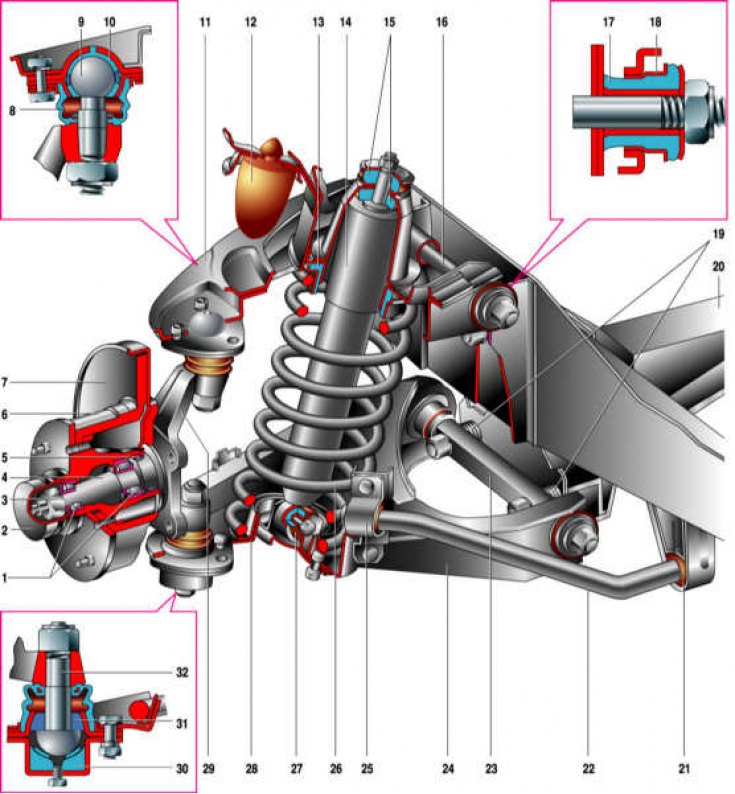
1 – hub bearings; 2 – hub cap; 3 – nut; 4 – steering knuckle journal; 5 – cuff; 6 – hub; 7 – brake disc; 8 – protective cover of the upper ball joint; 9 – upper ball pin; 10 – bearing (liner) of the upper support; 11 – upper arm; 12 – compression stroke buffer; 13 – spring insulating gasket; 14 – shock absorber; 15 – shock absorber mounting cushion; 16 – Upper arm axle; 17 – rubber bushing of the hinge; 18 – outer sleeve of the hinge; 19 – adjusting washers; 20 – suspension cross member; 21 – stabilizer bar cushion; 22 – stabilizer bar; 23 – lower arm axle; 24 – lower arm; 25 – stabilizer bar mounting clip; 26 – spring; 27 – rubber bushing of shock absorber spring; 28 – lower spring support cup; 29 – steering knuckle; 30 – lower ball pin cage insert; 31 – lower support bearing; 32 – lower ball joint.
Description of the design
The front suspension is independent, double wishbone, with a coil spring, telescopic hydraulic shock absorber and anti-roll bar.
The axle of the lower arms is secured with two bolts to the crossmember, which in turn is attached to the front side members. Between the axle and the crossmember, two sets of spacer washers and adjusting linings are installed, setting the angles of the longitudinal and transverse tilt of the front wheel pivot axis. The axle of the upper arms is a bolt passing through the mudguard pillar. The levers on the axles rotate on rubber-metal hinges. The steering knuckle is attached to the levers on ball joints. The wheel hub with the brake disc is mounted on the pivot pin of the steering knuckle on two tapered roller bearings. The nut securing the hub of the right wheel has a left-hand thread and is marked with dots on the end.
The front suspension springs are of the cylindrical type, with their upper end resting against the mudguard pillar through a support cup with a rubber gasket, and their lower end against the support cup of the lower arm.
The shock absorbers are located inside the springs and are attached by the rod to the body through rubber cushions, and by the body eye to the lower arm through a rubber-metal hinge.
Anti-roll bar (spring steel torsion bar) is designed to reduce the lateral roll of the car when turning. It is attached through rubber cushions with the central part to the front side members of the body, and with the ends to the lower suspension arms.
(The text is published on the portal: VazBook)