




Clutch with hydraulic release drive
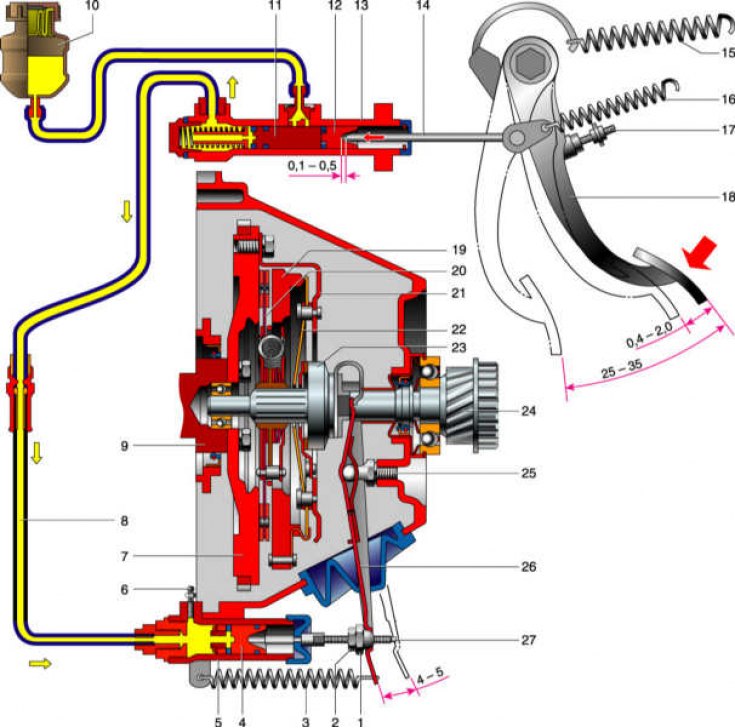
1 – adjusting nut; 2 – lock nut; 3 – release spring; 4 – clutch slave cylinder piston; 5 – working cylinder; 6 – bleed nipple; 7 – flywheel; 8 – clutch hydraulic drive pipeline; 9 – crankshaft; 10 – master cylinder reservoir; 11 – master cylinder piston; 12 – pusher piston; 13 – master cylinder; 14 – pusher; 15 – clutch pedal servo spring; 16 – clutch pedal release spring; 17 – clutch pedal travel limiting screw; 18 – clutch pedal; 19 – pressure plate; 20 – driven disk; 21 – clutch housing; 22 – pressure spring; 23 – clutch release bearing (release bearing); 24 – primary shaft of the gearbox; 25 – Clutch release fork ball joint; 26 – clutch release fork; 27 – clutch release fork pusher.
Description of the design
The car has a single-plate, dry clutch with a central pressure spring and hydraulic drive. It is mounted on the flywheel, inside an aluminum crankcase, fixed to the cylinder block. The clutch is constantly closed (on); it is switched off by pressing the clutch release pedal.
The clutch is designed to smoothly connect the engine crankshaft to the transmission when the car starts moving and to disconnect them when shifting gears. It protects transmission parts from breakage under dynamic loads. For this purpose, a damper is mounted on the driven clutch disk (torsional vibration damper).
[Original source is on the resource VAZbook]
The clutch consists of a leading and a driven part and a release drive.
The leading part of the clutch is a non-separable unit ("basket") and includes three main parts: the clutch housing, the pressure plate and the diaphragm pressure spring. The working surface of the pressure plate is ground, with a non-flatness of no more than 0.06 mm.
The leading part of the clutch is balanced. The permissible imbalance should not exceed 250 kgf·mm.
The driven part of the clutch is located on the splines of the leading one (primary) gearbox shaft. It is a driven disk assembled with friction linings and a torsional vibration damper (damper). The driven disk is steel, divided by radial slots into twelve sectors, which are bent alternately in different directions. Two friction linings are riveted to the sectors of the driven disk independently of each other. The driven disk is connected to its hub through a damper, which dampens torsional vibrations of the transmission during sudden changes in load. When the friction linings wear out, (when the distance from the surface of the lining to the rivets is less than 0.2 mm) it is advisable to replace the disk with a new one as a whole, since by this time, as a rule, the damper elements and other parts wear out. The disk is also replaced if the beating in the lining area is more than 0.5 mm, they are warped, cracked, or oiled (oil leak through seals on the engine or gearbox side).
The hydraulic clutch release drive consists of a master clutch release cylinder, a "slave" cylinder, a fork, a coupling, a bearing, a reservoir, and a clutch release pedal. The reservoir and the drive hydraulic cylinders are connected to each other by pipelines. The clutch hydraulic drive uses brake fluid.