The leading part of the clutch is a non-separable unit placed in the housing 7 and including the casing 1 (Fig. 60), the pressure plate 4, the pressure spring 2 and a number of other parts. This unit is attached to the flywheel 6 with bolts 8. Between the flywheel and the pressure plate on the splines of the drive shaft 9 of the gearbox there is a driven disk 5 with friction linings, which is connected to the hub through a torsional vibration damper.
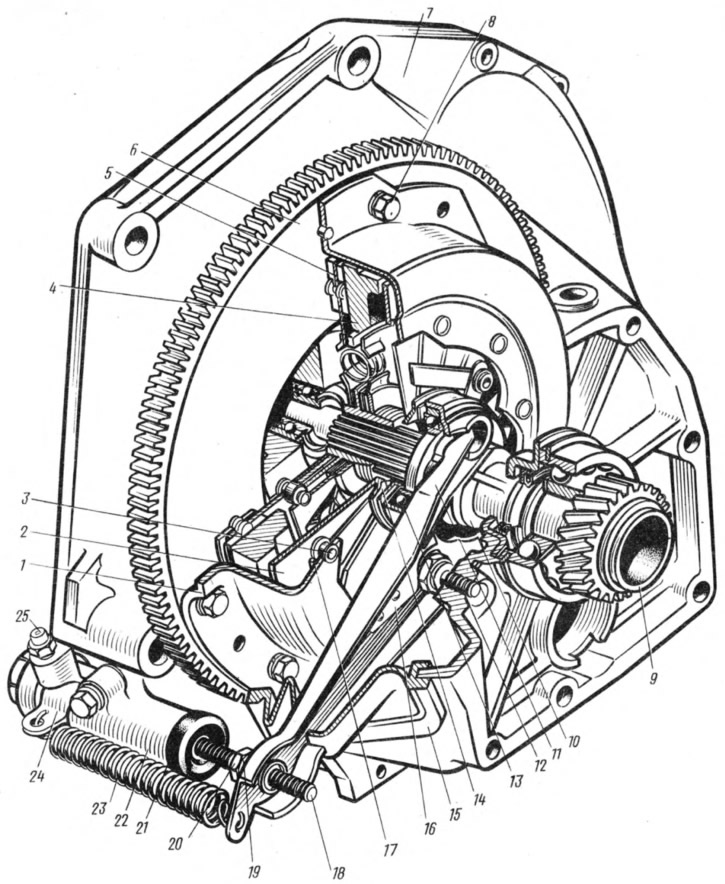
Fig. 60. Clutch:
1 - clutch housing; 2 - pressure spring; 3-step rivet; 4 - pressure plate; 5 - driven disk; 6 - flywheel; 7 - clutch housing; 8 - bolt; 9 - gearbox drive shaft; 10 - clutch release bearing sleeve; 11 - clutch release fork; 12 - fork ball joint; 13 - clutch release bearing; 14 - thrust flange of the pressure spring; 15 - Clutch release fork boot; 16 - spring; 17 - support ring of the pressure spring; 18 - Clutch release fork pusher; 19 - adjusting nut; 20 - lock nut; 21 - protective cap; 22 - clutch release drive cylinder (working); 23 - fork release spring; 24 - spring bracket; 25 - bleed nipple.
The clutch release bearing 13 acts on the petals of the pressure spring through the thrust flange 14, which is connected to the clutch housing through connecting plates and rivets 3.
The clutch drive is hydraulic. The clutch master cylinder is secured to bracket 11 (Fig. 61) of the clutch and brake pedals, and the slave cylinder 22 (see fig. 60) - on the clutch housing.
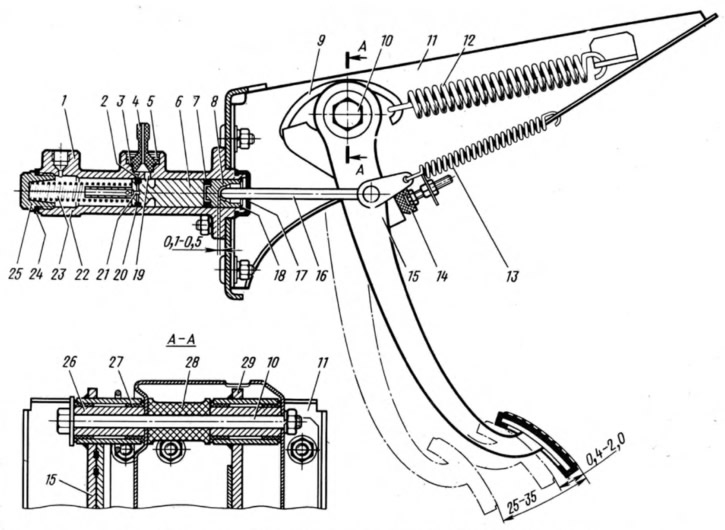
Fig. 61. Pedal and master cylinder of the clutch release drive:
1 - master cylinder body; 2 - compensation hole; 3 - nipple gasket; 4 - nipple; 5 - locking spring washer; 6 - master cylinder piston; 7 - seal; 8 - pusher piston; 9 - hook; 10 - clutch and brake pedal axle; 11 - clutch and brake pedal bracket; 12 - clutch pedal booster spring (servo spring); 13 - clutch pedal release spring; 14 - Clutch pedal travel limiter; 15 - clutch pedal; 16 - pusher; 17 - protective cap; 18 - retaining ring; 19 - bypass hole; 20 - sealing ring (ring valve); 21 - piston bypass hole; 22 - working cavity of the cylinder; 23 - spring; 24 - gasket; 25 - cork; 26 - inner pedal bushing; 27 - outer pedal bushing; 28 - spacer sleeve; 29 - brake pedal.
Pusher 4, the working length of which is adjusted by nut 5, rests against piston 13 (Fig. 62).
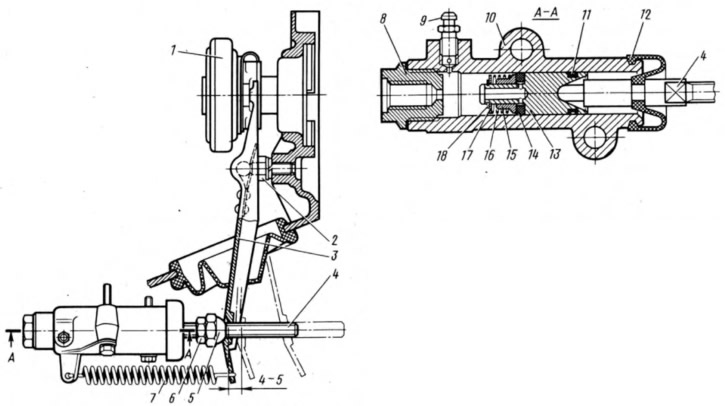
Fig. 62. Slave cylinder and clutch release fork:
1 - clutch release bearing; 2 - ball joint; 3 - clutch release fork; 4 - pusher; 5 - adjusting nut; 6 - lock nut; 7 - release spring; 8 - body plug; 9 - bleed nipple; 10 - cylinder body; 11 - sealing ring; 72-protective cap; 13 - piston; 14 - seal; 15 - plate; 16 - spring; 77 - support washer; 18 - retaining ring.
When disengaging the clutch, the pedal force is 15 (see fig. 61) through the pusher 16 is transmitted to the pistons 6, which, moving in the main cylinder, compress the spring 23. In this case, the front sealing ring 20 closes the compensation hole 2, and the cylinder cavity is separated from the tank. The liquid under pressure through the tube and hose enters the cavity of the working cylinder, moving the piston (see fig. 62) and pusher 4. Rotating relative to ball joint 2, the fork moves the clutch release bearing sleeve, which, through the bearing and thrust flange 14 (see fig. 60) bends the pressure spring on the support rings 17. The outer edge of the spring through the clamps moves the pressure disk 4 away from the driven disk 5 and the transmission of torque to the gearbox stops.
When the pedal is released, all parts return to their original position under the action of the springs. Sealing ring 20 (see fig. 61) moves away from compensation hole 2 and restores communication between the cavities of the master cylinder and the tank.
From July 1972 to November 1978, the described cars were equipped with a clutch and brake pedal bracket manufactured specifically for these models. Since December 1978, a bracket unified in terms of mounting location has been installed, which made it possible to install a bracket with or without a vacuum booster on the same body. The clutch pedal from the VAZ-2103 car is installed on unified brackets.
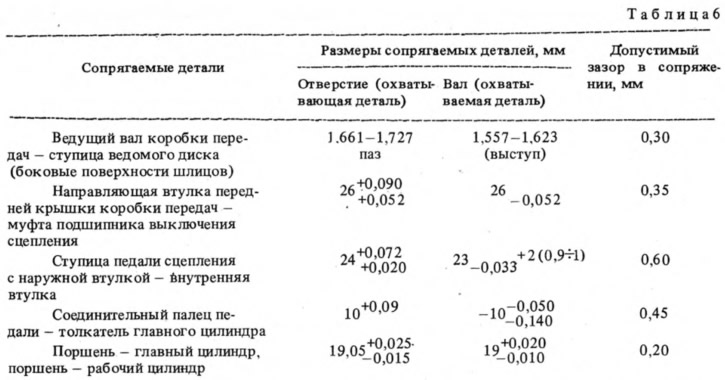
The dimensions of the main mating parts of the clutch and the limits of permissible wear are given in Table 6.