




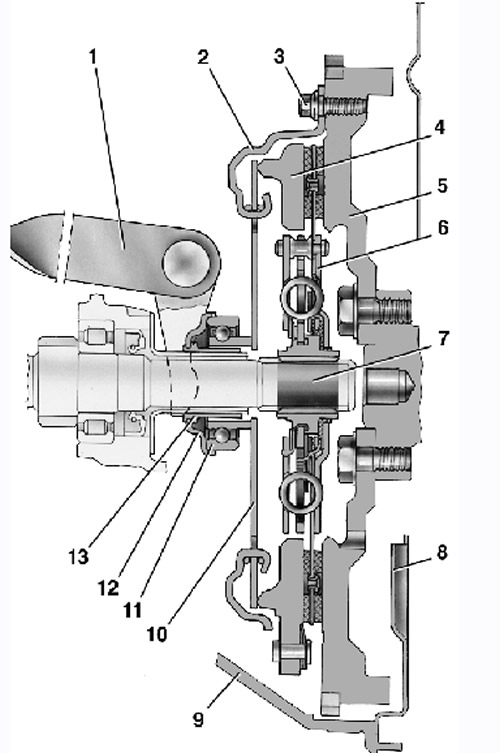
5.1 Clutch assembly: 1 – clutch release fork; 2 – clutch housing; 3 – bolt securing the clutch to the flywheel; 4 – pressure plate; 5 – flywheel; 6 – driven disk; 7 – primary shaft of the gearbox; 8 – lower clutch housing cover; 9 – clutch housing; 10 – pressure spring; 11 – clutch release bearing; 12 – bearing coupling flange; 13 – bearing coupling sleeve
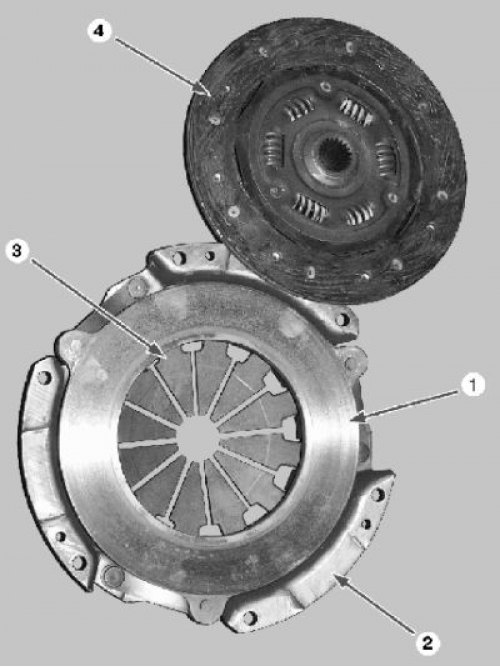
5.3. Clutch disassembled: 1 – pressure plate; 2 – clutch housing; 3 – diaphragm spring; 4 – driven disk
Single-disc clutch. With central diaphragm pressure spring 10 in Fig. 5.1 or 3 in Fig. 5.3. Casing 2 (see fig. 5.1. 5.3) the clutch is attached to the flywheel 5 by six bolts 3, and it is connected to the pressure plate 4 by three pairs of elastic plates.
Slave disk 6 (4 in Fig. 5.3) assembled with a damper, mounted on the splines of the primary shaft 7 of the gearbox. The clutch drive is cable-operated, gap-free (there are no gaps in the drive).
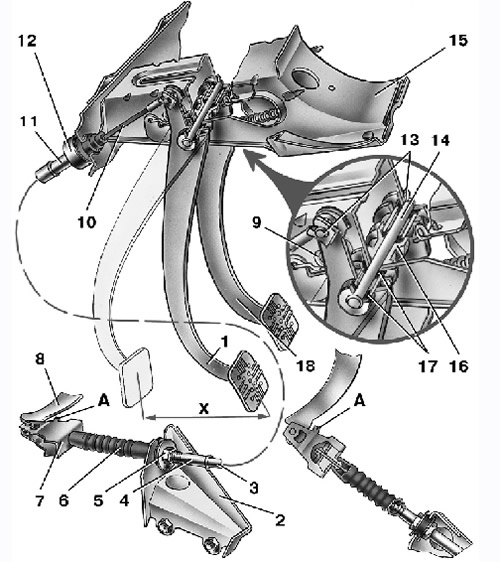
5.2. Clutch drive: A - element of the cable leash; X — clutch pedal stroke; 1 — clutch pedal; 2 — bracket for fastening the lower end of the cable sheath; 3 - cable sheath; 4 - lower end of the cable sheath; 5 - nut; 6 - protective cover; 7 — rope leash; 8 — clutch release fork lever; 9 — clutch pedal release spring; 10 — cable; 11 - upper end of the cable sheath; 12 — clip; 13 - locking brackets; 14 — pedal axle; 15 — clutch and brake pedal bracket; 16-distance bushing; 17- Clutch pedal bushings; 18 — brake pedal
Clutch pedal 1 (Fig. 5.2) is installed in bracket 15 on axle 14 via bushings 17. The upper part of the pedal is connected to cable tip 10. Upper tip 11 of the casing is secured to the clutch pedal bracket using a collar 12 of the rubber buffer. Lower tip 4 is secured with two nuts 5 in bracket 2 on the power unit. Cable leash 7 is connected to lever 8 of the clutch release fork. The clutch release bearing is of a closed type and does not require lubrication during operation. The main parameter determining the operation of the clutch drive is the travel X of the clutch pedal until it stops in the floor mat of the car body.
Helpful tips: To ensure that the clutch serves you for a long time and without failure, do not keep your foot on the clutch pedal all the time. This bad habit is often acquired during driving lessons at driving schools out of fear of not having time to disengage the clutch when the car stops. In addition to the rapid fatigue of the foot, which is always above the pedal, the clutch is at least slightly pressed, and the driven disk slips and wears out. In addition, despite the fact that the release bearing is designed to operate in a constant rotation mode, it experiences increased load when the pedal is pressed even slightly, and its service life is also reduced.
For the same reason, we do not recommend keeping the clutch in the disengaged position for a long time (for example, in traffic jams). If you don't have to move off right away, it's better to put the gearbox in neutral and release the pedal. Clutch slippage can be easily detected using a tachometer. If, while driving, when you press the accelerator pedal sharply, the revs rise sharply, then drop slightly and the car starts to accelerate, the clutch needs repair.
(The text is copied from the online resource VAZbook)