




Cold engine starting
1. Pump fuel into the carburetor float chamber by pressing the manual fuel pump lever 1 (Fig. 17) several times. It is recommended to perform this operation after the vehicle has been parked for a long time.
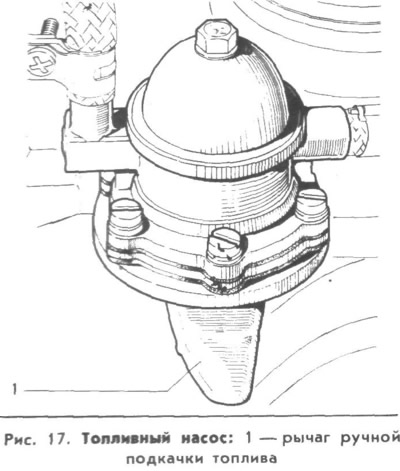
2. Set the gearshift lever to neutral and press the clutch pedal (especially recommended during the cold season).
3. Pull out the carburetor choke control handle.
4. Insert the key into the ignition switch and turn on the starter without pressing the accelerator pedal. If the engine does not start on the first attempt, turn off the ignition and after about 30 seconds turn on the starter again. It is not recommended to turn on the starter for more than 10-15 seconds.
(Information copied from the portal: «VAZBOOK.ru»)
5. After starting the engine, release the key, which will automatically return to position I (see fig. 4).
At low negative ambient temperatures, to facilitate engine starting, before engaging the starter, it is recommended to turn on the headlights for a few seconds to warm up the battery. Then, with the clutch pedal pressed and the choke control handle pulled out to the limit, engage the starter.
When the engine is running steadily after starting, smoothly release the clutch pedal and gradually, as the crankshaft speed increases, press the carburetor air damper control handle.
At temperatures of minus 25°C and below, as well as during heavy snowfalls, for more intensive warming of the engine and maintaining its thermal conditions, it is recommended to cover the radiator grille with a protective apron.
Starting a hot engine
When the engine is hot, the carburetor choke control handle should be depressed. When the engine is very hot, press the accelerator pedal about a third of its travel, and after starting, release the pedal gradually as soon as the engine begins to run smoothly.
Do not press the accelerator pedal repeatedly to avoid over-enriching the fuel mixture, which will make it difficult to start the engine.